
- CARC 29 — “the time limit for filing has expired” — means the payer received the claim after its filing deadline. As a CO adjustment, the balance is provider liability and generally cannot be billed to the patient.
- CO-29 is only unbeatable if you have no evidence. A claim originally submitted on time and denied late, or rejected and resubmitted, is appealable with proof of timely filing.
- The strongest proof is your clearinghouse acceptance trail: the 277CA payer acknowledgment showing an accepted status and timestamp inside the window, backed by the 999 acknowledgment and the submission report.
- Medicare allows narrow exceptions to its 12-month limit under 42 CFR 424.44(b): contractor administrative error, retroactive Medicare entitlement, and certain dual-eligible Medicaid recoupment situations.
- Filing clocks vary wildly — roughly 90 days to 12 months depending on payer and contract — so prevention means knowing every deadline and alarming claims long before they age out.
- Retain clearinghouse acknowledgment reports for years, not 90 days; practices that purge them lose winnable appeals.
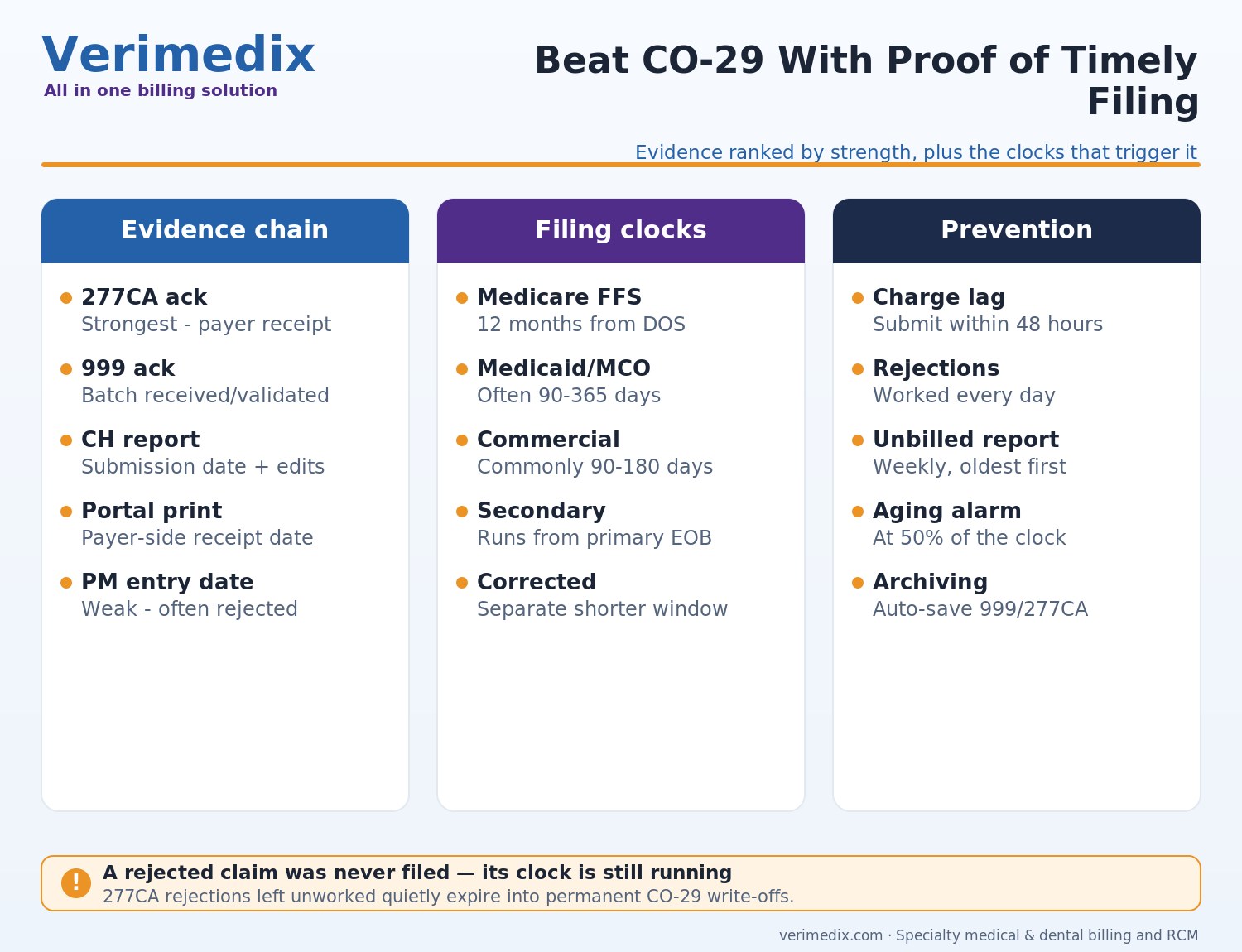
What the CO-29 denial code is telling you
Every payer contract contains a filing clock: submit the claim within so many days of the date of service (or of the primary payer's EOB, for secondary claims) or forfeit payment. CARC 29 fires when the payer's system says that clock ran out before a processable claim arrived. Because it almost always posts with group code CO — a contractual obligation — the money comes out of the practice's pocket; billing the patient for a claim your process filed late is prohibited under most contracts and by Medicare rules.
The critical distinction hiding inside this denial: received late is not the same as filed late. Claims that were transmitted on time but rejected at the clearinghouse, lost in a payer gateway, misrouted after an ID change, or held behind a coordination-of-benefits problem (see our CO-22 guide) frequently come back as CO-29. Those are winnable — if you can prove the original transmission.
Know your clocks: filing limits by payer type
Exact deadlines live in your contracts, and our timely filing limits by payer reference tracks the current published windows in detail. The shape of the landscape:
| Payer type | Typical initial filing window | Notes (verify your contract) |
|---|---|---|
| Medicare (Part B fee-for-service) | 12 months from date of service | Set by statute; narrow regulatory exceptions only |
| Medicaid / Medicaid MCOs | Often 90–365 days, state- and plan-specific | Some states run short clocks; MCO contracts can differ from the state agency |
| Commercial (UHC, Aetna, Cigna, BCBS plans) | Commonly 90–180 days; contracts range from 90 days to 12+ months | Participation agreements override published defaults; ASO/self-funded groups may vary by group |
| Medicare Advantage | Often 365 days, plan-specific | Check the plan's provider manual, not original Medicare rules |
| Secondary / COB claims | Clock often runs from the primary EOB date | Depends on payer policy — attach the primary remittance as proof |
| Corrected claims & appeals | Separate, usually shorter windows | A corrected claim filed after the correction window can trigger CO-29 even when the original was timely |
Bookmark the full payer-by-payer table and load those dates into your billing system as hard alarms — the clock you did not know about is the one that expires.
Building the proof-of-timely-filing appeal packet
A CO-29 appeal is not an argument; it is an evidence submission. Assemble the packet in this order:
- Appeal cover letter — one page: claim number, member ID, date of service, the payer's filing limit, the date you originally submitted, and the statement that enclosed documentation proves receipt within the limit. Reference the payer's own provider-manual language on acceptable proof.
- Primary evidence — the acceptance record (next section) showing payer receipt inside the window, with the trace/control number highlighted.
- The claim history timeline — a dated list of every transmission, rejection, correction and resubmission, exported from your PM or clearinghouse.
- Supporting context — for secondary claims, the primary payer's EOB showing its adjudication date; for eligibility problems, the eligibility responses you relied on; for payer-caused issues, reference numbers from calls or portal tickets.
- The corrected claim itself if the payer requires resubmission with the appeal.
Send it through the payer's designated reconsideration channel within the appeal deadline (often 60–180 days from the remittance date — that clock is running too). The general mechanics are in our step-by-step claim appeal guide.
The evidence chain: 999, 277CA and what payers accept
Every electronic claim generates an acknowledgment trail. Knowing which artifact proves what turns your clearinghouse archive into an appeals arsenal:
| Evidence | What it shows | Strength as proof |
|---|---|---|
| 277CA claim acknowledgment | Payer-side response to the 837 with claim-level accepted/rejected status, date and trace number | Strongest — payer's own system confirming receipt of that specific claim |
| 999 functional acknowledgment | The 837 batch was received and passed (or failed) syntax validation | Supporting — proves transmission of the batch, not acceptance of the individual claim |
| Clearinghouse submission/acceptance report | Date claim left your system and cleared clearinghouse edits | Widely accepted, especially with the 277CA alongside |
| Payer portal confirmation or DDE screen print | Claim visible in the payer's system with a receipt date | Good — payer-side evidence for portal-submitted claims |
| Certified mail / fax confirmation | Delivery date of a paper claim | Acceptable for paper; pair with the claim copy |
| PM system entry date alone | When the charge was created internally | Weak — payers routinely reject internal system dates as proof |
Two operational rules follow. First, an accepted 277CA is only proof if the claim stayed accepted — a claim rejected on the 277CA never legally reached the payer, so rejections must be worked as if the claim was never filed. Second, retention is everything: keep acknowledgment reports at least as long as your longest payer filing-plus-appeal window, and practically for several years. Clearinghouse portals often purge reports after 90–180 days unless you archive them.
Medicare's narrow exceptions — and the honest write-off
For Medicare FFS claims past 12 months, 42 CFR 424.44(b) recognizes limited exceptions: an administrative error by Medicare or its contractor caused the late filing; the beneficiary was granted Medicare entitlement retroactive to before the date of service; or a state Medicaid agency recouped payment for a dual-eligible patient six months or more after the service. Exception requests require documentation and generally cannot extend beyond four years from the date of service. Commercial payers occasionally grant similar “good cause” reviews for payer-caused barriers, but nothing obligates them to.
If none of that applies and the claim genuinely sat unbilled past every deadline, appeal effort is wasted. Post the write-off with a distinct timely-filing adjustment code — never buried in generic contractual adjustments — because that ledger visibility is what funds the prevention case below.
What CO-29 really costs: a worked example
Illustrative numbers. A three-provider practice discovers during an AR backlog cleanup that 140 claims averaging $95 denied CO-29 over the past year — about $13,300. The team finds 277CA acceptances for 45 claims and primary EOBs proving timely secondary filing for 15 more. Appealing those 60 claims (~$5,700) at a realistic 60–70% overturn rate recovers roughly $3,400–$4,000; the remaining $7,600 with no evidence is written off. The lesson is double-edged: archives turned $4,000 of “dead” denials back into revenue, but a 48-hour charge-to-submission standard would have kept nearly all $13,300 out of the denial column entirely.
The prevention workflow that ends CO-29
Timely filing denials are pure process failures — every one was preventable on the day the claim aged past its clock. Run this five-gate workflow:
- 48-hour submission standard: charges entered and claims out the door within two business days of the encounter; measure it as charge lag on your clean claim dashboard.
- Daily rejection queue: clearinghouse and 277CA rejections worked every business day — a rejected claim's filing clock is still running.
- Weekly unbilled/held report: every encounter without a submitted claim, sorted oldest first, with coding and documentation holds escalated at 14 days.
- Aging alarms at 50% of the clock: flag any unresolved claim at half its payer's filing window (day 45 of a 90-day payer) so nothing is discovered at day 91.
- Acknowledgment archiving: automated export of 999/277CA/acceptance reports to practice-controlled storage, indexed by claim.
Quick Answers
What does denial code CO-29 mean? The time limit for filing has expired — the payer says it received the claim after its contractual or statutory filing deadline, and the balance is a provider write-off unless overturned.
Can you bill the patient after a CO-29 denial? Generally no. The CO group code assigns liability to the provider, and payer contracts and Medicare rules prohibit shifting a late-filing penalty to the patient.
Can a CO-29 denial be appealed? Yes, when you can prove the claim was originally submitted within the limit or a payer-caused barrier delayed it. Without proof of timely filing, overturn odds are close to zero.
What counts as proof of timely filing? The payer's 277CA acknowledgment with an accepted status and date is strongest, supported by 999 acknowledgments, clearinghouse acceptance reports, portal confirmations, certified-mail receipts, or the primary EOB date for secondary claims.
What is Medicare's timely filing limit? Twelve months from the date of service for fee-for-service claims, with narrow exceptions under 42 CFR 424.44(b) for contractor error, retroactive entitlement, and certain dual-eligible recoupments.
How do you prevent CO-29 denials? Submit within 48 hours of service, work rejections daily, run a weekly unbilled report, alarm claims at half of each payer's filing window, and archive every acknowledgment report.
Frequently asked questions
Yes. Claims transmitted on time but rejected in a payer gateway, misrouted after payer ID changes, or delayed by the payer's own eligibility or COB errors can surface as CO-29. Those situations are appealable when your acknowledgment trail or call reference numbers document the payer-side failure.
Usually not. A claim rejected at the clearinghouse or on the 277CA never reached adjudication, so most payers treat it as never filed. That is why rejection queues must be worked daily — the filing clock keeps running while a rejected claim sits.
For most payers the secondary clock runs from the primary payer's adjudication date, not the date of service, though policies vary. Attach the primary EOB to the appeal to prove when the secondary filing window actually opened.
42 CFR 424.44(b) allows exceptions for administrative error by Medicare or its contractor, retroactive Medicare entitlement to or before the date of service, and certain dual-eligible cases where Medicaid recouped payment six months or more after service. Requests need documentation and cannot extend past four years from the date of service.
At least as long as your longest filing-plus-appeal window, and practically several years. Many clearinghouse portals purge reports after 90-180 days, so set up automated archiving to storage the practice controls — purged acknowledgments are lost appeals.