
- AR past 90 days should stay under roughly 13.5% of total AR for a healthy practice; above 20% signals an active backlog problem.
- Triage backlog claims by filing-deadline risk and dollar value first, not chronologically.
- Assigning backlog cleanup to already-stretched staff on top of active client work is the most common cause of missed deadlines and burnout.
- A dedicated white-label aging specialist starts around $1,000–$1,500+/month and focuses exclusively on backlog recovery without displacing active-account work.
- Practices conducting structured post-backlog audits commonly recover 10–30% of previously written-off balances from the last 18 months.
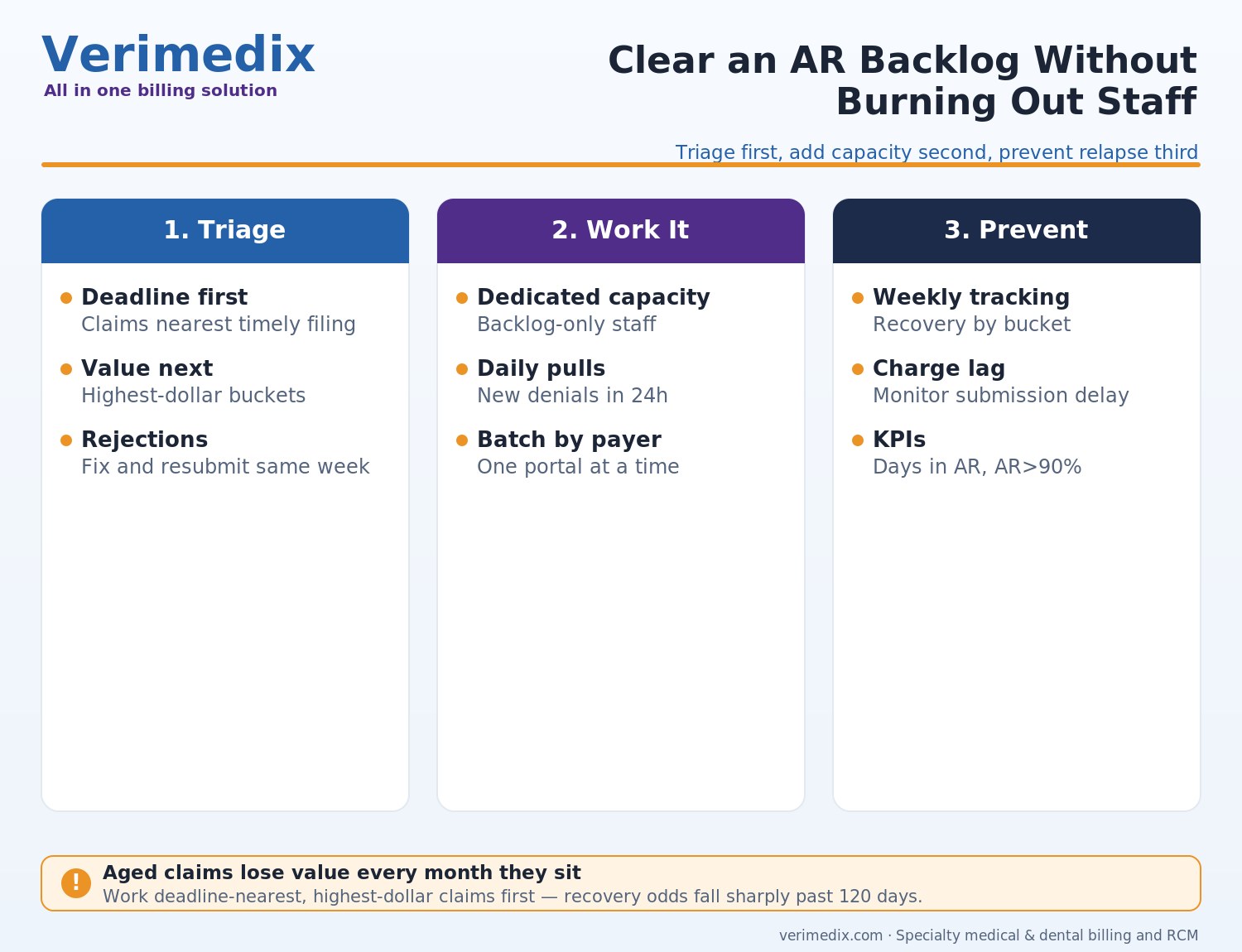
Step 1: Triage the Backlog
Pull a claim-level AR aging report and sort by two factors: proximity to timely-filing deadline and dollar value. Claims at both risk levels — old and high-value — go first; everything else follows a documented, scheduled cadence rather than "whenever there's time."
Step 2: Decide Who Works the Backlog
| Option | Pros | Risk |
|---|---|---|
| Existing staff, overtime | No new hiring | High burnout risk; active accounts get deprioritized |
| Temporary VA | Fast, low-cost admin support | Limited denial/coding expertise for complex backlog claims |
| Dedicated white-label aging specialist | Focused exclusively on backlog, no disruption to active work | Requires system access setup before starting |
Step 3: Add Dedicated Capacity Instead of Spreading Thin
White-label billing workforce providers such as Verimedix place dedicated aging specialists who work inside the client's own systems under the client's brand, starting at two resources — a model built specifically to work down backlog without pulling staff off active client accounts.
Step 4: Track Recovery and Prevent Recurrence
Track weekly: claims resolved vs. remaining, dollar value recovered, and claims that hit appeal deadlines. Once the backlog clears, keep AR past 90 days under roughly 13.5% by maintaining ongoing follow-up capacity rather than letting it re-accumulate — see What Are Days in AR? How to Calculate and Reduce It.
The Triage Matrix: Deadline Risk × Dollar Value
Sort every backlog claim into four quadrants and work them in this order:
- Near deadline + high dollar — work today. These are the claims where waiting converts recoverable revenue into permanent write-offs. Timely-filing and appeal windows are hard walls; payer appeal windows commonly run 90–180 days from the denial date.
- Near deadline + low dollar — batch daily. Individually small, collectively meaningful; process them in dedicated daily blocks so they never queue behind research-heavy claims.
- Safe deadline + high dollar — schedule and research. These reward root-cause work: correct the claim properly once rather than burning a resubmission attempt fast.
- Safe deadline + low dollar — scheduled cadence. Work them on a fixed weekly rotation, and make deliberate, documented write-off decisions below your cost-to-collect threshold rather than letting them expire silently.
The matrix matters because chronological AR reports bury quadrant-1 claims in the middle of the list — the single most common reason backlogs bleed money even while everyone is busy.
Keeping the Backlog From Re-Forming
A cleared backlog re-forms when follow-up capacity returns to the level that created it. Three habits prevent the relapse: hold a weekly aging review with claim-level accountability on the over-60 bucket, not a monthly glance at percentages; maintain a standing follow-up cadence where every open claim has a documented next-touch date, so "whenever there's time" never returns; and run a quarterly write-off audit, because balances written off in a rush during backlog panic are often recoverable — structured audits commonly find 10–30% of recent write-offs worth reworking. If the volume that created the backlog is permanent, make the capacity permanent too — keeping the dedicated aging resource on maintenance follow-up costs less than the next cleanup project.
Real-World Example
A U.S.-based dental billing company needed dedicated capacity to work down an aging accounts receivable backlog without pulling internal staff off active client work. Verimedix placed a trained dental billing resource focused specifically on AR and aging follow-up, working directly inside the client's existing systems and under the client's brand. The resource prioritized high-value aged claims, worked denials tied to aging accounts, and maintained a consistent daily follow-up cadence — the client reported measurable improvement in aging position.
Frequently asked questions
Sort by proximity to timely-filing deadline first, then dollar value — not by claim age alone.
Often yes — practices conducting structured audits commonly recover 10–30% of previously written-off balances from the last 18 months, since many payer appeal windows run 90–180 days from the denial date.
Dedicated capacity is generally safer — spreading backlog work across staff already handling active accounts is a leading cause of missed deadlines and burnout.
White-label aging specialists start around $1,000–$1,500+/month, with a minimum 2-resource engagement.
Timelines vary by backlog size and claim complexity; providers scope a specific plan once the AR aging report and system access are reviewed.