
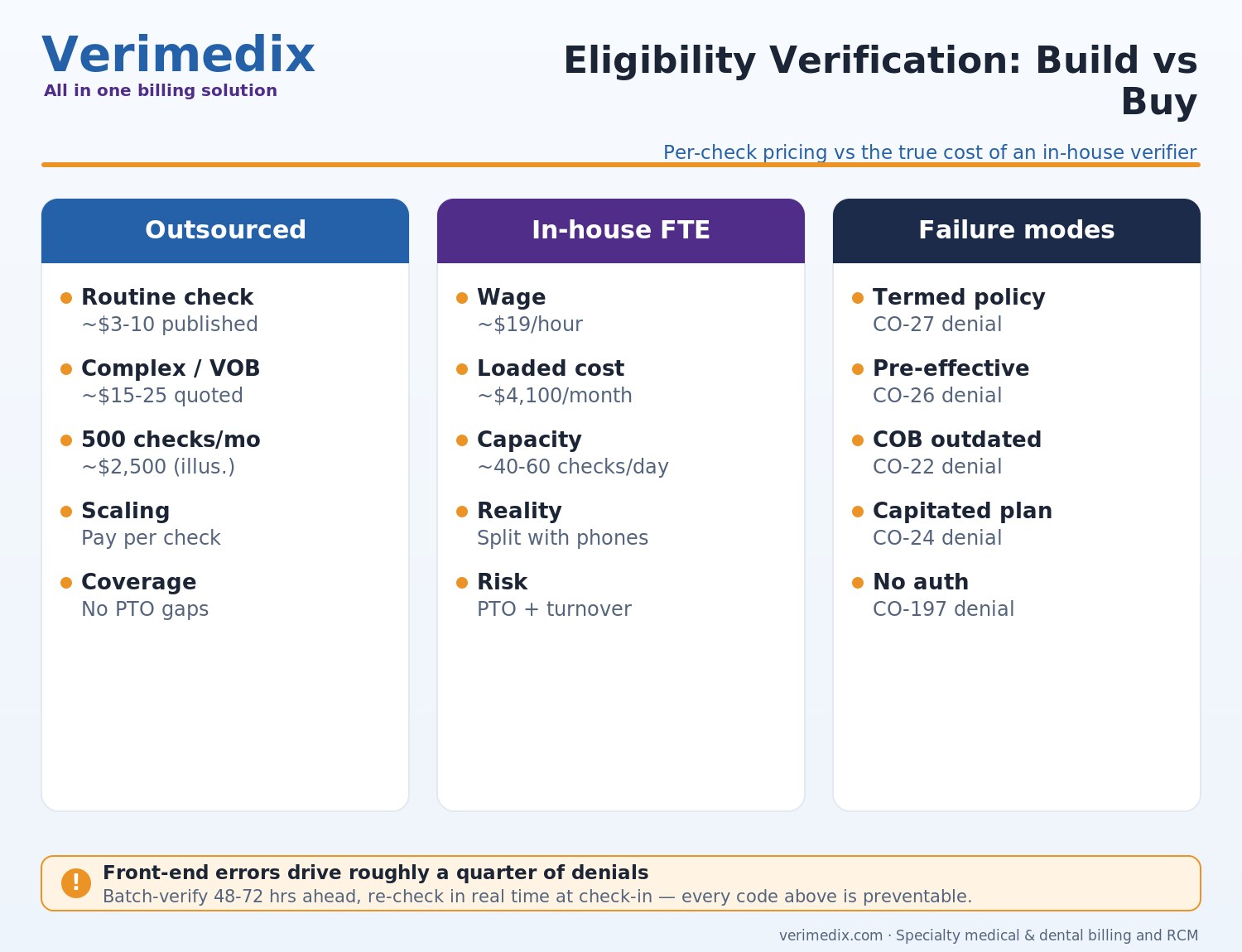
- Published rates for outsourced eligibility verification commonly fall between roughly $3 and $10 per routine check, with deep benefits verifications quoted at $15-$25 by some vendors.
- An in-house verifier costs far more than the wage line: a $19/hour hire is roughly $4,000+ per month fully loaded, and PTO, turnover, and split duties cut real capacity.
- Front-end mistakes are among the most preventable denial drivers — industry analyses attribute roughly a quarter of denials to eligibility and registration issues, against HFMA-reported initial denial rates near 12%.
- The strongest workflow pairs batch 270/271 checks 48-72 hours before appointments with real-time re-checks at check-in for changes and walk-ins.
- A basic eligibility ping is not a verification of benefits: know whether you're buying active-coverage confirmation or full benefit, auth, and COB detail.
- Break-even is arithmetic: multiply monthly check volume by the per-check rate and compare it to loaded staff cost — most small practices land below one FTE.
What eligibility verification services actually check
Eligibility verification is the front-end control that decides whether the claim you file in two weeks gets paid. A verification service (or your own staff) confirms, before the visit, that the policy is active on the date of service and pulls the details that drive collections: plan type and network status, copay, coinsurance, remaining deductible, out-of-pocket progress, benefit limits, prior-authorization or referral requirements, and coordination of benefits when a patient carries more than one policy.
The market sells this at three depths, and conflating them causes most buyer disappointment:
- Basic eligibility check: an automated 270/271 ping confirming active coverage and headline cost-sharing. Fast and cheap, but blind to service-specific benefits.
- Full verification of benefits (VOB): service-level detail — visit limits, exclusions, carve-outs, auth triggers — often requiring payer portal work or a phone call. Our guide to the VOB process covers this tier in depth.
- Auth-aware verification: VOB plus flagging and initiating prior authorizations for scheduled services.
Verimedix runs all three tiers as a managed eligibility verification service, but the build-vs-buy math below applies whoever does the work.
Real-time vs batch verification: the 270/271 loop
Electronic eligibility runs on the HIPAA X12 270 (inquiry) and 271 (response) transactions — CMS operates its own HETS 270/271 system for Medicare. The operational choice is when you fire them:
| Dimension | Batch verification | Real-time verification |
|---|---|---|
| How it works | A file of 270 inquiries for upcoming appointments runs on a schedule (typically nightly) | Single 270 fired at check-in or scheduling; 271 returns in seconds |
| Best timing | 48-72 hours before the visit — enough runway to fix problems | Day of service, walk-ins, same-day adds, coverage re-checks |
| Strength | Catches termed policies and plan changes before the patient arrives | Catches what changed since the batch ran |
| Blind spots | Response data can go stale; exceptions still need human follow-up | Payer system downtime; headline data without benefit depth |
| Cost profile | Lowest per check via clearinghouse | Slightly higher per transaction; still cents-to-dollars |
Best practice is both: batch the schedule two or three days out, work the exception list, then re-verify at check-in. The 271 alone is not the finish line — someone still has to read it, chase discrepancies, and update the registration record. That human layer is what you're really pricing in a build-vs-buy decision.
What eligibility verification services cost
| Model | Commonly published range | Best fit |
|---|---|---|
| Per-verification outsourcing | ~$3-$10 routine; $15-$25 for complex or deep-benefit checks per some vendor pricing | Variable volume; paying only for work performed |
| Dedicated remote verifier (flat monthly) | Flat per-FTE rate, typically well below a loaded onshore hire | Steady volume that would occupy most of a person |
| Software / clearinghouse transactions | Cents to ~$1 per 270/271; tools from roughly $20-$100 per month per provider at published price points | Practices keeping the human layer in-house |
| Bundled into full RCM | Folded into a percentage-of-collections contract | Practices outsourcing the whole revenue cycle anyway |
Vendors price on three drivers: payer mix (portal-only and phone-verification payers cost more than clean EDI payers), depth (eligibility ping vs full VOB vs auth checks), and turnaround time. Quotes at the extremes usually differ on depth, not efficiency — compare scope line by line.
Build vs buy: the FTE math (illustrative)
Take a practice with 500 visits a month:
- In-house: a verifier at $19/hour costs about $39,520 a year in wages; add a typical 25-30% benefits-and-burden load and you're near $50,000 a year, or roughly $4,100 a month. A focused verifier handles on the order of 40-60 routine checks a day — ample capacity on paper, except the same person is usually also answering phones, and PTO or a resignation takes verification capacity to zero overnight.
- Outsourced per-check: 500 verifications × $5 midpoint = $2,500 a month, scaling down in slow months.
- Dedicated white-label verifier: a flat-rate specialist through an embedded billing team works your schedule inside your PM system, under your brand — typically at a fraction of the loaded onshore cost, and the seat doesn't vanish when someone quits.
The denial side belongs in the same math. If eligibility failures are denying even 3% of 500 monthly claims at a $120 average, that's about $1,800 a month stuck in rework or written off — before staff time to appeal. Numbers are illustrative; run them with your own volume, wage, and denial rate.
Front-desk failure modes — and the denial codes they trigger
Eligibility denials are rarely exotic. The same handful of front-desk misses produce them, and each maps to a specific remittance code:
| Denial code | What it means | Front-desk failure behind it | Prevention |
|---|---|---|---|
| CO-27 | Expenses incurred after coverage terminated | Policy termed; nobody re-checked after the batch ran | Real-time re-verify at check-in |
| CO-26 | Expenses incurred prior to coverage | New policy effective date after the visit date | Confirm effective dates, not just "active" |
| CO-22 | Care may be covered by another payer per COB | Secondary/primary order never updated — see our CO-22 fix guide | Ask about other coverage at every visit; verify COB annually |
| CO-24 | Charges covered under a capitation/managed care plan | Patient moved to an MA or managed Medicaid plan unnoticed | Check plan type in the 271, not just payer name |
| PR-31 | Patient cannot be identified as insured | Typo'd ID, transposed DOB, name mismatch | Scan the card; verify demographics against the 271 |
| CO-197 | Precertification/authorization absent | Auth requirement never flagged at scheduling | Auth-aware verification for scheduled procedures |
Every row above is preventable for a few dollars before the visit — and expensive to appeal after. That asymmetry is the entire business case for verification services.
How to choose: a build-vs-buy decision path
Work through four questions:
- Volume: monthly checks × ~$5 vs loaded staff cost. Under roughly 800-1,000 checks a month, per-check outsourcing usually wins; well above it, a dedicated (in-house or white-label) verifier wins.
- Complexity: heavy Medicaid, behavioral health carve-outs, or auth-dense specialties push you toward human-led VOB rather than software-only pings.
- Failure history: pull 90 days of remits and count CO-22/26/27/197 denials. That number is your budget justification — or evidence you don't need help.
- Front-desk reality: if verification competes with check-in and phones, it loses. Moving it off the desk — to a service, or to a virtual receptionist or back-office verifier — is often worth more than the tool choice. Where the verification seat should sit as you grow is covered in our billing team structure guide.
Vendor vetting questions: Which payers can you verify electronically vs by phone or portal? What's the turnaround commitment for add-ons? Who chases discrepancies and updates our PM system? Is COB investigation included? What HIPAA safeguards and BAA terms apply? What per-check volume discounts kick in, and where?
Quick Answers
How much do insurance eligibility verification services cost? Published outsourcing rates commonly run about $3-$10 per routine verification, with complex or deep-benefit checks quoted at $15-$25 by some vendors. Software-only 270/271 transactions cost cents to about a dollar through most clearinghouses.
Is outsourcing eligibility verification cheaper than hiring? Usually, below roughly 800-1,000 checks a month. A dedicated in-house verifier runs near $4,000+ a month fully loaded (illustrative), while 500 outsourced checks at a $5 midpoint cost about $2,500 — and flat-rate white-label verifiers undercut the loaded hire at higher volumes.
What is the difference between real-time and batch eligibility verification? Batch sends a file of 270 inquiries on a schedule — ideally 48-72 hours before appointments — while real-time fires a single 270 at check-in and returns a 271 in seconds. Strong workflows use batch for runway and real-time to catch last-minute changes.
What denials come from skipped eligibility checks? The classic set is CO-27 (coverage terminated), CO-26 (care before effective date), CO-22 (coordination-of-benefits conflicts), CO-24 (capitated plan), PR-31 (patient not identified), and CO-197 (missing authorization) — all largely preventable before the visit.
Is an eligibility check the same as verification of benefits? No. An eligibility check confirms the policy is active and returns headline cost-sharing; a verification of benefits digs into service-level coverage, limits, exclusions, and authorization requirements, and often requires portal or phone work.
Frequently asked questions
Published vendor rates most commonly fall between about $3 and $10 per routine verification, with complex cases — deep benefit breakdowns, payers requiring phone calls, or auth checks — quoted at $15-$25 by some vendors. Clearinghouse 270/271 transactions themselves cost only cents to about a dollar; the fee mostly buys the human follow-up.
A focused verifier typically completes on the order of 40-60 routine electronic checks a day; phone-based or complex VOB work runs far slower. Real front-desk capacity is usually much lower because verification competes with check-in, phones, and scheduling — which is why errors cluster on busy days.
Both. Run batch 270 inquiries for the full schedule 48-72 hours before appointments so problems can be fixed in advance, then re-verify in real time at check-in to catch terminations, plan changes, and walk-ins. Batch-only workflows miss late changes; real-time-only workflows leave no runway to fix what they find.
Industry analyses commonly attribute roughly a quarter of denials to front-end registration and eligibility issues, and HFMA has reported initial denial rates near 12% overall. Practice case studies published by RCM vendors show denial rates dropping severalfold after proactive verification, though results vary by payer mix.
When steady volume exceeds roughly 800-1,000 checks a month, a dedicated seat starts beating per-check fees — though a flat-rate white-label verifier often fills that seat for less than a loaded onshore hire and without turnover risk. Below that volume, per-verification outsourcing usually wins.