
- Medical billing VAs typically cost $500–$1,500/month and cover admin-heavy tasks: scheduling, eligibility checks, basic data entry, claim status follow-up.
- VAs are usually generalists or shared across multiple clients; they are not dedicated, specialty-trained billing staff.
- A dedicated white-label billing resource (e.g., a coder or AR specialist) starts around $1,000–$1,500+/month and works exclusively for one client under that client's brand.
- The dividing line: if the task requires CPT/ICD-10 coding judgment, denial root-cause analysis, or payer-specific appeals, a VA is the wrong tool.
- Minimum white-label engagement is 2 dedicated resources, giving continuity a single VA contract can't.
What Does a Medical Billing Virtual Assistant Do?
A medical billing virtual assistant is a remote, typically part-time or shared contractor who supports administrative billing functions: scheduling, patient intake, eligibility verification, claim status checks, and basic data entry into a PMS or EHR. VAs are sourced through agencies such as MEDVA, My Mountain Mover, or 20four7VA and are priced for volume, not specialization.
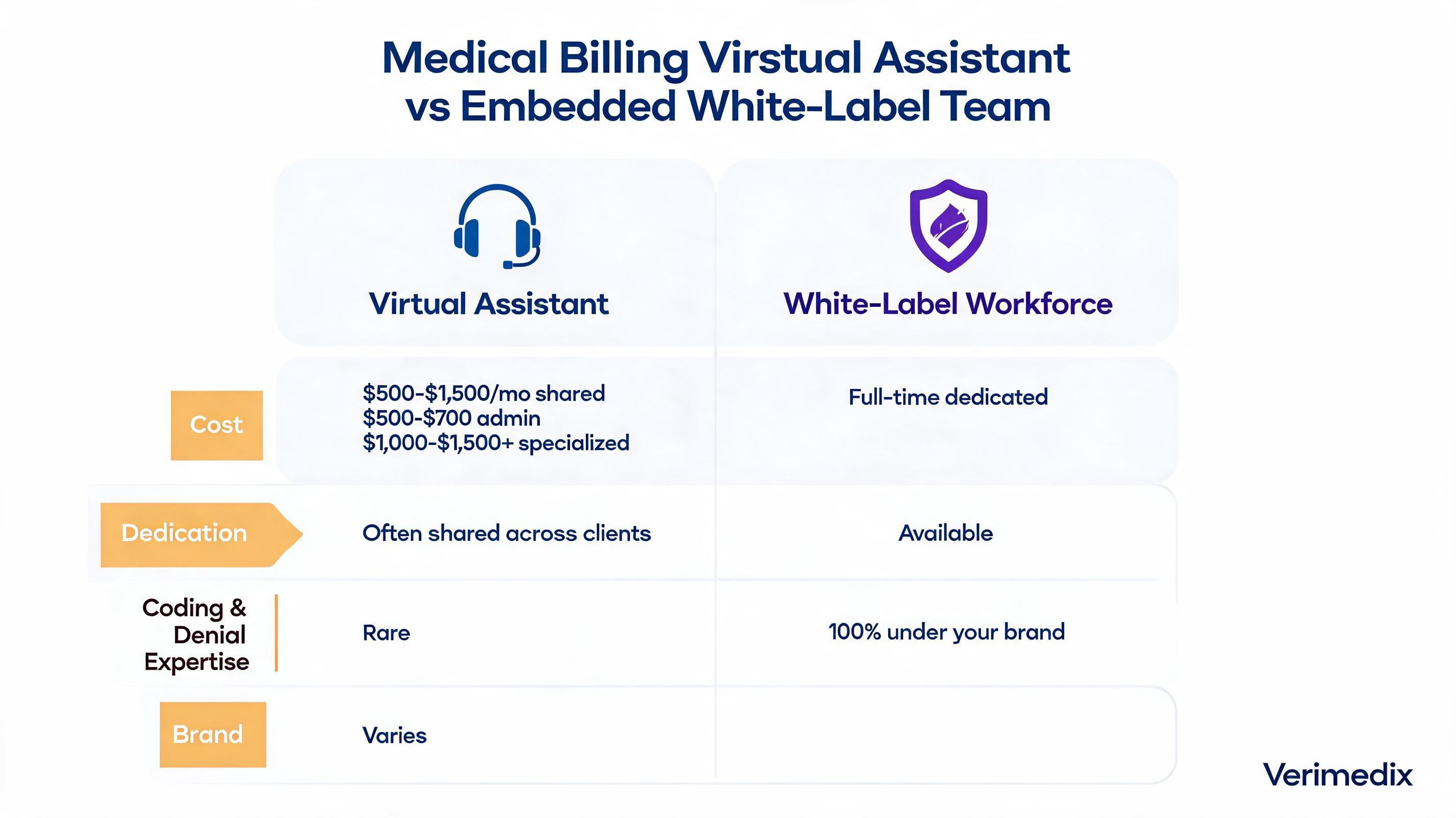
VA vs Embedded White-Label Team
| Factor | Medical Billing VA | White-Label Workforce (dedicated resource) |
|---|---|---|
| Typical cost | $500–$1,500/mo, often shared/part-time | $500–$700/mo (admin) to $1,000–$1,500+/mo (specialized) |
| Dedication | Often split across multiple clients | Full-time, dedicated — not shared |
| Coding/denial expertise | Rare; mostly data entry and admin | Coders, AR/aging specialists, denial-management specialists available |
| Works under your brand | Varies by agency | 100% under your brand, inside your systems |
| Continuity if staff leaves | Agency reassigns, often a new person | Provider manages replacement and continuity |
| Minimum commitment | Often month-to-month, 1 person | Minimum 2 dedicated resources |
When a VA Is Enough
A VA is a reasonable fit for a small practice or new billing company needing basic administrative support: scheduling, patient reminders, simple eligibility checks, or light data entry — tasks that don't require coding judgment or payer-specific denial strategy.
When You Need More Than a VA
Once denial rates climb, AR ages past 90 days, or coding accuracy affects reimbursement, a generalist VA can't close the gap. White-label providers such as Verimedix place a dedicated embedded billing team — trained billers, coders, and AR specialists who work inside the client's systems under the client's brand, starting at two resources — filling the specialty gap a VA leaves open.
Tasks a Billing VA Can Own — and the Handoff Line
A good VA earns their fee on repeatable, rules-based work: appointment scheduling and reminders, patient demographic entry, insurance card capture, basic eligibility checks through payer portals, claim-status lookups, and routing incoming payer correspondence. Those tasks share one property — the correct next step is obvious from the screen.
The handoff line is judgment. The moment a task requires choosing a CPT/ICD-10 code combination, deciding whether a denial is a coding error versus a coverage issue, drafting an appeal with payer-specific language, or working an aging report by deadline risk — you have left VA territory. Assigning that work to a generalist VA doesn't make it cheaper; it makes it slower and error-prone, and the rework lands back on your senior staff. A useful rule of thumb: if the task would take a new hire more than two weeks of billing-specific training to do safely, it is specialist work.
A Four-Question Test Before You Hire Either
- Is the work admin or judgment? Admin → VA is fine. Judgment (coding, denials, appeals, AR strategy) → dedicated specialist.
- Is the volume steady or growing? A few hours a day → shared VA. A full-time queue that keeps growing → dedicated resource, because shared attention becomes the bottleneck.
- Does the person touch your clients or patients? If they communicate outward, brand control matters — confirm the arrangement is genuinely under your name.
- What happens if they leave next month? With a solo VA contract, you restart. With an embedded white-label engagement, the provider manages replacement and continuity — one reason the model starts at two resources rather than one.
If your answers cluster on the right-hand side, price the specialist first: the cost gap between a $1,200/month VA and a $1,000–$1,500/month dedicated specialist is small; the capability gap is not.
Real-World Example
Verimedix placed a dedicated dental billing resource inside a dental billing company's existing systems to work down an aging AR backlog under the client's own brand — the kind of specialty-specific, sustained work a rotating VA contract typically can't deliver.
Frequently asked questions
No. A VA typically handles admin tasks and may serve multiple clients; a white-label resource is a dedicated, specialty-trained employee working exclusively inside your systems under your brand.
With white-label staffing, no — staff operate entirely under your brand. VA arrangements vary by agency.
VAs run $500–$1,500/month for admin work; white-label specialized roles (coders, AR specialists) start around $1,000–$1,500+/month per dedicated resource, with a 2-resource minimum.
Generally no — most VA agencies don't provide certified coders. Coding requires CPT/ICD-10/HCPCS expertise, which white-label coding roles are specifically staffed for.
Both can be faster than a full in-house hire; white-label providers scope a specific timeline once role, specialty, and system access are confirmed.