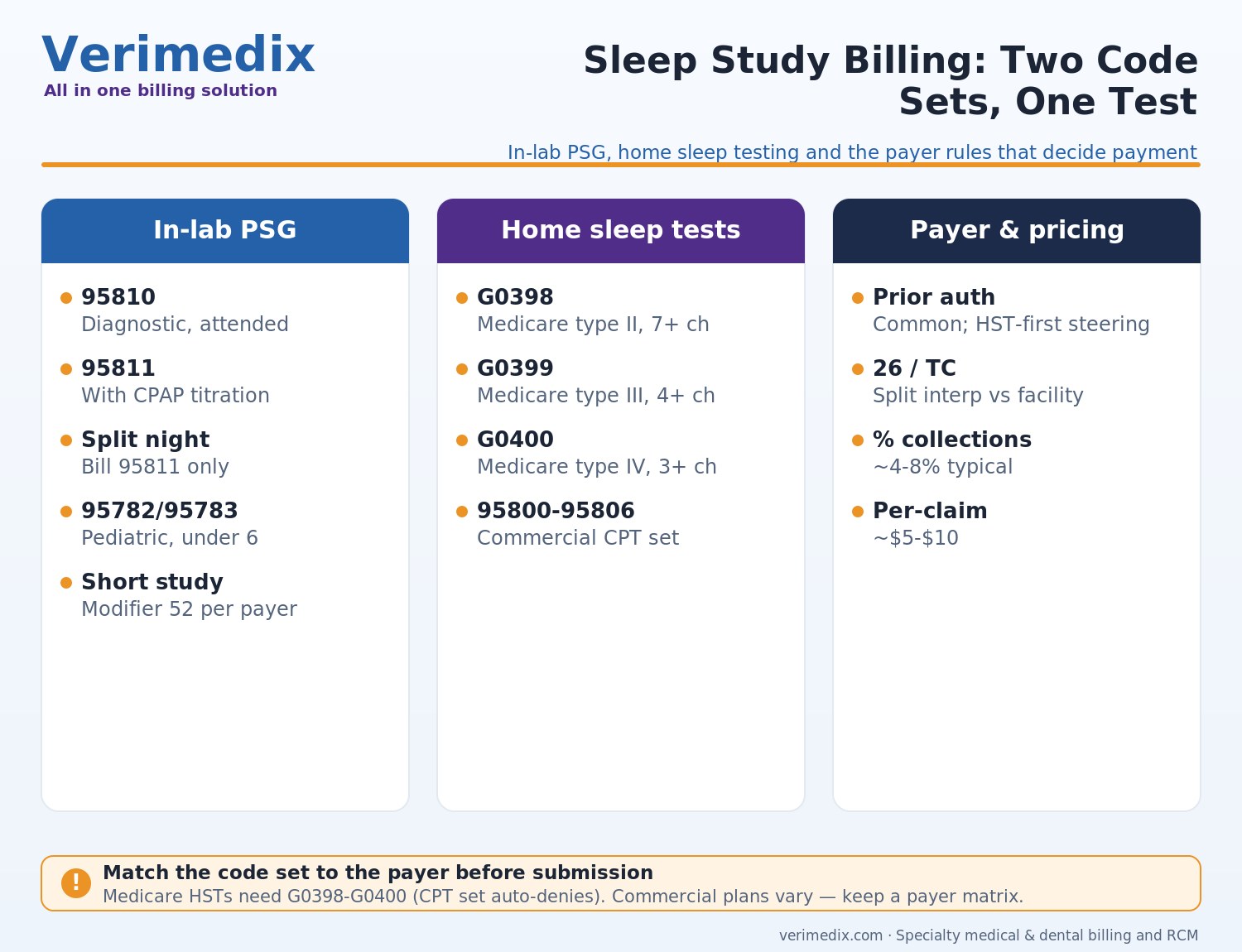
- Sleep medicine bills the same test under two code systems: CPT codes (95800–95811) for most commercial payers and HCPCS G-codes (G0398–G0400) for Medicare home sleep tests — submitting the wrong set to the wrong payer is the specialty's signature instant denial.
- In-lab polysomnography runs on 95810 (diagnostic, attended, sleep staging) and 95811 (with CPAP titration); a split-night study is billed as 95811 alone, never both codes.
- Prior authorization dominates the specialty: many commercial payers route sleep studies through utilization managers and often require a home sleep test first for uncomplicated suspected OSA.
- Global vs. professional/technical splits (modifiers 26/TC) decide who bills what when the interpreting physician and the testing facility are different entities.
- Outsourced sleep billing commonly prices at roughly 4–8% of collections, with per-study and flat models as alternatives; auth management is the scope item that matters most.
- The revenue cycle extends past the study: positive results feed CPAP/DME claims with their own coverage rules, so vendor competence should cover the handoff.
Why sleep study billing trips up general billers
No other specialty asks a biller to choose between two entirely different code systems for the identical service. A home sleep apnea test goes out as G0399 to Medicare and, frequently, as 95806 to a commercial plan — and each payer decides which set it accepts. Submit CPT codes to Medicare for a home study and the claim typically auto-denies; submit G-codes to a commercial payer that wants CPT and the reverse happens. A sleep-literate billing service maintains a payer-by-payer code matrix and updates it as plans change policy.
Add the heaviest prior-authorization environment outside advanced imaging, the split-night coding rule, 26/TC component splits, and the downstream CPAP equipment claim, and sleep medicine becomes a specialty where billing expertise is measurable in dollars quickly. Verimedix's sleep medicine billing services page describes our offering; this guide is the buyer's version: what services should include, what they cost, and how to test competence.
What full-service sleep billing should include
- Authorization management — verifying requirements per payer, submitting clinical documentation, tracking approvals and expiration windows, and scheduling peer-to-peers. This is the make-or-break scope item; see our guide to prior authorization outsourcing costs and staffing.
- Payer code-set mapping — a maintained matrix of which payers take CPT HST codes (95800/95801/95806) vs. G-codes (G0398–G0400), plus place-of-service and accreditation details.
- Component billing logic — global vs. modifier 26 (professional) vs. TC (technical) claims depending on who owns the lab and who interprets; our modifier 26 vs TC guide covers the mechanics.
- Split-night and reduced-study handling — billing 95811 alone for split nights and applying payer rules (often modifier 52) when recording time falls short.
- DME coordination — clean handoff of positive studies to CPAP setup claims, including compliance-period documentation; see our complete DME guide.
Pricing models for sleep billing
Illustrative industry ranges — confirm current written quotes and scope line by line.
| Model | Typical range | Best fit | Watch-outs |
|---|---|---|---|
| Percentage of collections | ~4–8% (published outsourcing ranges span ~3–10%) | Sleep labs wanting incentives tied to auth wins and appeals | Confirm auth management is included, not a per-case add-on |
| Per-study / per-claim fee | ~$5–$10 per claim; per-study project pricing varies | High-volume HST programs with standardized workflows | Denial rework and appeals often excluded |
| Flat monthly fee | ~$1,500–$4,000+ by lab size | Stable-volume labs wanting predictable cost | Check surge capacity for seasonal referral spikes |
Sleep study code map: in-lab and home testing
| Code | Service (abbreviated) | Setting | Key rule |
|---|---|---|---|
| 95810 | Polysomnography, sleep staging with 4+ additional parameters, attended | In-lab | Technologist-attended; payers commonly expect ~6+ hours recording (modifier 52 if reduced) |
| 95811 | PSG with CPAP/bilevel titration | In-lab | Split-night studies bill 95811 alone — it includes the diagnostic portion |
| 95808 | PSG, 1–3 additional parameters | In-lab | Less common; parameter count must match the record |
| 95805 | Multiple sleep latency / wakefulness testing (MSLT/MWT) | In-lab | Distinct indications (e.g., narcolepsy work-up); auth rules differ |
| 95782 / 95783 | Pediatric PSG, younger than 6 (diagnostic / with titration) | In-lab | Age-specific codes — adult codes for young children invite denials |
| 95800 / 95801 | Home sleep study with sleep time / minimum heart rate, O2 sat and respiratory analysis | Home | CPT HST codes — accepted by many commercial payers |
| 95806 | Home sleep study with heart rate, O2 sat, airflow and respiratory effort | Home | The most commonly used commercial HST code |
| G0398 | Home sleep test, type II device (minimum 7 channels) | Home | Medicare code set — use G-codes for Medicare HSTs |
| G0399 | Home sleep test, type III device (minimum 4 channels) | Home | The workhorse Medicare HST code |
| G0400 | Home sleep test, type IV device (minimum 3 channels) | Home | Coverage narrower; verify device qualification |
Descriptors are abbreviated — verify against current AMA CPT®, HCPCS, and payer policy (including your MAC's billing article) before claims go out.
Prior auth and payer patterns that decide payment
HST-first steering. Many large commercial payers — often through utilization management vendors — require a home sleep test as the initial study for uncomplicated suspected obstructive sleep apnea, reserving in-lab PSG approval for patients with comorbidities (heart failure, significant pulmonary disease, neuromuscular disorders), non-diagnostic home results, or titration needs. Booking an in-lab study without checking the steering policy produces an unauthorized-service denial that is hard to appeal after the fact.
Authorization is date- and code-specific. An auth for 95810 does not automatically cover the 95811 the night became when titration started — payers differ on whether split-night conversion rides the original auth, and a sleep-specialty biller knows which plans require notification. Auth windows also expire; rescheduled patients are a quiet denial source.
Documentation prerequisites. Medicare billing articles require that home sleep tests follow a clinical evaluation and that patients receive device instruction; payers commonly require interpreting-physician credentials and, depending on policy, facility accreditation details. These are front-end data points to collect before the study, not after the denial.
Component accuracy. When an independent physician interprets a hospital-owned lab's study, the physician bills the professional component with modifier 26 and the facility bills TC; a physician-owned lab or IDTF may bill globally. Two entities both billing global creates overlapping-claim denials that take months to untangle.
Common sleep billing denials and fixes
| Denial pattern | Root cause | Fix |
|---|---|---|
| Wrong code set for payer | CPT HST codes sent to Medicare (or G-codes to CPT-only plans) | Maintain a payer code matrix; scrub HST claims against it pre-submission |
| No prior authorization | Steering policy or auth requirement missed at scheduling | Auth verification embedded in scheduling, not billing |
| 95810 and 95811 billed together | Split night coded as two services | Bill 95811 alone; train coders on the inclusion rule |
| Duplicate/overlap on components | Both facility and physician billed global | Contract-level clarity on 26/TC; reconcile before submission |
| Medical necessity (CO-50) | Documentation doesn't meet coverage criteria | Map ICD-10 and clinical indicators to policy; appeal with the sleep evaluation note — see the CO-50 guide |
How to choose a sleep billing partner: decision tree
Work down this sequence; a "no" at any node changes the shortlist:
- Do you run in-lab studies, HST, or both? Both → the vendor must show a payer code matrix and split-night handling. HST-only → weight auth automation and volume pricing.
- Do you own the interpretation, the facility, or both? Split entities → require demonstrated 26/TC reconciliation. Global → simpler, but confirm POS coding.
- Do you dispense CPAP? Yes → the vendor needs DME billing capability including compliance-period documentation; if not in-house, how is the handoff managed?
- Is your denial pain auth-driven or coding-driven? Pull your last 90 days of CARCs; choose the vendor whose staffing matches the dominant cause.
- Contract test: auth management in base scope, appeal SLAs in writing, monthly reporting by study type and payer.
Worked example (illustrative only). A sleep center performs 120 in-lab studies and 80 HSTs monthly. At illustrative average collections of $600 per in-lab study and $180 per HST, monthly revenue is about $86,400; a 6% fee is roughly $5,184. If the vendor's auth discipline prevents six unauthorized in-lab denials a month (~$3,600) and correct code-set mapping rescues eight HST claims (~$1,440), recovered revenue alone offsets most of the fee — before appeal wins or faster AR. Actual allowables vary by payer, region, and contract.
Quick Answers
What is the difference between 95810 and 95811? 95810 is attended diagnostic polysomnography with sleep staging; 95811 adds CPAP or bilevel titration. A split-night study — diagnostic first, titration after — is billed as 95811 alone.
What codes does Medicare require for home sleep tests? HCPCS G-codes: G0398 (type II device, minimum 7 channels), G0399 (type III, minimum 4 channels), and G0400 (type IV, minimum 3 channels). Sending CPT HST codes to Medicare typically triggers automatic denial.
Do sleep studies require prior authorization? Very often with commercial payers — many route requests through utilization management vendors and require a home sleep test first for uncomplicated suspected OSA before approving in-lab PSG. Verify per plan before scheduling.
How much do sleep medicine billing services cost? Commonly around 4–8% of collections for full-service RCM, with per-claim (~$5–$10) and flat monthly models as alternatives — illustrative ranges that move with auth-management scope.
Who bills what when the physician and lab are separate? The interpreting physician bills the professional component with modifier 26 and the facility bills the technical component with TC; a single entity owning both may bill globally. Both billing global creates overlap denials.
Frequently asked questions
The most common cause is code-set mismatch: Medicare requires G-codes (G0398–G0400) for home sleep tests and typically auto-denies CPT HST codes, while some commercial plans accept only the CPT set (95800, 95801, 95806). The fix is a payer-by-payer code matrix checked before submission, not after the remit arrives.
Many payer policies, including Medicare billing articles, expect a minimum recording period and direct reduced studies to be reported with modifier 52 rather than the full code. The exact threshold and modifier treatment vary by payer, so the operative rule is documenting recording time and applying each plan's reduced-service policy.
It is billed as 95811 alone, since that code includes the diagnostic portion before titration began. Authorization is the trap: some payers cover the conversion under the original diagnostic auth while others require notification or a separate auth for titration — a sleep-specialty biller tracks which plans fall into each bucket.
Some do, and it matters because a positive study's value is partly downstream: CPAP setup, supplies, and Medicare's usage-compliance documentation all bill under DME rules with their own denial patterns. If your center dispenses equipment, choose a vendor with demonstrated DME capability or a defined handoff to one.
Monthly reporting split by study type (in-lab vs. HST) and payer: authorization denial rate, clean claim rate, days in AR, net collection rate against contracted allowables, and appeal overturn rate. Study-type segmentation is the tell — a vendor that reports only blended numbers cannot see the specialty's real failure points.