
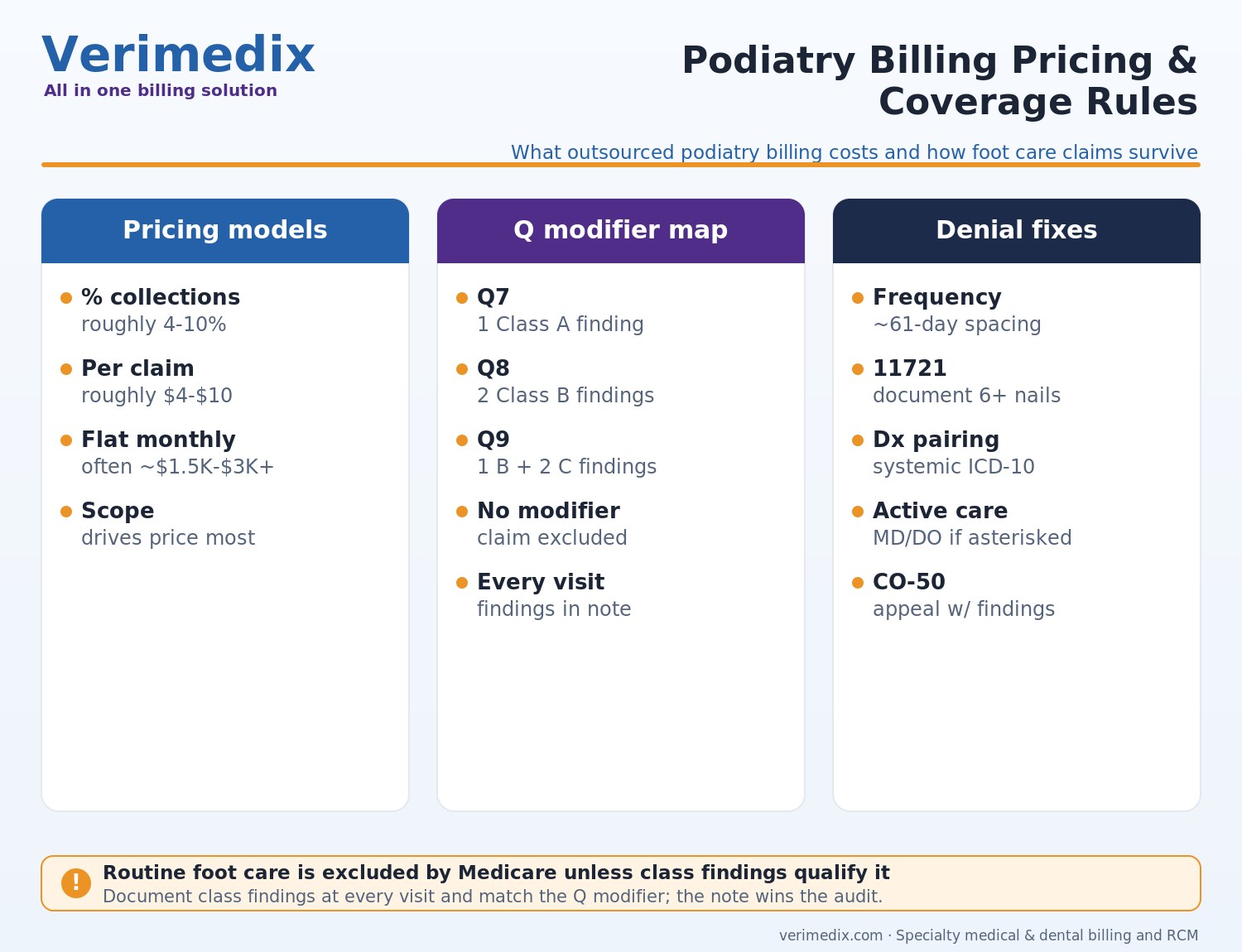
- Outsourced podiatry billing typically costs 4-10% of collections, roughly $4-$10 per claim, or a flat monthly fee -- but scope (coding review vs claims-only) moves price more than the model does.
- Medicare excludes routine foot care by statute; coverage exceptions depend on qualifying systemic conditions plus documented class findings, signaled by modifiers Q7, Q8, or Q9.
- Q7 = one Class A finding, Q8 = two Class B findings, Q9 = one Class B plus two Class C findings -- the modifier must match findings recorded in the note at every visit.
- Nail debridement (11720 for 1-5 nails, 11721 for 6+) is frequency-limited -- most Medicare contractors expect roughly a 60-61 day interval -- and 11721 requires documentation that at least six nails were debrided.
- The highest-yield vendor test is denial prevention on routine foot care claims: ask any candidate to walk you through their Q-modifier and class-findings scrub before you sign.
- All fee figures here are illustrative industry ranges; get written quotes and verify current CMS/MAC policy for coverage rules.
What a full-scope podiatry engagement covers
Podiatry revenue rarely leaks where practice owners expect. It is usually not the surgical claims -- bunionectomies and hammertoe corrections get coded carefully because the dollars are visible. The leak is in the high-volume, low-dollar visits: nail debridement, callus paring, diabetic foot care. Those claims fail quietly on coverage rules, and a mediocre billing company will write them off rather than fight them.
A full-scope engagement should include:
- Charge review and coding support -- checking CPT/HCPCS selection (11719-11721, 11055-11057, G0127, E/M) and the diagnosis pairing that routine foot care coverage depends on.
- Modifier scrubbing -- Q7/Q8/Q9 on routine foot care, modifier 25 when a significant E/M accompanies a procedure, and site modifiers (TA-T9) on toe procedures.
- Eligibility and frequency checks -- confirming the patient is inside the payer's routine foot care interval before the visit is billed.
- Claim submission and rejection handling -- daily batching, clearinghouse edits, resubmissions.
- Payment posting and underpayment review -- ERA posting plus fee-schedule variance checks.
- Denial management and appeals -- especially medical-necessity denials such as CO-50 on foot care claims, which are frequently winnable when class findings exist in the note.
- Insurance AR follow-up -- systematic work queues so claims do not die inside timely filing limits.
Verification-heavy add-ons (prior authorization for surgery, DME billing for orthotics and CAM boots, patient statements) are often priced separately -- confirm line by line what the quoted fee includes.
Pricing models and the fee-band math
Three pricing models dominate, and published industry ranges are consistent enough to benchmark against. Treat every figure below as an illustrative range, not a quote.
| Pricing model | Typical range (industry-published) | Best fit | Watch out for |
|---|---|---|---|
| Percentage of collections | Roughly 4-10%; many podiatry quotes cluster near 5-8% | Most practices; aligns vendor incentive with collections | How "collections" is defined -- patient payments and old AR may be included in the base |
| Per-claim fee | Roughly $4-$10 per claim | High-volume routine foot care clinics with clean charge capture | Vendor gets paid whether or not the claim does; pair with denial-rate guarantees |
| Flat monthly fee | Often ~$1,500-$3,000+ by provider count and volume | Predictable budgeting for stable single-provider offices | Scope creep exclusions -- appeals and old AR often cost extra |
Because average podiatry claim values are modest, a percentage fee on a routine-foot-care-heavy practice can be cheaper in absolute dollars than the same percentage in a surgical specialty -- which is exactly why some vendors quietly push per-claim pricing on podiatry accounts. Run both models against your own volume before choosing.
The routine foot care exclusion and Q7-Q9 modifiers
Medicare excludes routine foot care -- cutting or trimming of nails, paring of corns and calluses, and similar maintenance -- by statute (see Medicare Benefit Policy Manual, Chapter 15, Section 290). Coverage becomes possible when the patient has a systemic condition, such as diabetes with complications or peripheral arterial disease, severe enough that non-professional foot care would be hazardous. Severity is evidenced by class findings, and the Q modifier on the claim tells the contractor which combination the chart supports:
| Modifier | Findings required | Class definitions (per CMS) |
|---|---|---|
| Q7 | One Class A finding | Class A: nontraumatic amputation of the foot or an integral skeletal portion of it |
| Q8 | Two Class B findings | Class B: absent posterior tibial pulse; absent dorsalis pedis pulse; or advanced trophic changes (at least three of: decreased/absent hair growth, nail thickening, skin discoloration, thin shiny skin, rubor) |
| Q9 | One Class B plus two Class C findings | Class C: claudication, temperature changes (e.g., cold feet), edema, paresthesia, burning |
Three compliance details separate good billing services from claim-pushers. First, the class findings must be documented at every covered visit, not just the first -- contractors audit exactly this. Second, some qualifying systemic conditions (asterisked in CMS policy) also require that the patient be under the active care of an MD or DO for that condition, typically evidenced within roughly six months. Third, the Q modifier must match what the note actually says: a Q8 claim with only one pulse finding documented is an audit finding waiting to happen.
High-volume podiatry codes and their denial risks
| Code | Service | Common denial trigger | Prevention |
|---|---|---|---|
| 11720 / 11721 | Nail debridement, 1-5 nails / 6+ nails | Frequency (most MACs expect ~60-61 day spacing); 11721 without a nail count | Track intervals per patient; document the number of nails and their condition |
| 11719 / G0127 | Trimming of nondystrophic / dystrophic nails | Billed without Q modifier or qualifying diagnosis | Class findings + systemic ICD-10 pairing on every claim |
| 11055-11057 | Paring of corns/calluses (1 / 2-4 / 5+ lesions) | Routine care exclusion; lesion count unsupported | Q modifier logic plus lesion count in the note |
| 11730 / 11750 | Nail avulsion / permanent matrixectomy | Site modifier missing; global period overlaps | TA-T9 toe modifiers; check 10-day global on 11730 |
| 97597-97598, 11042+ | Wound and ulcer debridement | Depth/measurement documentation gaps | Document tissue type, depth, and wound size at each session |
| 28285 / 28296 | Hammertoe repair / bunionectomy | Prior auth missing; medical necessity (conservative care not shown) | Auth workflow plus documented failed conservative treatment |
A 5-question routine foot care decision check
Ask a prospective billing service to describe their pre-claim scrub. It should look something like this sequence, applied before any routine foot care claim leaves the building:
- Is the service routine foot care? (Nail trimming/debridement, corn/callus paring.) If not -- normal coding rules apply.
- Does the patient have a qualifying systemic condition coded on the claim in the position the MAC's policy article expects?
- Do documented class findings support a modifier? Map to Q7, Q8, or Q9; if the findings are not in today's note, the claim should be held, not sent.
- If the condition is asterisked, is active MD/DO care documented within the contractor's look-back window?
- Is the visit inside the frequency window (commonly ~61 days for covered routine care and nail debridement, per MAC policy)?
A vendor that cannot articulate this flow will process your denials instead of preventing them.
Worked example: what a Q-modifier leak costs (illustrative)
Consider a two-podiatrist practice with 220 routine foot care encounters per month. Assume an illustrative average of $85 in billable services per encounter (debridement plus paring or an E/M where supported) -- about $18,700 per month at risk on coverage rules alone.
- Scenario A -- 12% of these claims denied for missing Q modifiers, mismatched class findings, or frequency errors, with half never recovered: roughly $1,122 lost per month, about $13,464 per year.
- Scenario B -- a billing service scrubs to a 3% denial rate with 80% recovery on the remainder: roughly $112 lost per month, about $1,346 per year.
The difference -- about $12,100 per year on routine foot care alone -- is in the same range as a 6% collections fee on that claim category. In other words, on this illustrative math, competent routine-foot-care handling can substantially self-fund the service before counting surgical claims, AR recovery, or staff time saved. Your numbers will differ; ask vendors to model yours.
How to choose: questions that expose weak vendors
- Walk me through your routine foot care scrub. Where do Q modifiers and class findings get checked, and by whom?
- How do you track 61-day frequency windows across our patient panel?
- What is your current denial rate and first-pass resolution rate for podiatry clients specifically?
- Who appeals CO-50 medical-necessity denials, and what is your win rate on them?
- How is "collections" defined in the fee base -- does it include patient payments, and old AR you did not work?
- Do you handle DME (orthotics, CAM walkers) and surgical prior auth, or are those out of scope?
- What reporting do we get monthly, and can we see a live sample report?
- What are the exit terms -- notice period, data handover format, and who owns the AR wind-down?
Compare answers against a specialty-focused option such as Verimedix's podiatry billing services, and against the broader trade-offs in our guide to outsourced vs in-house billing.
Quick Answers
What does outsourced podiatry billing cost? Published ranges run roughly 4-10% of collections, about $4-$10 per claim, or flat monthly fees often between $1,500 and $3,000+ depending on volume and scope. Get written quotes; figures vary by practice.
What are the Q7, Q8, and Q9 modifiers? They are Medicare routine foot care modifiers reporting documented class findings: Q7 for one Class A finding, Q8 for two Class B findings, and Q9 for one Class B plus two Class C findings.
How often will Medicare cover nail debridement? Most Medicare contractors expect roughly a 60-61 day interval between covered nail debridement services (11720/11721); check your MAC's LCD and policy article for exact rules.
Is routine foot care covered by Medicare? Not by default -- it is statutorily excluded. Coverage exceptions apply when a qualifying systemic condition plus documented class findings make lay foot care hazardous.
What is the difference between 11720 and 11721? 11720 covers debridement of one to five nails; 11721 covers six or more. For 11721, the note must state that at least six nails were debrided.
Frequently asked questions
The good ones do -- it is the core competency for the specialty. Ask any candidate to explain Q7-Q9 modifiers, class findings, and frequency windows unprompted. If they cannot, they will submit excluded claims and let them die as denials.
It depends on your claim mix. Routine-foot-care-heavy practices have many low-dollar claims, so a percentage fee can cost less in absolute dollars, while per-claim pricing rewards the vendor for volume regardless of payment. Model both against three months of your actual claims before deciding.
Two Class B findings recorded at the visit -- for example, absent posterior tibial pulse plus absent dorsalis pedis pulse, or one absent pulse plus advanced trophic changes (which themselves require at least three specific signs). The findings must appear in the note for the date of service billed.
Common causes: the note did not document six or more nails debrided, the systemic diagnosis was missing or in the wrong claim position, class findings were absent, or the service fell inside the frequency window from the prior debridement. A diabetes diagnosis alone does not establish coverage.
Many offer AR cleanup as a separate project fee or an incentive percentage on recovered dollars. Prioritize claims still inside timely filing and appeal windows -- medical-necessity denials with class findings in the chart are often the most winnable.