
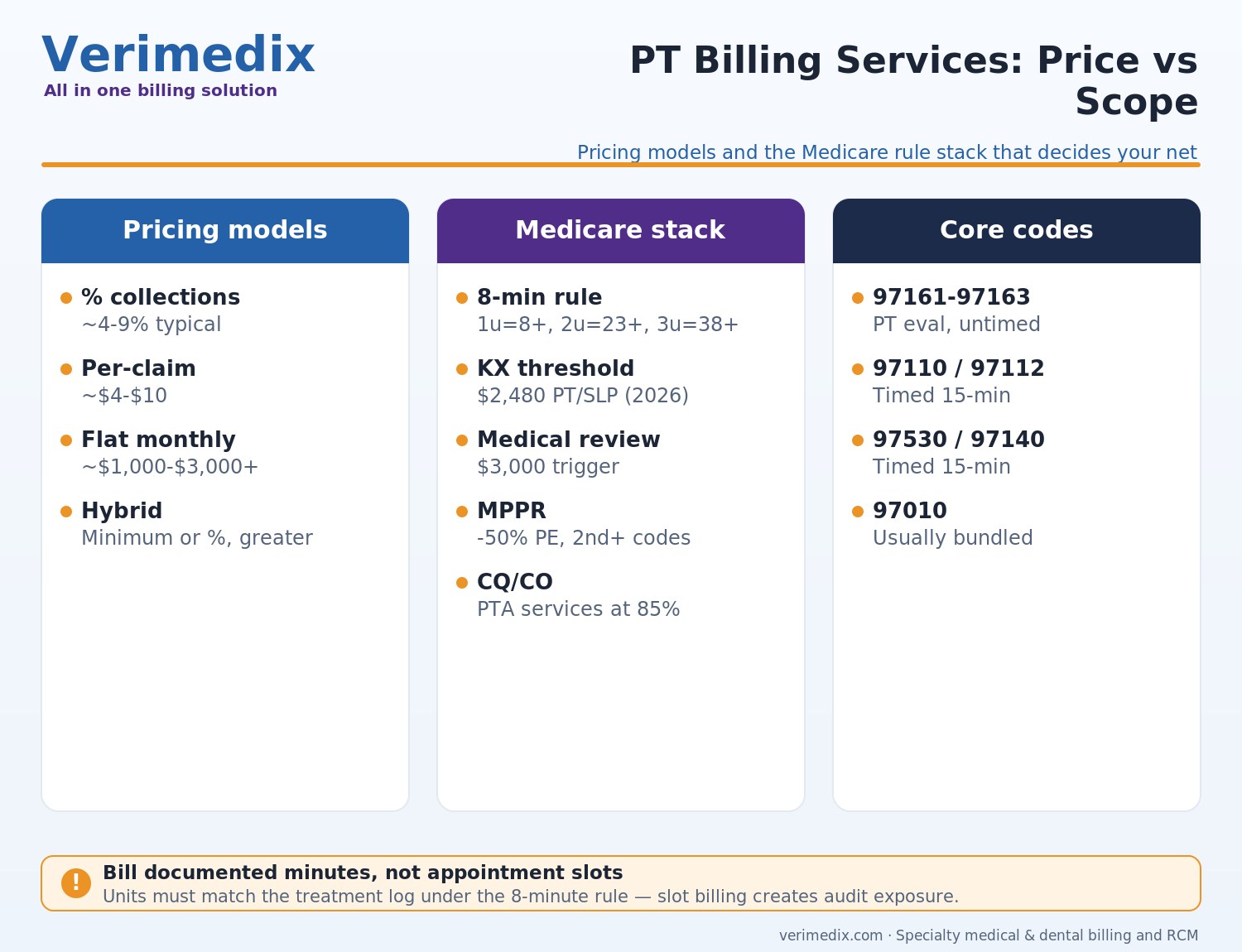
- Physical therapy billing services commonly price at roughly 4–9% of collections (published ranges span ~3–10%), with per-claim (~$4–$10) and flat monthly models as alternatives — PT's low average ticket makes the percentage math different from other specialties.
- Scope decides value: claims-only deals are cheap but leave denials, unit audits, and patient AR on your desk; full RCM includes eligibility, denial appeals, and Medicare rule compliance.
- The Medicare rule stack — the 8-minute rule, the $2,480 KX modifier threshold for CY 2026 (PT/SLP combined), 50% MPPR on practice expense, and CQ/CO assistant modifiers at 85% — is where PT clinics leak the most revenue.
- Timed-unit errors are the signature PT denial: one unit at 8+ minutes, two at 23+, three at 38+, four at 53+ — billing by appointment length instead of documented minutes invites audits.
- A vendor that cannot explain MPPR's effect on your per-visit reimbursement, or when the KX modifier attaches, is not a PT billing company — it is a claims typist.
- This guide covers services and pricing; for ranked vendor lists see our separate PT billing company roundups.
Why PT billing is a volume business with thin margins for error
A physical therapy clinic's revenue arrives in small, frequent slices — dozens of visits a day, each worth well under a couple hundred dollars, each carrying two to four timed CPT codes with their own unit rules. Nobody writes off a single $95 visit denial the way they fight a denied surgery; the danger is that hundreds of small denials disappear quietly into adjustments. PT billing is therefore a systems problem: unit-counting discipline, modifier automation, and relentless small-dollar follow-up.
Medicare adds a rule stack unique to therapy: timed codes governed by the 8-minute rule, an annual KX modifier threshold that requires attestation of medical necessity, the multiple procedure payment reduction (MPPR) that trims every second procedure on a visit, assistant-provided services paid at 85% under CQ/CO modifiers, and the GP therapy modifier on every claim line under a PT plan of care. Our physical therapy billing services page covers Verimedix's offering; this guide is the vendor-agnostic version — what PT billing services include, what they cost, and how to choose. If you want ranked vendor lists instead, see our 10 best PT billing companies roundup and the companion piece on top PT billing companies for outpatient rehab.
What a full-service PT billing partner should cover
- Front-end: eligibility and benefits verification (visit limits, therapy caps, auth requirements), plan-of-care certification tracking, and authorization renewals before visits run out.
- Coding and claims: timed-unit validation against documented minutes, modifier automation (GP, KX, CQ/CO, 59/X where supported), NCCI edit scrubbing, and daily submission.
- Back-end: ERA posting, denial work queues with appeal deadlines, patient statements and small-balance strategy, and credentialing maintenance.
- Reporting: units per visit, reimbursement per visit by payer, denial rate by reason code, days in AR, and net collection rate — monthly, at clinic and therapist level.
Claims-only contracts typically cover the middle bullet alone. That is not wrong — it is just a different product, and it should cost meaningfully less.
Pricing models and typical ranges
All figures are illustrative industry ranges drawn from published vendor pricing patterns; get current written quotes and compare scope line by line.
| Model | Typical range | Best fit | Watch-outs |
|---|---|---|---|
| Percentage of collections | ~4–9% (published ranges span ~3–10%; full-service PT RCM often mid-single digits) | Clinics that want incentives aligned with collections and denial recovery | Ask what counts as collections — patient payments? old AR the vendor didn't work? |
| Per-claim fee | ~$4–$10 per claim | High-volume clinics with clean front ends | Denial appeals and AR follow-up usually excluded; PT's denial volume makes this expensive fast |
| Flat monthly fee | ~$1,000–$3,000+ per clinic by size | Predictable budgeting for stable caseloads | Verify surge handling and whether new therapists raise the fee |
| Hybrid (minimum + %) | Monthly minimum or ~4–8%, whichever is greater | Seasonal or growing clinics | Model the minimum against your slowest month before signing |
The PT code set a billing service must master
| CPT | Service | Timed? | Billing note |
|---|---|---|---|
| 97161–97163 | PT evaluation (low / moderate / high complexity) | Untimed | One unit regardless of duration; complexity must match documentation |
| 97164 | PT re-evaluation | Untimed | Payable for documented status change, not routine progress notes |
| 97110 | Therapeutic exercise | Timed (15 min) | The workhorse code — see our full CPT 97110 billing guide |
| 97112 | Neuromuscular re-education | Timed (15 min) | Distinct documentation from 97110; see the 97112 units guide |
| 97530 | Therapeutic activities | Timed (15 min) | Functional, dynamic activities; NCCI pairings apply — see the 97530 guide |
| 97140 | Manual therapy | Timed (15 min) | Edit pairs with evaluation and CMT codes; modifier support required |
| 97010 | Hot/cold packs | Untimed | Bundled by Medicare and most payers — usually not separately payable |
The Medicare rule stack: 8-minute rule, KX, MPPR
The 8-minute rule converts documented minutes of timed codes into billable units: 1 unit at 8–22 minutes, 2 at 23–37, 3 at 38–52, 4 at 53–67. The trap is mixed-remainder visits, where leftover minutes from different codes must be combined per CMS logic rather than rounded per code. Our 97110 deep dive works through the unit math with examples, so we will not duplicate it here — the buyer's-guide point is that your billing service must audit minutes-to-units on every claim, not spot-check quarterly.
The KX modifier threshold for CY 2026 is $2,480 for PT and speech-language pathology combined (a separate $2,480 applies to OT), per the CMS therapy services update. Above that amount, claims must carry the KX modifier as an attestation that continued therapy is medically necessary and documented; a targeted medical review threshold sits at $3,000. Miss the KX and claims deny automatically; append it reflexively and you build audit exposure. The full mechanics — tracking accrual, when to attach, documentation standards — are in our KX modifier and Medicare therapy threshold guide.
MPPR reduces the practice expense component of the second and subsequent "always therapy" procedures on the same day by 50% under Medicare. In practice that means your second, third, and fourth units of the day reimburse less than the first — so a vendor forecasting your revenue from raw fee-schedule rates is overstating it. CQ/CO modifiers mark services furnished in whole or substantial part by PTAs/OTAs and pay at 85% under Medicare; misapplying them either leaks 15% or misrepresents who treated. GP is required on services under a PT plan of care. A competent PT biller automates all four; ask to see the logic.
Common PT denials and fixes
| Denial pattern | Root cause | Fix |
|---|---|---|
| CO-97 bundled service | 97010 or edit-pair code billed without support | Know payer bundling lists; see the CO-97 guide |
| Units exceed documented minutes | Billing by appointment slot, not treatment log | Minutes-to-units audit on every claim |
| Threshold denial (no KX) | Accrual tracking missed the $2,480 crossing | Automate running totals per beneficiary; attach KX with documentation |
| Plan-of-care certification lapsed | Physician signature not obtained/renewed on time | Certification calendar with alerts before expiry |
| Authorization visits exhausted | Front desk and biller tracking different counts | Single source of truth for auth counts inside the billing workflow |
How to choose: a PT-specific vetting checklist
Use this as a pass/fail screen before comparing price:
- Explain MPPR's effect on a 4-unit visit in dollars. (If they can't, stop.)
- How do you track each Medicare beneficiary's progress toward the KX threshold?
- What is your minutes-to-units audit process and error rate?
- How do you handle CQ/CO when a PTA delivers part of a session?
- What is your denial overturn rate on timed-code and bundling denials?
- Which PT EMRs and clearinghouses do you work in daily?
- What patient-balance workflow do you run for high-frequency, small-balance accounts?
- What exactly is out of scope — credentialing, old AR, patient calls?
Worked example (illustrative only). A clinic runs 1,200 visits/month at a $92 average collected per visit — about $110,400/month. A 6% full-service deal costs $6,624/month. Compare: an in-house biller (~$4,200/month loaded) plus clearinghouse and statement costs (~$500) looks cheaper — until you price the gap. If outsourcing lifts net collections just 3% through denial recovery and unit-audit accuracy (about $3,300/month on this base), the effective cost difference nearly closes, and the clinic sheds hiring, training, and turnover risk. If a vendor claims a 10%+ lift, ask for client references; modest, verifiable improvement is the credible pitch. All numbers are illustrative.
Quick Answers
How much do physical therapy billing services cost? Commonly about 4–9% of monthly collections for full-service RCM, roughly $4–$10 per claim for submission-only models, or flat monthly fees around $1,000–$3,000+ by clinic size — illustrative ranges that vary with scope.
What is the 8-minute rule in PT billing? Medicare's method for converting timed-code minutes into units: 1 unit at 8–22 minutes, 2 at 23–37, 3 at 38–52, 4 at 53–67, with remainder minutes combined across codes per CMS logic.
What is the KX modifier threshold for 2026? $2,480 for PT and SLP services combined (OT has its own $2,480), per CMS. Claims above it require the KX modifier attesting medical necessity; targeted medical review can apply above $3,000.
What is MPPR in physical therapy? Medicare's multiple procedure payment reduction: the practice expense portion of the second and subsequent therapy procedures on the same day is reduced by 50%, lowering effective per-visit reimbursement below raw fee-schedule rates.
Is outsourcing PT billing worth it for a small clinic? Often, when the clinic lacks a biller fluent in timed units and Medicare therapy rules — the fee is frequently offset by recovered denials and cleaner unit capture, though results depend on payer mix and current performance.
Frequently asked questions
Percentage pricing usually wins for clinics with meaningful denial volume, because the vendor only earns on what actually collects — aligning them with appeals and follow-up. Per-claim pricing suits high-volume clinics with very clean front ends, but check what happens to denied claims: if rework costs extra, the effective rate can exceed a mid-range percentage deal.
Full-service vendors track certification and recertification dates and alert the clinic before they lapse, since claims after an expired certification deny. Claims-only vendors generally do not — the clinic keeps that burden. Ask specifically, because lapsed certs are one of the most preventable PT denial categories.
The KX threshold is a Medicare mechanism; commercial plans instead use visit limits and authorization caps that vary by contract. A good billing partner tracks both systems separately — Medicare accrual toward $2,480 (CY 2026) and per-payer visit counts — because mixing them up produces both denials and unnecessary patient cutoffs.
Benchmark targets commonly cited are a 95%+ clean claim rate and net collection rates in the mid-to-high 90s against contracted allowables, with days in AR under about 35–40 for outpatient therapy. Treat any vendor guaranteeing a specific percentage lift with skepticism and ask for verifiable references instead.
Yes — under-billing is common in PT when therapists round minutes down or skip a defensible fourth unit. A vendor that audits treatment logs against billed units typically finds both overcounts and undercounts; correcting the undercounts is compliant revenue recovery, provided units always match documented minutes.