
- CPT 97110 (therapeutic exercise) is a timed code billed in 15-minute units; Medicare pays roughly $30–$35 per unit in 2026, varying by locality and MPPR.
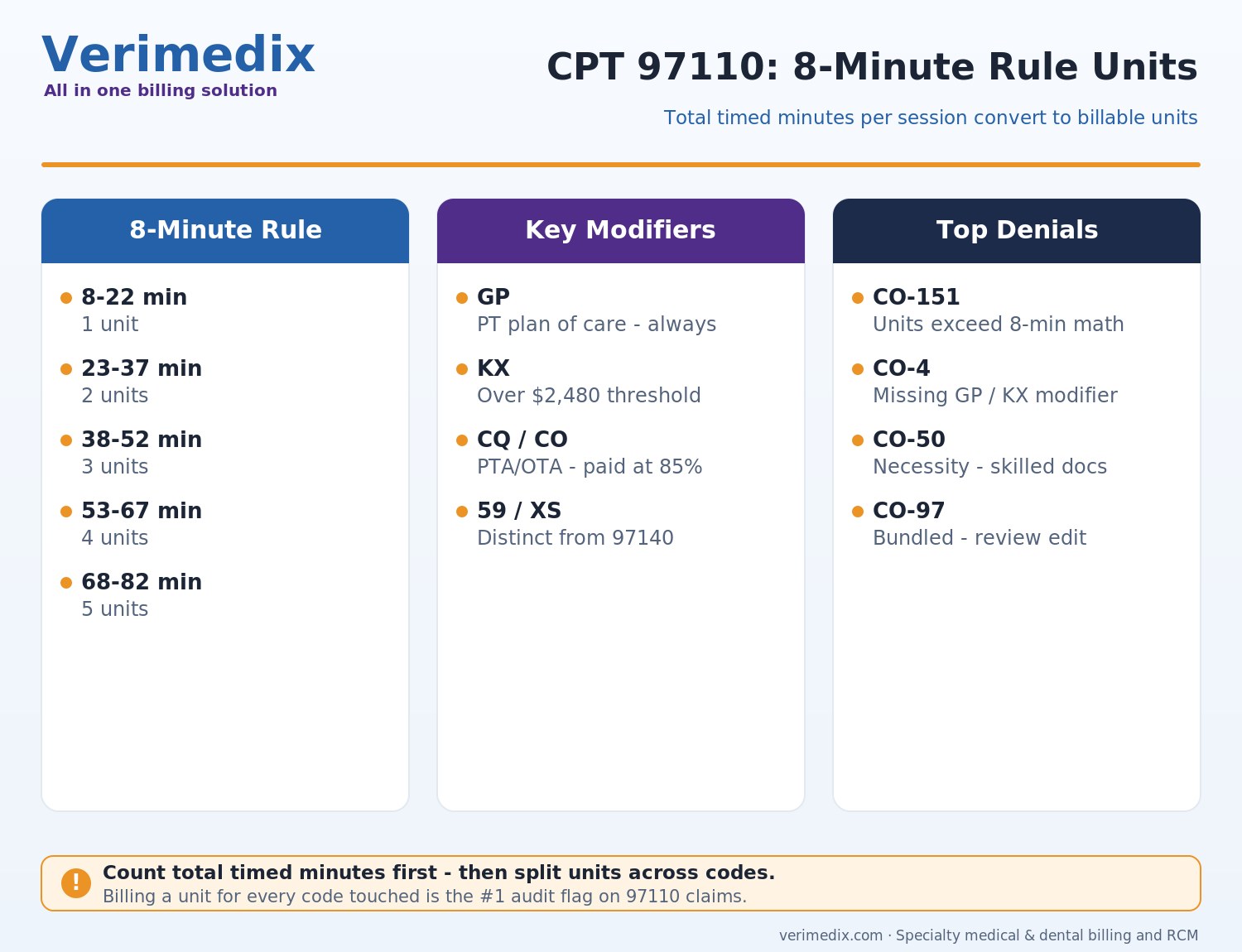
- Under Medicare's 8-minute rule, total timed minutes drive units: 8–22 minutes = 1 unit, 23–37 = 2, 38–52 = 3, 53–67 = 4.
- Every 97110 line needs a discipline modifier — GP for services under a physical therapy plan of care — and KX once the patient passes the $2,480 (2026) therapy threshold.
- CQ/CO assistant modifiers reduce Medicare payment to 85% when a PTA or OTA furnishes more than 10% of the service.
- The most common denials — CO-151 (unit math), CO-4 (missing modifier), CO-50 (medical necessity) — are preventable at charge entry.
- Document total treatment time, timed minutes per code, and why the exercise required a therapist's skill — a repeated flow sheet is the classic audit finding.
What CPT 97110 covers — and what it pays
Therapeutic exercise under 97110 means exercise performed with direct, one-on-one contact by a qualified clinician to develop strength, endurance, range of motion, or flexibility in one or more body areas. Per the AMA CPT descriptor it is a "therapeutic procedure, 1 or more areas, each 15 minutes." That last phrase is the whole billing story: 97110 is a timed code, and units — not visits — are what you get paid for.
Physical therapists bill it most, but occupational therapists, chiropractors, physicians, and NPPs report it too when exercise is part of a documented plan of care. Two boundaries matter. First, the one-on-one requirement: if you are supervising two patients doing exercises at once, that is group therapy (97150), not two lines of 97110. Second, 97110 is for exercise targeting a single parameter (strength, ROM, endurance, flexibility); dynamic, functional, multi-parameter tasks belong under 97530 therapeutic activities, and balance, coordination, or proprioception work under 97112 neuromuscular re-education. Coding everything as 97110 because it is familiar leaves money on the table — 97112 and 97530 often reimburse a few dollars more per unit.
On the 2026 Medicare Physician Fee Schedule, one unit of 97110 generally allows in the low $30s nationally, though the exact figure varies by locality, by whether your clinician participates in an Alternative Payment Model (two conversion factors apply in 2026), and by Medicare's multiple procedure payment reduction (MPPR), which cuts the practice-expense portion of second and subsequent therapy procedures on the same day by 50%. Commercial and Medicaid rates range widely — verify your fee schedules rather than assuming parity.
The 8-minute rule: converting minutes to units
Medicare's 8-minute rule aggregates all timed minutes in the session — 97110, 97112, 97140, 97530, and other constant-attendance codes — then converts the total into billable units. You need at least 8 minutes beyond each full 15-minute block to add a unit. Untimed codes (evaluations 97161–97163, unattended e-stim 97014/G0283) never enter the math.
| Total timed minutes | Billable units |
|---|---|
| 0–7 | 0 units |
| 8–22 | 1 unit |
| 23–37 | 2 units |
| 38–52 | 3 units |
| 53–67 | 4 units |
| 68–82 | 5 units |
| 83–97 | 6 units |
After you know the total units, assign them to specific codes: each code first earns a unit per full 15 minutes, then remaining units go to the codes with the largest leftover minutes. Beware the competing AMA "rule of eights" (midpoint rule), which some commercial payers follow: it evaluates each code separately — a unit is billable only when that individual service crosses 8 minutes — and leftover minutes from different codes are never combined. The same visit can legitimately produce different unit counts for Medicare versus a commercial plan, so your billing platform needs payer-specific logic, not one global setting.
Modifiers: GP always, KX past the threshold, CQ/CO for assistants
Modifier errors are the fastest route to a CO-4 denial on 97110. The table below covers the set Medicare expects on outpatient therapy claims.
| Modifier | When it goes on 97110 | Payment effect |
|---|---|---|
| GP / GO / GN | Always — identifies the PT / OT / SLP plan of care | None; claim rejects or denies without it |
| KX | Once the beneficiary exceeds the annual therapy threshold — $2,480 for PT and SLP combined and $2,480 for OT in 2026 | Attests medical necessity; allows continued payment above the threshold |
| CQ / CO | When a PTA/OTA furnishes more than 10% of the service (de minimis standard) | Medicare pays 85% of the allowed amount |
| 59 / XS / XU | Only when an NCCI or payer edit pairs 97110 with another same-day service (e.g., 97140 under some policies) and the services were truly distinct | Bypasses the edit when documentation supports it |
| 96 / 97 | Some plans want habilitative (96) vs rehabilitative (97) identified | Routing/benefit adjudication |
The KX threshold is not a cap — you can and should keep treating medically necessary patients past $2,480 — but claims above it without KX typically deny (often CO-119, benefit maximum), and claims above the $3,000 targeted medical review threshold face possible record requests. Track each Medicare patient's accrued therapy dollars proactively; our full guide to the KX modifier and the Medicare therapy threshold covers the workflow, the 2018–2028 medical review rules, and appeal language.
Documentation that survives an audit
Reviewers deny 97110 for vague notes more than for wrong codes. Each date of service should record: total treatment time and total timed minutes; minutes per timed code; the specific exercises with objective parameters (sets, reps, resistance, positioning); and — the part most notes miss — why the service required the skills of a therapist. "Continued HEP supervision" describes something a gym membership provides; "progressed eccentric loading with tactile cueing to correct scapular substitution" describes skilled care. Tie every entry back to plan-of-care goals, show progression over time, and co-sign assistant-furnished minutes consistent with your state practice act.
A worked unit-and-dollar example (illustrative)
Say a Medicare patient's visit includes 24 minutes of therapeutic exercise (97110), 10 minutes of manual therapy (97140), and 8 minutes of neuromuscular re-education (97112), plus an unattended modality. Timed total: 42 minutes → the 38–52 row → 3 units. Assignment: 97110 earns one full-block unit (15 min) with 9 left over; the two remaining units go to the largest leftovers — 97140 (10 min) and 97110's remainder (9 min). Final claim: 97110 × 2, 97140 × 1, 97112 × 0 (its 8 minutes lose the tiebreak). At illustrative allowables of $31 for 97110 and $28 for 97140, the visit yields about $90 before MPPR trims a few dollars from the second and third procedures' practice expense. Billing 97112 × 1 as well — "because we did it" — would claim 4 units on 42 minutes and is exactly what CO-151 edits and comparative billing reports catch.
Top 97110 denials and how to fix them
| Denial | Why it happens on 97110 | Fix |
|---|---|---|
| CO-4 (modifier missing/inconsistent) | GP omitted, or KX absent above the threshold | Scrub every therapy line for a discipline modifier; auto-flag beneficiaries near $2,480 and resubmit corrected claims |
| CO-151 (units exceed) | Units billed do not match timed minutes, or exceed the payer's MUE/LCD daily limits | Recompute with the 8-minute chart; appeal with the treatment-time grid if minutes genuinely support the units |
| CO-50 (not medically necessary) | Notes show maintenance-level or unskilled exercise; goals stalled | Appeal with objective progress data and skilled-need language; update the plan of care |
| CO-97 (bundled) | Payer edit pairs 97110 with a same-day eval, re-eval, or 97140 | Verify the edit; if services were distinct, resubmit with 59/XS per NCCI unbundling rules |
| CO-119 (benefit max) | Threshold or visit-limit reached without attestation | Add KX (Medicare) or obtain continued-care authorization (commercial); verify remaining benefits at intake |
A 6-point pre-claim checklist for timed codes
Run every rehab claim through this before it leaves the door:
- Sum timed minutes only. Exclude untimed evals and unattended modalities.
- Convert with the correct rule. Medicare chart vs AMA rule of eights, by payer.
- Assign units to codes — full blocks first, largest remainders next; never exceed the total.
- Stack modifiers in order: discipline (GP), payment (KX, CQ/CO), then edit modifiers (59/XS) only with support.
- Check the threshold ledger for every Medicare patient past $2,000 accrued.
- Match the note: minutes per code in the documentation must equal minutes implied on the claim.
If that discipline is consuming your front office, a specialty billing partner that lives in timed codes daily — see our physical therapy billing services — typically pays for itself in recovered CO-151 and CO-4 denials alone.
Quick Answers
What is CPT 97110? Therapeutic exercise: a timed therapeutic procedure, one or more areas, each 15 minutes, performed one-on-one to develop strength, endurance, range of motion, or flexibility.
How many minutes do you need to bill one unit of 97110? At least 8 minutes of direct treatment under Medicare's 8-minute rule; 8–22 total timed minutes supports exactly 1 unit.
Does 97110 require a modifier? Yes — Medicare requires the discipline modifier (GP for PT plans of care) on every line, KX above the $2,480 2026 therapy threshold, and CQ/CO when an assistant furnishes over 10% of the service.
How much does Medicare pay for 97110 in 2026? Roughly $30–$35 per unit nationally, varying by locality, conversion factor, and the multiple procedure payment reduction; confirm your MAC's fee schedule.
Can you bill 97110 and 97140 together? Often yes, when each service is distinct and separately timed; some payer edits require modifier 59 or XS on the appropriate line with documentation of separate intervals or regions.
Frequently asked questions
97110 is a timed, constant-attendance code billed in 15-minute units under the 8-minute rule. Total timed minutes across the session determine how many units you can bill, and each unit requires at least 8 qualifying minutes. Untimed services like evaluations and unattended modalities are billed once regardless of duration and never enter the unit math.
97110 targets a single parameter \u2014 strength, endurance, range of motion, or flexibility \u2014 through structured exercise. 97530 (therapeutic activities) uses dynamic, functional tasks such as lifting, carrying, or reaching that address multiple parameters at once. Payers expect the note to match the code, and 97530 often reimburses slightly more, so accurate selection matters both ways.
Append KX once a Medicare beneficiary's combined PT/SLP (or separate OT) spending passes the annual therapy threshold \u2014 $2,480 in 2026 \u2014 and continued care remains medically necessary. KX is an attestation, not an authorization request, but claims above the threshold without it typically deny. Above the $3,000 targeted medical review threshold, expect possible documentation requests.
Only as many as your total timed minutes support: 8\u201322 minutes is 1 unit, 23\u201337 is 2, 38\u201352 is 3, and 53\u201367 is 4. Payers also apply daily MUE limits and LCD frequency expectations, and consistently high unit counts per visit are a known trigger for comparative billing review. Bill the math, not the schedule slot.
CO-4 means a required modifier is missing or inconsistent \u2014 on therapy claims that is almost always the discipline modifier (GP/GO/GN) or a missing KX above the threshold. Correct the modifier and resubmit as a corrected claim rather than appealing. A charge-entry scrub rule that blocks therapy CPT codes without a discipline modifier prevents nearly all of these.