
- White-label medical billing means embedded staff, not outsourced work — the client keeps its brand, SOPs, and client relationships.
- Minimum engagement is typically 2 dedicated resources; pricing runs $500–$700/mo for admin roles and $1,000–$1,500+/mo for specialized roles like coders and AR specialists.
- It differs from traditional outsourcing, where the vendor's own systems and brand touch the client's customers.
- Staff work inside the client's existing EHR/PMS (SimplePractice, Open Dental, Athenahealth, eClinicalWorks, AdvancedMD, DrChrono, Tebra, and more) — no new platform required.
- Best fit: medical billing companies, MSOs, and group practices that already have a process and need execution capacity, not a new system.
What Is White-Label Medical Billing?
White-label medical billing is the practice of a third-party staffing provider recruiting, placing, and managing billing-side professionals — billers, coders, AR specialists, denial-management staff, eligibility reps — who work entirely inside the client's own environment and communicate under the client's brand. Unlike traditional RCM outsourcing, where the vendor's processes and name are visible to the end client, white-label staffing is invisible: patients and referring clients never know a third party is involved.
How the Model Works
- Scope the role — the client defines the role, specialty, systems, and workload.
- Workflow review — the provider reviews the client's SOPs, escalation paths, and platforms.
- Staffing match — trained professionals are matched by specialty exposure and system familiarity.
- Onboarding & access — secure access and orientation happen inside the client's environment.
- Go-live & oversight — staff begin work under the client's brand while the provider manages performance and continuity behind the scenes.
White-Label vs Traditional Outsourcing vs In-House Hiring
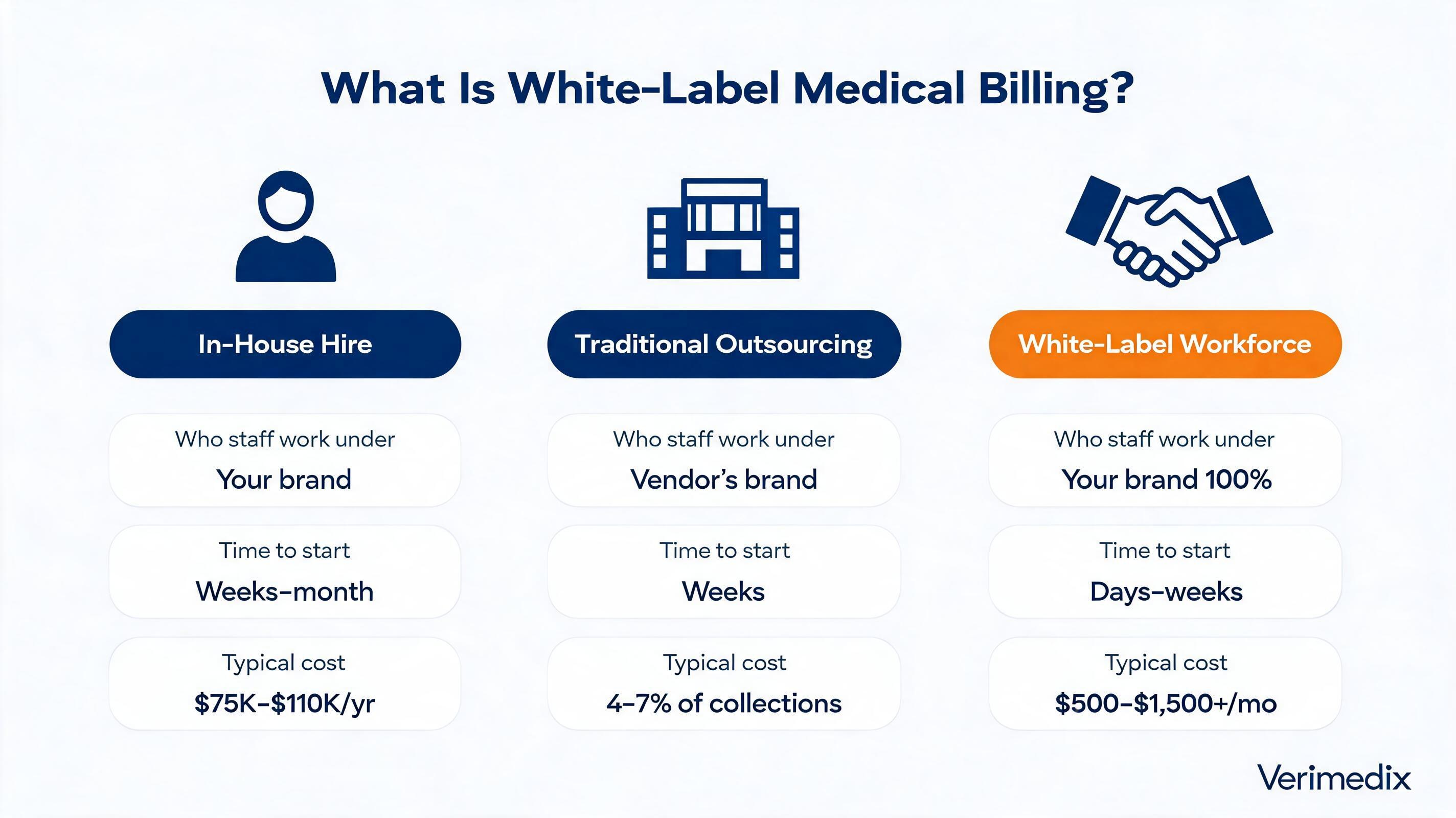
| Model | Who staff work under | Time to start | Typical cost | Brand visibility to client |
|---|---|---|---|---|
| In-house hire | Your brand | Weeks to months (recruiting + training) | ~$75,000–$110,000+/yr fully loaded ($45,000–$62,000 base + benefits, tax, software, turnover) | Fully yours |
| Traditional RCM outsourcing | Vendor's brand/process | Weeks (vendor onboarding) | 4–7% of collections (solo often 6–9%) | Vendor may be visible to end clients |
| White-label workforce (e.g., Verimedix) | Your brand, 100% | Days to a few weeks after scoping | $500–$700/mo (admin) to $1,000–$1,500+/mo (specialized), min. 2 resources | Invisible — staff operate as your team |
Who White-Label Billing Is For
- Medical billing companies that have built client relationships and pricing models but need reliable execution capacity without months of recruiting.
- MSOs and group practices managing billing across multiple locations that need dedicated AR, denial, or eligibility staff without building a full internal department.
- Independent and growing practices that need billing-side support but aren't ready for a full outsourced RCM engagement.
White-label billing workforce providers such as Verimedix place dedicated, trained billers who work inside the client's systems under the client's brand, starting at two resources.
What White-Label Billing Is Not
Because the term gets borrowed loosely, it helps to rule out three things white-label medical billing is not. It is not software white-labeling — rebranding a billing platform or clearinghouse under your logo involves no people and solves no capacity problem. It is not subcontract reselling, where you pass client work to a vendor who runs it through their own process and you mark up the invoice; in that model you inherit the vendor's turnaround times, their quality variance, and their way of working. And it is not a shared BPO queue, where your claims sit in a pool worked by whoever is available across dozens of accounts. In a true white-label staffing model, named individuals are assigned to your organization full-time, learn your SOPs, appear in your systems under your accounts, and answer to your workflow — the provider's job is recruiting, performance management, and continuity behind the scenes, not processing.
Questions to Ask a White-Label Staffing Provider
Before signing with any provider, get specific answers to these:
- Dedication: Is the resource assigned to us full-time, or shared across accounts?
- Systems: Have you placed staff in our exact PMS/EHR before, and how is platform fit scoped?
- Brand control: Will staff communicate in our email domain, ticketing, and phone scripts — with nothing vendor-branded visible?
- HIPAA posture: How are data-handling training, access controls, and minimum-necessary access handled inside our environment?
- Continuity: If our resource resigns, who covers the work, and how fast is a trained replacement placed?
- Oversight: Is a team lead or managed-oversight layer available as the pod grows, and how is it priced?
- Minimums and exit: What is the minimum engagement (commonly 2 resources), and what are the terms to scale down?
- Reporting: What does the provider report to us monthly on performance, and what do we measure ourselves?
A provider comfortable with all eight questions is describing a staffing operation. A provider who redirects to their own platform or process is describing outsourcing with extra steps.
Real-World Example
In one engagement, a U.S. dental billing company needed dedicated capacity to work down an aging accounts receivable backlog without pulling internal staff off active client work. Verimedix placed a trained dental billing resource focused specifically on AR and aging follow-up, working inside the client's existing systems and under the client's brand — the client reported measurable improvement in aging position.
Frequently asked questions
No. Staff can operate entirely under the hiring company's brand — in email, on calls, and inside ticketing systems.
Most white-label workforce providers, including Verimedix, set a minimum of 2 dedicated resources for real coverage and continuity.
Pricing is role-based: roughly $500–$700/month for administrative/front-desk roles and $1,000–$1,500+/month for specialized roles like coders, AR specialists, and denial management.
Offshore billing can be white-label or not; white-label specifically means staff work under your brand regardless of location. Many white-label providers, including Verimedix, are U.S.-registered and HIPAA-aware.
Timelines depend on role complexity and system-access requirements; providers typically scope a specific timeline once the role and platforms are confirmed.
No. Staff are trained to work inside the client's existing EHR, PMS, clearinghouse, and communication tools.