
- A complete billing operation covers seven functions — charge entry, coding, claim submission, payment posting, AR follow-up, denial management and reporting — whether one person does all seven or a department of forty splits them.
- Commonly cited planning ratios run from one biller per 2–4 providers in manual, paper-heavy workflows to one per 4–6 in well-automated practices; an older MGMA benchmark put total billing-office staffing near 2–3 staff per FTE physician. Treat all of these as starting points, not law.
- Specialty, payer mix, claim volume per provider and automation move real staffing needs far more than headcount rules of thumb do.
- The signal to add a seat is a KPI breach — AR days drifting past ~45, a coding queue over 2–3 days, posting lag over 48 hours — not a provider count milestone.
- Solo practices, multi-provider groups and billing companies need structurally different org charts; copying a bigger practice's structure too early is how billing payroll outruns collections.
- A hybrid structure — a small in-house core plus an embedded outsourced team for volume work — is increasingly the default for groups between roughly 5 and 25 providers.
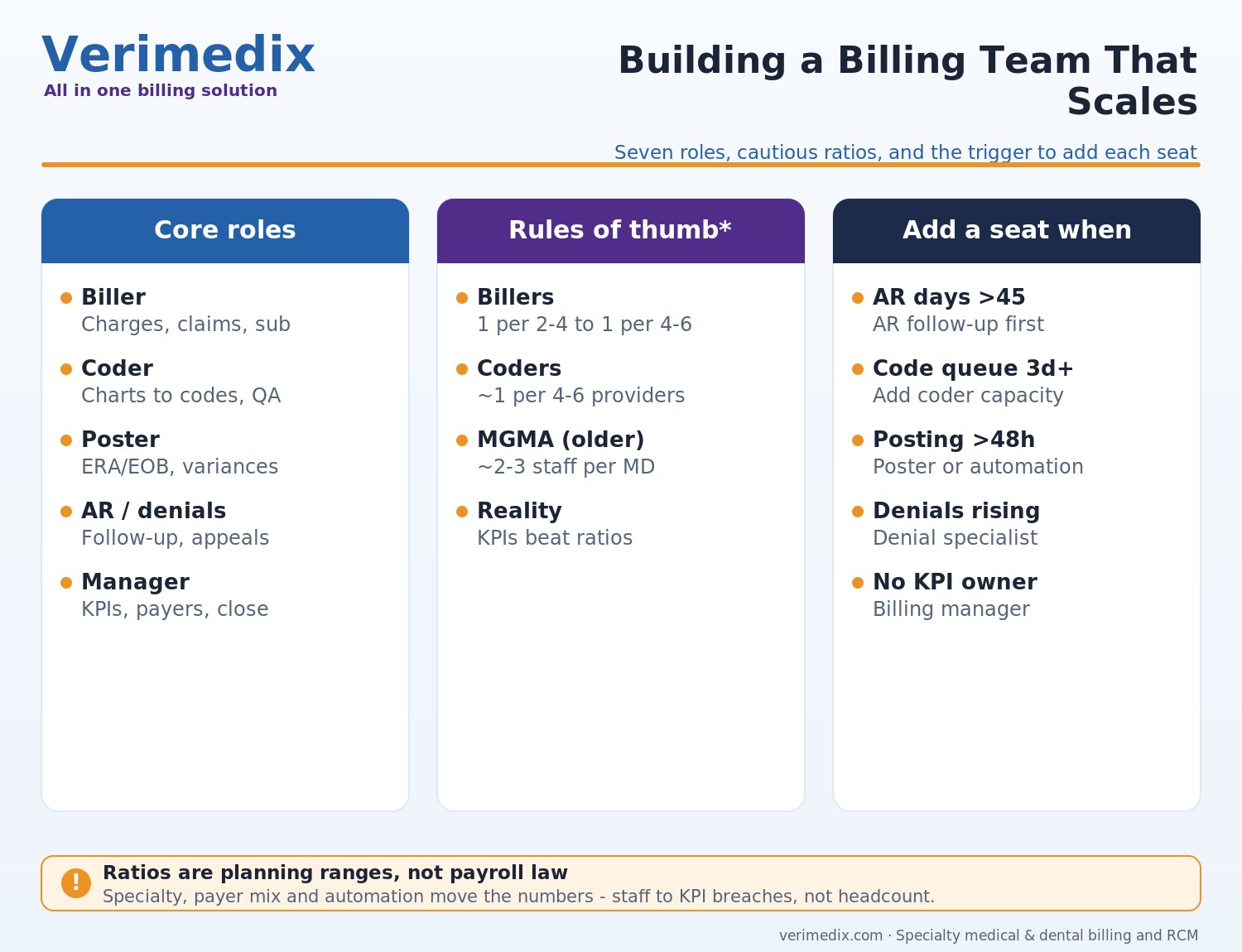
The seven functions every billing team must cover
Org charts differ, but the work does not. Every clean revenue cycle performs the same seven functions, and most billing breakdowns trace back to one function that nobody explicitly owns. Map your current team against this table before touching headcount — unowned functions, not understaffed ones, are usually the first problem.
| Role / function | Owns | KPI that shows it's working |
|---|---|---|
| Charge entry / billing specialist | Capturing encounters, entering charges, scrubbing and submitting claims | Charge lag <48 hrs; first-pass clean claim rate ~95%+ |
| Medical coder | ICD-10/CPT/HCPCS assignment, modifiers, coding queries | Coding queue <2–3 days; audited accuracy ~95%+ |
| Payment poster | ERA/EOB posting, adjustments, variance flags | Posting lag <24–48 hrs; unapplied cash near zero |
| AR follow-up specialist | Working unpaid claims by age and payer | AR days ~35–45 or better; %AR >90 days under ~15–20% |
| Denial specialist | Appeals, corrected claims, root-cause tagging | Denial overturn rate; denial rate trending down |
| Eligibility / front-end | Verification, auth, patient estimates | Eligibility-related denials near zero |
| Billing manager / RCM lead | KPIs, payer relationships, escalations, staff QA | Net collection rate ~96%+; monthly close on time |
Staffing ratios: what the benchmarks actually say
Practices ask for a single number — "how many billers per provider?" — and the honest answer is a range with caveats. Consultant rules of thumb commonly land around one dedicated biller per 2–4 providers for practices with manual workflows, stretching to one per 4–6 providers where eligibility checks, claim scrubbing and ERA posting are well automated. MGMA's older benchmarking work measured total business-office staffing (billing plus related front-end functions) at roughly 2–3 staff per FTE physician across specialties. For coders, planning ranges of one per 4–6 providers appear frequently, but E/M-heavy primary care and surgical specialties sit at opposite ends of that band.
| Ratio (rule of thumb) | Commonly cited range* | What moves it |
|---|---|---|
| Billers per provider | ~1 per 2–4 (manual) to 1 per 4–6 (automated) | Claim volume per provider, payer mix, scrubber quality, ERA adoption |
| Coders per provider | ~1 per 4–6, wide variance | Specialty complexity, EHR-assisted coding, provider documentation quality |
| Total billing-office staff per FTE physician | ~2–3 (older MGMA benchmarking) | Includes front-end functions; leaner in tech-forward practices today |
| AR accounts per follow-up FTE | Often ~30–50 worked accounts/day capacity | Payer portal access, claim complexity, aging mix |
*Directional industry figures, not standards; validate against your own claim volume and KPI trends. The deeper build-vs-buy math — salaries, pricing models and what each seat costs loaded — is in our RCM staffing guide: roles, pricing and build vs. buy.
Org charts that work: solo, group, billing company
Solo and 1–3 provider practices. One billing specialist owns all seven functions end to end, with the practice manager as backup and escalation point. This chart is fragile by design: one resignation removes 100% of billing capacity. The mitigations are documented SOPs, cross-trained front desk coverage for eligibility and posting, and an overflow arrangement — many small practices pair their generalist with an embedded billing team that absorbs coding and AR follow-up overflow without adding payroll.
4–10 provider groups. Specialization starts here, and it should follow the money path: first split front-end (eligibility, charge entry, submission) from back-end (posting, AR, denials); the third seat is usually a dedicated AR/denial specialist, because unworked follow-up is where groups this size leak the most revenue. A working billing manager — a senior biller with KPI ownership, not a pure supervisor — typically emerges around 5–8 providers.
10+ providers and billing companies. Structure shifts to functional pods: a coding unit with a QA auditor, a submissions/posting unit, an AR unit organized by payer or aging bucket, and a denials unit organized by root cause. Billing companies layer client-facing account managers on top and staff production pods per client block. At this scale the constraint is rarely finding bodies — it is supervision quality, which is why growing billing companies increasingly run domestic account management over an offshore or white-label production floor.
When to add each role: triggers, not milestones
Provider count is a lagging indicator. Add seats when leading indicators breach, in this order of urgency: Teams that can't justify every seat in this structure often fill specific roles through embedded staffing — Verimedix's White-Label Workforce, for instance, covers 12 billing-side roles from eligibility reps to AR specialists, placed inside the practice's existing workflow starting at two resources.
| Symptom (sustained 4+ weeks) | Add / fix | Why this seat first |
|---|---|---|
| AR days drift past ~45; %AR>90 climbing | AR follow-up specialist | Aging claims approach timely-filing and appeal deadlines — this leak compounds |
| Coding queue over 2–3 days | Coder (or fractional coding support) | Everything downstream waits on codes; charge lag becomes cash lag |
| Posting lag over 48 hrs; unapplied cash growing | Payment poster or ERA automation | You cannot work denials you have not posted; often solvable with automation before headcount |
| Denial rate rising with no root-cause tagging | Denial specialist | Untagged denials repeat; a dedicated owner turns rework into prevention |
| No one can answer "what's our net collection rate?" | Billing manager / RCM lead | Beyond ~5–8 providers, unmanaged teams optimize for activity, not collections |
| Eligibility denials recurring | Front-end verification coverage | Cheapest denials to prevent; fix at the front, not the back |
Worked example: staffing a 6-provider group (illustrative)
Take a 6-provider multispecialty group submitting ~2,400 claims a month. A conventional in-house build might be: two billers (~$48,000 each), one coder (~$58,000), and a working billing manager (~$65,000) — $219,000 in base salaries, roughly $274,000 loaded at 25% for taxes and benefits, before software, recruiting and turnover risk. A hybrid alternative keeps the billing manager and one senior biller in-house (~$141,000 loaded) and places coding, posting and AR follow-up with a white-label team at a contracted rate — for many groups this lands 25–40% below the fully loaded in-house figure while adding bench coverage no 4-person team can match. Both numbers are illustrative; the point is to price the structure, not just the salaries, and to re-price it at every growth step.
The 5-question structure scorecard
Score one point per "yes." Four or five means your structure fits; two or less means restructure before you hire.
- Does every one of the seven functions have a named owner — including vacation coverage?
- Can you state your AR days, clean claim rate and net collection rate from last month without looking?
- Would billing continue at ≥80% capacity if your most senior biller resigned tomorrow?
- Is anyone reviewing denial root causes monthly and feeding fixes upstream?
- Has billing payroll grown slower than collections over the past two years?
Question 3 is the one most teams fail — and the full cost of failing it is quantified in our companion piece on what medical billing staff turnover really costs. If the gap is a specific seat you cannot fill, start with the salary bands in our guide to hiring a medical coder.
Quick Answers
How many billers does a practice need per provider? Commonly cited ranges run from one biller per 2–4 providers in manual workflows to one per 4–6 with strong automation; specialty, payer mix and claim volume matter more than the ratio itself.
What roles make up a medical billing team? Seven functions: charge entry/claim submission, coding, payment posting, AR follow-up, denial management, front-end eligibility, and a billing manager who owns KPIs. Small teams combine them; the functions never disappear.
When should a practice hire a billing manager? Typically around 5–8 providers, or whenever nobody can state AR days and net collection rate on demand. Before that, a senior biller with explicit KPI ownership usually suffices.
What KPIs tell you the billing team is understaffed? AR days sustained above ~45, more than ~15–20% of AR over 90 days, coding queues beyond 2–3 days, and posting lag beyond 48 hours are the classic capacity breaches.
Should a growing group build an in-house billing team or outsource? Between roughly 5 and 25 providers, a hybrid is often strongest: keep a manager and senior biller in-house for control, and use an embedded or white-label team for volume functions like coding, posting and AR follow-up.
Frequently asked questions
No. Figures like one biller per 2-4 providers or MGMA's older benchmark of roughly 2-3 total billing-office staff per FTE physician are planning ranges drawn from surveys and consulting practice, not standards. Your claim volume, specialty and automation level determine the real number, which is why KPI triggers beat ratios.
Once volume allows, yes - the skill sets, error modes and KPIs differ. Combined biller-coder roles work in small practices but tend to shortchange coding accuracy or AR follow-up as volume grows. A common middle step is a fractional or outsourced coder supporting an in-house biller.
AR follow-up works unpaid claims broadly by age and payer; a denial specialist works denied claims specifically - appeals, corrected claims and root-cause tagging that feeds prevention upstream. Small teams combine them, but the root-cause loop is what usually gets dropped when they do.
Billing companies organize by function-based production pods (coding, submissions, AR, denials) assigned to client blocks, with account managers layered on top for client communication. Many run domestic account management over an offshore or white-label production floor to control cost while keeping client contact local.
A small in-house core - typically a billing manager and a senior biller who own KPIs, payer relationships and escalations - combined with an embedded outsourced team handling volume functions like coding, posting and AR follow-up. It keeps control and institutional knowledge in-house while making capacity elastic.