
- SHRM-cited research puts the cost of replacing an employee at roughly six to nine months of salary — and 50–200% of salary for skilled roles — before you count what makes billing turnover uniquely expensive: the revenue that ages while the seat is empty.
- A departing biller takes an unwritten map with them — payer quirks, portal logins, appeal habits, which claims to chase first — and that knowledge does not appear in any handover document.
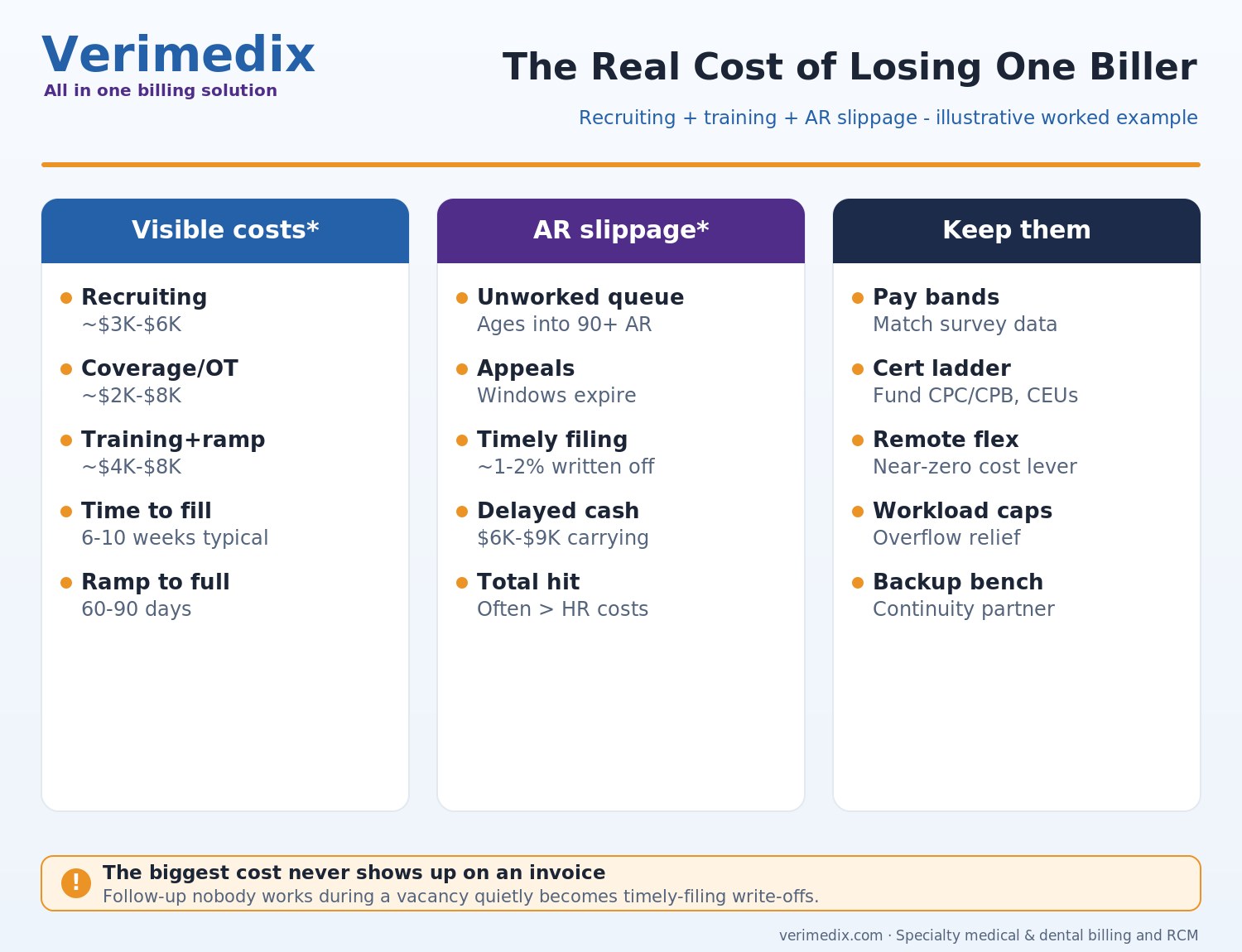
- The largest line in the true cost is usually AR slippage: follow-up nobody works during a 6–10 week vacancy quietly becomes 90+ day AR, expired appeal windows and timely-filing write-offs.
- An illustrative worked example below lands the real cost of one $48,000 biller's resignation at roughly $35,000–$50,000 — most of it invisible on any invoice.
- The strongest retention levers in billing are surveyed pay bands, a certification-linked career ladder, remote flexibility and workload caps — all cheaper than one resignation.
- Continuity planning — SOPs, a cross-training matrix, an access inventory and pre-arranged backup capacity — converts a resignation from a revenue event into a staffing event.
Why billing turnover costs more than other back-office turnover
When a receptionist resigns, work piles up and gets done late. When a biller resigns, work piles up and gets cheaper — every week an unpaid claim sits unworked, its odds of ever being collected fall, appeal windows close, and some claims cross payer timely-filing limits into permanent write-offs. That asymmetry is why generic turnover math understates billing turnover. General HR research cited by SHRM puts replacement cost at six to nine months of the departing employee's salary, with skilled-role estimates running 50–200% of annual pay. Those figures cover recruiting, training and lost productivity. They do not cover a denial queue that nobody appeals for eight weeks.
There is also a concentration problem: in practices with one or two billing staff, a single resignation removes 50–100% of billing capacity overnight — the same key-person fragility we flagged in our guide to medical billing team structure and ratios, and the reason continuity planning belongs in this article and not just in HR's binder.
Anatomy of the true cost
| Cost category | Typical range (illustrative) | What's in it |
|---|---|---|
| Recruiting | ~$3,000–$6,000 | Job ads, screening hours, interviews, possible agency fee (often far more if a recruiter's percentage fee applies) |
| Coverage during vacancy | ~$2,000–$8,000 | Overtime for remaining staff, temp/contract help, manager hours diverted to production |
| Training & ramp | ~$4,000–$8,000 | Trainer time plus 60–90 days of paying full wage for 50–70% output |
| AR slippage | Often the largest line | Unworked follow-up aging into 90+ buckets, expired appeal windows, timely-filing write-offs, denial rework |
| Knowledge loss | Hard to price | Payer quirks, contact habits, undocumented workarounds; shows up later as repeated denials |
| Morale / cascade risk | Hard to price | Overloaded remaining staff are the next resignation risk — turnover clusters |
Worked example: one biller resigns (illustrative)
Assume a two-biller practice collecting $250,000 a month. One biller earning $48,000 resigns with two weeks' notice; the seat takes eight weeks to fill and the new hire needs eight more weeks to reach full speed. Every number below is illustrative — swap in your own collections, wages and vacancy length. One structural hedge against resignation risk is an embedded-staffing layer: providers like Verimedix maintain trained backup coverage behind every placed resource, so a departure triggers a managed replacement rather than a six-week vacancy on your AR.
| Line item | Assumption | Cost |
|---|---|---|
| Recruiting | Ads + ~30 staff hours of screening and interviews | $4,200 |
| Overtime & manager coverage | Remaining biller OT + manager pulled into production, 8 weeks | $5,100 |
| Training & ramp loss | New hire at ~60% output for 8 weeks + trainer time | $6,400 |
| AR slippage — delayed cash | Half the follow-up queue unworked for 8 weeks; carrying cost and rework on ~$125K/mo of claims flow | $6,000–$9,000 |
| AR slippage — permanent write-offs | ~1–2% of two months' affected charges lost to timely filing and expired appeals | $12,000–$24,000 |
| Total (illustrative) | 16 weeks from notice to full speed | ~$34,000–$49,000 |
Note the shape of that total: the visible HR costs (~$16,000) are consistent with SHRM-style estimates of several months' salary, but the AR lines — the ones that never appear on an invoice — can double the bill. If a vacancy has already left you with an aged pile, our step-by-step guide to clearing a medical billing AR backlog covers triage order: timely-filing deadlines first, high-dollar appeals second, everything else by expected value.
Retention levers, priced against one resignation
Every lever below costs less than the worked example above. That is the whole argument.
| Lever | Annual cost (illustrative) | Why it works in billing specifically |
|---|---|---|
| Pay at surveyed market bands | $2,000–$5,000/head | Billers and coders see market data constantly (AAPC surveys, remote job boards); underpaying is visible |
| Certification-linked ladder | $500–$1,500/head | Fund CPC/CPB exams and CEUs, tie titles and raises to them — growth without leaving |
| Remote or hybrid flexibility | Near zero | Billing is a remote-national labor market; refusing flexibility means competing with employers who offer it |
| Workload caps & overflow relief | Varies | Chronic backlog is the top stated reason billing staff quit; a standing overflow arrangement removes it |
| Denial-win visibility | Near zero | Celebrate overturned appeals and recovered dollars — billing rarely hears when it wins |
Continuity planning: the 4-part resignation-proofing checklist
You cannot make turnover zero; you can make it boring. Four artifacts, built before anyone resigns, do most of the work:
- SOP library. Written procedures for the top 15 recurring workflows — claim submission by payer, ERA posting, appeal templates, patient statement runs — each current within the last 6 months.
- Cross-training matrix. Every one of the seven billing functions has a named primary and a tested backup who actually performs the task quarterly, not just once at training.
- Access inventory. A managed list of every payer portal, clearinghouse and EHR login with an owner — so departures trigger clean credential transfers instead of lockouts (and no shared passwords walking out the door).
- Pre-arranged backup capacity. A standing relationship — contract signed, workflows tested — with a partner who can absorb production within days. This is where dedicated billing staff under your brand function as insurance: the same white-label team that handles overflow in good months becomes the continuity plan the day a resignation letter lands.
Dental offices, where a single front-desk biller often carries the entire revenue cycle, face this in its sharpest form — we covered that scenario in dental staffing challenges in 2026. And when you do rebuild the seat, budget with open eyes: the salary bands and hire-vs-staff math in our guide to hiring a medical coder apply just as well to planning the replacement as to the first hire.
Quick Answers
How much does it cost when a medical biller quits? General HR benchmarks cited by SHRM suggest six to nine months of salary; for billing roles the realistic total is often higher — roughly $35,000–$50,000 on a $48,000 biller in our illustrative example — because unworked AR ages into write-offs during the vacancy.
What is AR slippage from turnover? It is the revenue damage from follow-up nobody performs while a billing seat is empty: claims aging past 90 days, appeal windows expiring, and some claims crossing payer timely-filing limits into permanent write-offs.
How long does it take to replace a medical biller? Commonly 6–10 weeks to fill the seat plus 60–90 days for the new hire to reach full, accurate speed — roughly a quarter of degraded billing capacity from notice to normal.
What keeps billing staff from leaving? Market-band pay, a funded certification ladder, remote flexibility and protection from chronic backlog are the levers that surface most consistently — each costing a fraction of one resignation.
What should be in a billing continuity plan? Four artifacts: a current SOP library, a cross-training matrix with tested backups, an access inventory of every portal and login, and pre-arranged backup capacity that can absorb production within days.
Frequently asked questions
Because billing work loses value while it waits. Unworked claims age toward appeal deadlines and payer timely-filing limits, so a vacancy converts delayed work into permanently lost revenue - something that doesn't happen when most other administrative work piles up. Generic six-to-nine-months-of-salary estimates therefore understate billing turnover.
Add four buckets: recruiting spend plus screening hours; coverage costs (overtime, temps, manager time) during the vacancy; training and ramp loss (wage paid times the productivity shortfall for 60-90 days); and AR slippage - estimate the share of monthly claims flow that went unworked and apply a cautious 1-2% write-off rate plus delayed-cash carrying cost. The example in this article shows the arithmetic.
Triage AR by deadline, not by age alone: identify claims approaching timely-filing limits and appeals nearing their windows first, then high-dollar claims. Simultaneously line up temporary or white-label capacity so the follow-up queue is worked while you recruit, rather than after.
Yes, but only if backups actually perform the task on a schedule - a quarterly rotation where the backup runs posting or follow-up for a week keeps the skill live. A matrix that was filled in once at onboarding and never exercised provides paper coverage, not real coverage.
It depends on volume and management bandwidth, but many practices land on a hybrid: rehire for the in-house core role and place overflow or specialized functions (coding, AR follow-up) with a managed team. That structure also becomes your standing continuity plan for the next departure.