
- Medical billing outsourcing companies come in four distinct models: full-service RCM firms, billing staffing/FTE providers, offshore BPO operations, and white-label workforce partners — and they price, perform and fail in different ways.
- Typical 2026 pricing: full-service firms charge 4–9% of monthly collections (most competitive quotes land near 5–7%); staffing models run roughly $1,600–$4,500 per full-time biller per month depending on region and role.
- The cheapest percentage is rarely the cheapest partner — weak denial follow-up and silent write-offs can cost more than the fee difference saves.
- Vet every candidate on the same 12 questions: who actually works your account, denial and clean-claim metrics, reporting cadence, data ownership, termination terms and liability carve-outs.
- Contract red flags include 3–5-year lock-ins, vague setup and per-report fees, no BAA, data held hostage at termination, and assignment clauses that let the vendor sell your account.
- Practices that want outside execution but in-house control increasingly pick the white-label staffing model: dedicated billers work under your brand, in your systems, with vendor-side management.
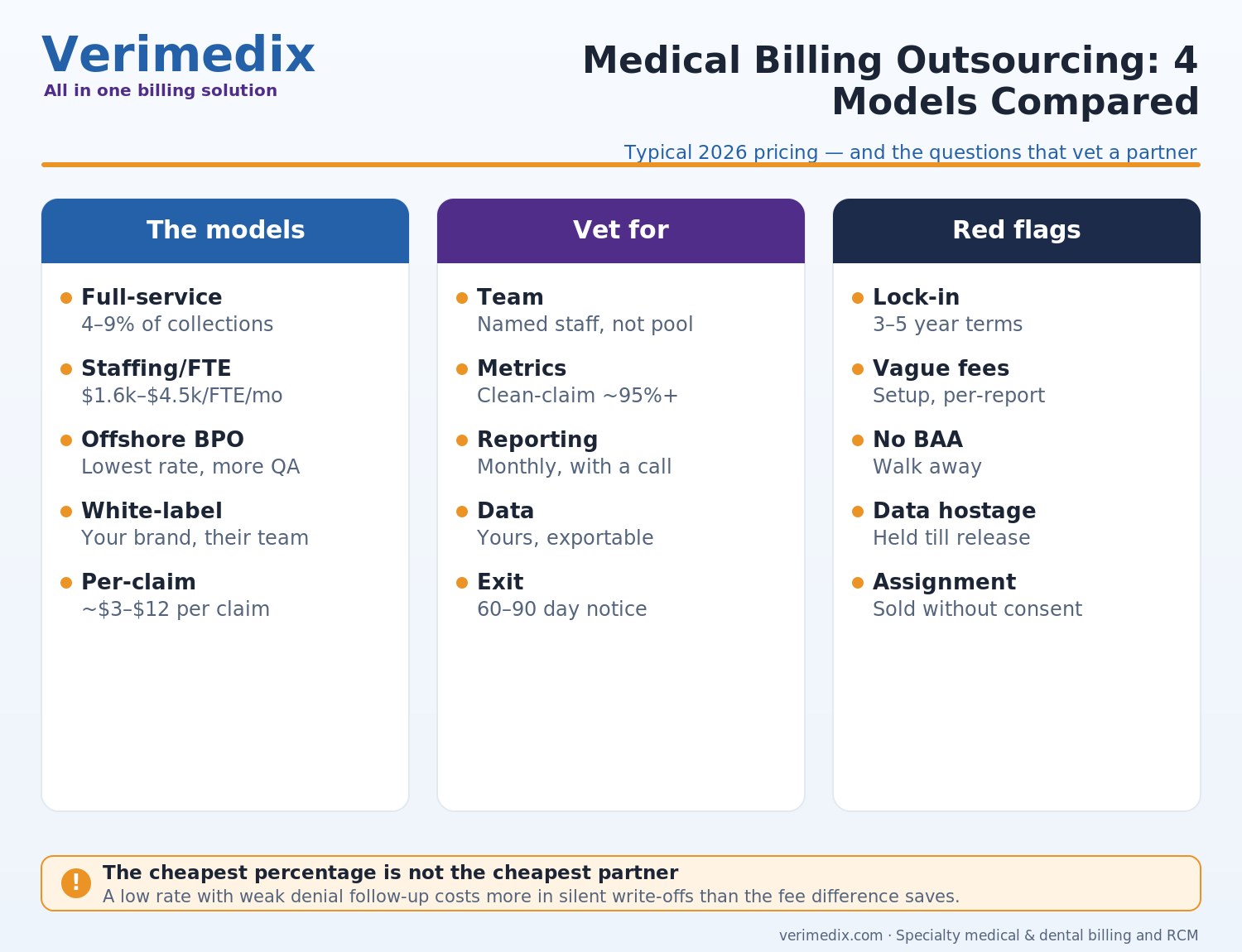
The four outsourcing models — and why the label matters
Shopping for a billing partner by company name is backwards; shop by model first. Two vendors with identical marketing can operate completely differently under the hood — one runs your claims through a shared offshore pool, the other assigns named billers who work only your account. Sorting candidates into these four buckets before comparing prices will save you from comparing things that are not comparable.
| Model | How it works | Typical pricing | Best fit | Main risk |
|---|---|---|---|---|
| Full-service RCM firm | Vendor owns the process end to end — charge entry through appeals — and reports results to you | 4–9% of collections | Practices that want billing fully off their plate | Black-box operations; small accounts get junior attention |
| Billing staffing / FTE | Vendor supplies dedicated billers who work inside your systems and workflows; you direct the work | ~$1,600–$4,500 per FTE/mo by region | Practices and billing companies with process knowledge but hiring gaps | You still carry management burden and QA |
| Offshore BPO | Large delivery centers (commonly India or the Philippines) process high volumes at the lowest labor rates | Lowest per-FTE or per-claim rates | High-volume groups with strong internal QA | Quality variance, oversight load, communication lag |
| White-label workforce | Dedicated, vendor-managed team operates under your practice or company brand — your name on calls, your systems, their recruiting and supervision | Per-FTE monthly, between staffing and full-service | Practices and billing companies that want scale without losing identity or control | Requires clear SOPs and a real onboarding period |
The fourth model is the newest and most misunderstood. White-label medical billing staffing means the vendor recruits, trains and manages your billers, but everything patient- and client-facing carries your brand — useful for practices that never want patients hearing a third-party name, and for billing companies that need capacity without subcontracting optics. We cover the concept in depth in what is white-label medical billing.
Pricing: what billing companies actually charge in 2026
Across published rate guides and vendor quotes, three fee structures dominate. Percentages and ranges below are typical market figures — treat them as negotiation context, not quotes. Staffing-model providers such as Verimedix occupy the fourth category: rather than taking over your billing under their own name, the White-Label Workforce model places dedicated, trained staff inside your existing systems and brand, typically starting at two resources.
| Fee structure | Typical 2026 range | How it behaves | Questions to ask |
|---|---|---|---|
| Percentage of collections | 4–9% of net collections; 5–7% most common for outpatient practices | Vendor earns more when you collect more; aligns incentives but taxes your growth | Percentage of what, exactly? Gross charges, net collections, or posted payments? Are patient payments included? |
| Per-claim flat fee | Roughly $3–$12 per claim by complexity and payer mix | Predictable per unit; vendor has no stake in whether the claim actually pays | What happens to rejected and denied claims — rebilled free or billed again? |
| Monthly retainer / per-FTE | From ~$1,000/mo for small practices; $1,600–$4,500 per dedicated FTE | Flat and budgetable; quality depends entirely on who is on your account | Named staff or shared pool? What is included — posting, denials, AR follow-up, reporting? |
One structural warning: percentage deals reward collecting the easy money. A vendor earning 5% of whatever comes in still profits if they let hard denials age into write-offs — you lose 100% of those claims while they lose 5%. Whatever the structure, tie the relationship to metrics (first-pass rate, denial overturn rate, days in AR) rather than trusting the fee model to align incentives on its own.
Worked example: percentage vs. dedicated team (illustrative)
Take a hypothetical three-provider practice collecting $150,000 per month:
- Full-service at 6% of collections: $9,000/month, or $108,000/year. Billing is fully outsourced; your staff role shrinks to oversight and escalations.
- Two dedicated white-label FTEs at ~$2,400 each: $4,800/month, or $57,600/year — plus roughly 4–6 hours a week of an in-house manager’s time to direct priorities.
- Break-even logic: the dedicated team saves about $50,000/year if your processes are sound. But if the full-service firm lifts net collections just 3% ($54,000/year) through better denial work than your directed team achieves, the models converge.
That is the honest trade: percentage models sell outcomes, staffing models sell capacity. Choose based on whether your practice has billing process knowledge worth keeping — figures above are illustrative, not quotes.
The 12-point vetting checklist
Put every finalist through the same interrogation. Their comfort answering is itself a signal.
| # | Question | What a good answer sounds like |
|---|---|---|
| 1 | Who exactly works my account? | Named team, credentials, location, and how many other accounts they carry |
| 2 | What is your first-pass clean-claim rate? | A number with a definition behind it — commonly 95%+ is cited as a healthy benchmark |
| 3 | How do you work denials? | Categorized by CARC, worked within days, appeal templates, root-cause reporting back to the practice |
| 4 | What reporting do I get, and when? | Monthly minimum: collections, AR aging, denial reasons, unbilled encounters — with a named review call |
| 5 | Do you know my specialty and payers? | References from practices your size in your specialty and state |
| 6 | Who owns my data? | You do — exportable, readable format, returned promptly at termination without conditions |
| 7 | What are the contract term and exit? | 6–12-month initial term, 60–90-day notice, no punitive termination fee |
| 8 | What is NOT included? | Clear list — credentialing, coding, patient statements, prior auth — with prices for each add-on |
| 9 | Where is the work performed? | Straight answer on onshore/offshore mix and how offshore quality is audited |
| 10 | What is your compliance posture? | BAA as standard, HIPAA training records, breach protocol, liability terms that do not carve out negligence |
| 11 | How does implementation work? | Written 60–90-day transition plan covering credentialing status, old AR, and system access |
| 12 | Why do clients leave you? | An honest answer. Everyone loses clients; vendors who claim otherwise are hiding churn |
Contract red flags that should end the conversation
Billing-contract disputes tend to trace back to a handful of clauses that were visible on day one. Multi-year lock-ins with steep early-termination fees top the list — reasonable market terms run 6–12 months with 60–90-day notice. Watch equally for: data held until final payment and a signed release; vague “additional services” pricing that turns reports and appeals into billable extras; liability caps that carve out HIPAA breaches and missed timely filing; assignment clauses letting the vendor transfer your contract in an acquisition without consent; and any hesitation about signing a BAA. If you are already stuck with one of these vendors, our guide on switching billing companies without losing revenue maps the exit.
How to shortlist: a practical sequence
First, pick your model using one question: do you want to keep billing knowledge in-house? If no — shortlist full-service firms and judge them on outcomes. If yes — shortlist staffing and white-label partners and judge them on people and management. Second, gather three to five candidates; our ranked review of the best medical billing companies in the USA for small practices is a working starting list, and the outsourced vs. in-house comparison helps if you have not yet committed to outsourcing at all. Third, run the 12-question vetting above, check two references each, and pilot with a defined 90-day scorecard: first-pass rate, denial turnaround, days in AR, and responsiveness. Structure also matters as you grow — see our guide to billing team structure, roles and ratios for what the staffing math should look like at your size, and outsourcing medical coding if the coding side is the actual bottleneck.
Quick Answers
How much do medical billing outsourcing companies charge? Most full-service firms charge 4–9% of monthly collections, with competitive quotes typically at 5–7%. Per-claim pricing runs roughly $3–$12, and dedicated-staff models run about $1,600–$4,500 per biller per month depending on region.
What are the main types of medical billing outsourcing? Four models: full-service RCM (vendor owns the process), staffing/FTE (dedicated billers work under your direction), offshore BPO (lowest-cost high-volume processing), and white-label workforce (a managed team operating under your brand).
What is a white-label billing company? A provider that builds and manages a dedicated billing team that presents as your own staff — your brand on calls and correspondence, your systems, the vendor’s recruiting, training and supervision.
What contract terms are reasonable? A 6–12-month initial term, 60–90-day termination notice, no punitive exit fee, explicit data ownership with prompt return, and a signed BAA. Three-to-five-year lock-ins are a red flag.
Is outsourcing billing worth it for a small practice? Often, yes — when billing staff turnover, denial backlogs or unbilled encounters are costing more than a vendor fee would. Run the percentage-vs-FTE math on your own collections before deciding; the break-even shifts with practice size.
Frequently asked questions
Most full-service firms charge 4–9% of net monthly collections, with competitive outpatient quotes usually landing between 5% and 7%. Always pin down the base: net collections is standard, and patient payments, refunds and old-AR recoveries should be explicitly addressed in the definition.
Full-service means the vendor owns and manages the entire billing process and reports results; staffing means the vendor supplies dedicated billers who work inside your systems under your direction. Full-service buys outcomes; staffing buys capacity while you keep control of the process.
With white-label staffing, the team is dedicated to you and presents under your practice or company name — patients and clients never hear a third-party brand. The vendor still handles recruiting, HIPAA training and supervision, which is what separates it from simply hiring remote contractors.
Plan for 60–90 days. A serious vendor provides a written transition plan covering system access, payer portal setup, work-in-progress claims, and who owns the old AR. Rushed cutovers with no plan for in-flight claims are a leading cause of revenue dips after switching.
Negotiate it explicitly. Many firms either decline legacy AR, work it at a higher percentage, or quote a one-time cleanup project. Leaving old AR unassigned is the worst outcome — it quietly ages past timely filing limits while both sides assume the other is working it.