
- Laboratory billing services manage the accession-to-cash cycle: order and ABN capture, eligibility, coding, claim submission, denial appeals, and both client billing and third-party billing streams.
- Lab billing fees typically run lower than physician billing on a percentage basis — published ranges cluster around 3–6% of collections — because labs are high-volume, low-ticket operations.
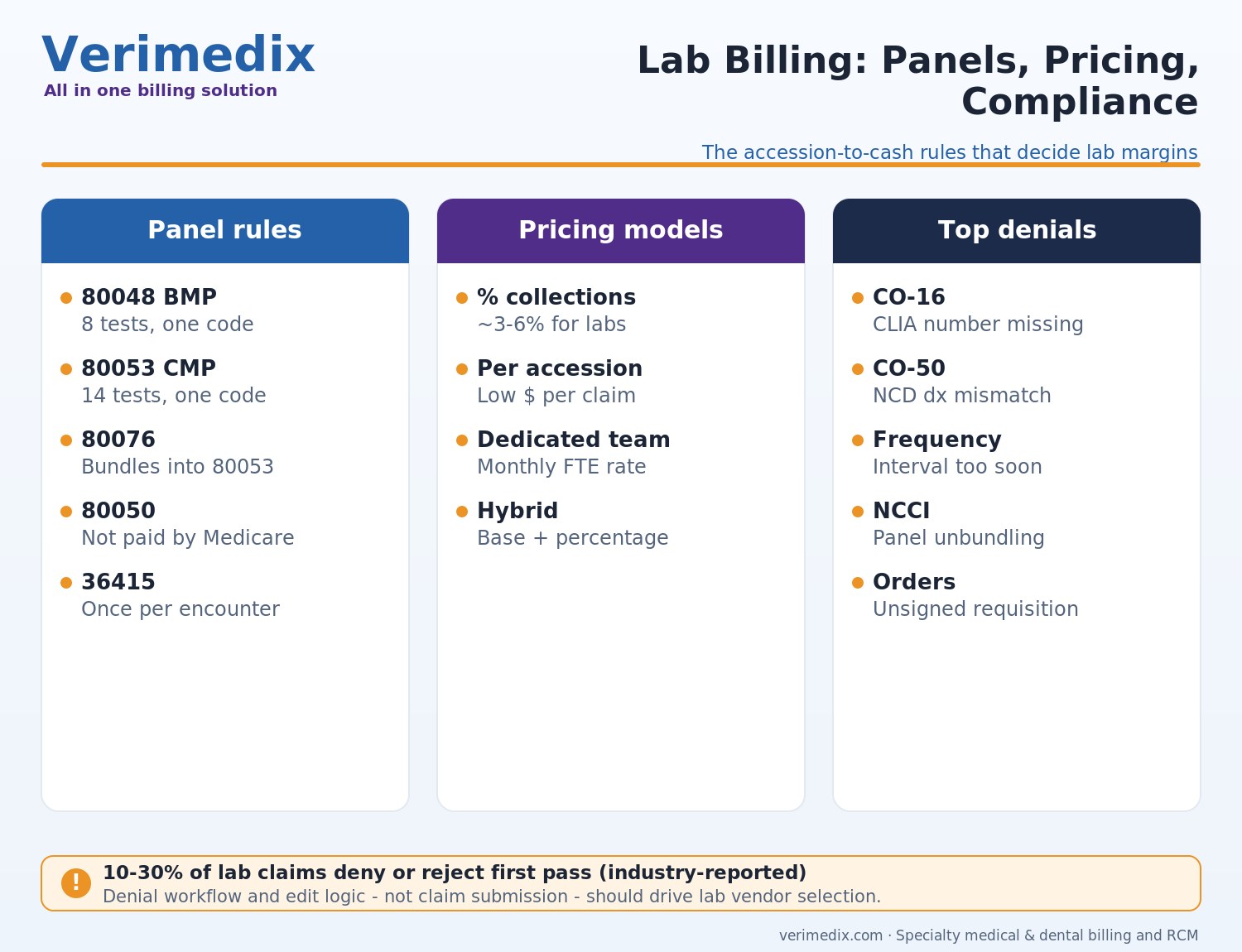
- Panel bundling is non-negotiable: when all components of 80048 (8 tests) or 80053 (14 tests) are performed together, bill the panel code — billing components separately triggers NCCI unbundling denials.
- Medicare pays labs under the Clinical Laboratory Fee Schedule (CLFS), with PAMA-based rates; scheduled reductions of up to 15% were paused into early 2026, so verify current rates before projecting revenue.
- A missing or mismatched CLIA number is one of the most preventable lab denials — the performing lab's CLIA certificate must be on the claim, with modifier QW for waived tests.
- Industry sources report first-pass lab claim denial and rejection rates of roughly 10–30%, which is why denial workflow — not just claim submission — should drive vendor selection.
What the fee actually covers, stage by stage
A clinical lab does not bill the way a physician office bills. Each specimen becomes an accession, each accession can carry multiple CPT codes, and reimbursement per test is often measured in single or low double digits — so the entire economics of clinical laboratory billing services depend on getting thousands of small claims right the first time. A competent lab billing service owns that pipeline end to end, across both insurance claims and client-bill invoices to referring practices and facilities.
| Cycle stage | What the service does | Why it matters for labs |
|---|---|---|
| Front end | Order and requisition capture, signed-order verification, eligibility checks, ABN handling for Medicare-limited tests | Missing orders and absent ABNs become unbillable tests, not just denials |
| Coding & charge entry | CPT/HCPCS assignment, panel vs component logic, diagnosis linkage to support medical necessity | Panels, NCDs and frequency rules make lab coding rule-dense despite low code counts |
| Claims & clearinghouse | Batch submission, CLIA number placement, QW modifier logic, rejection work | Volume means one systematic error repeats hundreds of times per week |
| Denials & AR | Denial categorization, appeals, payer-specific bundling disputes, insurance AR follow-up | With 10–30% first-pass denial/rejection rates reported industry-wide, this is where revenue is won |
| Client billing | Monthly invoicing to referring practices, fee schedule maintenance, reconciliation | Many labs run dual revenue streams; services must handle both cleanly |
| Compliance | CLIA certificate tracking, payer enrollment, audit support, anti-markup and state direct-bill rule awareness | Lab billing sits under heavier regulatory scrutiny than most specialties |
Fee models and what each one really costs
Because a lab claim might be worth $15 and a physician claim $150, percentage pricing for labs sits below the 4–9% commonly quoted for practice billing. Published laboratory billing ranges cluster around 3–6% of collections, with per-claim and dedicated-team pricing as alternatives. Treat every figure below as an illustrative industry range, not a quote. Lab billing rewards specialization: full-service partners such as Verimedix maintain payer-specific panel edits and CLIA/QW scrubbing as part of routine claim preparation, which is where most component-bundling denials are prevented.
| Model | Typical published range | Best fit | Watch for |
|---|---|---|---|
| Percentage of collections | ~3–6% for labs | Labs with variable volume; aligns vendor incentive with collections | How "collections" is defined — does it include client-bill revenue you largely generate yourself? |
| Per-claim / per-accession | Low single dollars per claim, varying widely by payer mix and test menu | High-volume labs with clean referral data | Fees accrue on denied claims too unless the contract says otherwise |
| Dedicated team / FTE | Monthly rate per biller or team | Larger reference labs wanting control and continuity | You manage productivity; ask for lab-specific experience, not generalists |
| Hybrid (base + %) | Negotiated | Labs adding new lines (toxicology, molecular, pathology) | Model complexity can hide effective cost — always compute the blended percentage |
Panel bundling rules: 80048, 80053 and the CBC
Organ- and disease-oriented panel codes exist precisely so labs cannot bill each analyte separately when tests are run together. The AMA CPT panel definitions and the NCCI edits enforce the same principle from two directions: if every component of a panel was performed on the same date from the same encounter, report the panel code — once.
| Code | Panel | Components | Bundling rule to remember |
|---|---|---|---|
| 80048 | Basic metabolic panel (BMP, total calcium) | 8 tests: glucose, BUN, creatinine, sodium, potassium, chloride, CO2, calcium | All 8 components are inside 80053 — 80048 is never billed alongside a CMP for the same encounter |
| 80053 | Comprehensive metabolic panel (CMP) | 14 tests: the BMP analytes plus albumin, total protein, ALP, ALT, AST, total bilirubin | Billing components next to 80053 is unbundling; NCCI edits reject it |
| 80076 | Hepatic function panel | 7 liver-related tests | Bundled into 80053 under NCCI — the CMP already contains the liver analytes |
| 85025 / 85027 | CBC with / without automated differential | Hemogram components | Report one CBC code per encounter; the differential is not separately billable with 85025 |
| 80050 | General health panel (CMP + CBC + TSH) | Composite panel | Not recognized for Medicare payment — report the constituent panels instead, per CMS policy |
Two adjacent traps are worth flagging. First, upcoding by panel: ordering a CMP when only a BMP was clinically indicated invites medical-necessity denials, because the liver components need supporting diagnoses. Second, the blood draw itself: venipuncture is reported with 36415 once per encounter regardless of tubes drawn, Medicare prices it at only a few dollars under the CLFS, and several commercial payers bundle it into the test payment entirely — our CPT 36415 venipuncture guide covers which payers pay and which do not.
CLFS pricing, PAMA and CLIA compliance
Medicare pays most lab tests under the Clinical Laboratory Fee Schedule rather than the Physician Fee Schedule. Under PAMA, CLFS rates are derived from weighted-median private payer rates that labs report to CMS. Phased reductions of up to 15% for hundreds of tests have been repeatedly delayed by Congress — most recently paused into early 2026 per the CMS annual CLFS update — so any revenue projection should be checked against the current quarterly CLFS file, not last year's rates.
Compliance is the other half of lab billing. Every claim must carry the CLIA certificate number of the laboratory that actually performed the test (Item 23 on the CMS-1500). Labs holding only a Certificate of Waiver or PPMP certificate must append modifier QW to tests on the CMS waived list, or the claim will deny. Certificate scope matters too: performing moderate-complexity testing on a waiver certificate is a compliance problem, not just a billing error. A good billing partner tracks certificate type, expiration, and test-menu alignment as part of routine claim scrubbing.
The lab denial table: causes and fixes
| Denial pattern | Common trigger | Fix |
|---|---|---|
| CO-16 (missing information) | CLIA number absent or wrong performing-lab CLIA on the claim | Resubmit with valid CLIA in Item 23; scrub claims against certificate database — see our CO-16 denial guide |
| Medical necessity (CO-50) | Diagnosis does not support the test under an NCD/LCD — Medicare maintains lab NCDs for high-volume tests | Map orderable tests to covered ICD-10 lists; obtain ABNs when coverage is doubtful |
| Frequency limits | Test repeated sooner than the payer's allowed interval | Front-end frequency checking; ABN for Medicare when the patient wants the test anyway |
| Unbundling / NCCI | Panel components billed separately, or 80076 with 80053 | Automated panel-rollup logic in charge entry |
| Missing signed order | Requisition unsigned or documentation unavailable at audit | Order-capture workflow with e-signature chase before claim release |
| MUE unit denials | 36415 billed more than once, or units exceeding medically unlikely edits | Unit edits at scrubber level; appeal only with documentation of distinct encounters |
A worked example: what a 6% denial gap costs (illustrative)
Take a regional lab processing 6,000 accessions a month at an average reimbursement of $28 per accession — $168,000 in monthly billed value. At a 14% unresolved denial/rejection rate, $23,520 per month stalls or dies in AR. A billing partner that drives that to 6% through CLIA scrubbing, panel logic and NCD mapping recovers roughly $13,440 per month. Against a 4%-of-collections fee on, say, $150,000 collected (about $6,000), the lab nets around $7,400 monthly — before counting staff time saved. These numbers are illustrative only; run the same arithmetic on your own denial report before signing anything.
A 10-point scorecard before you sign a quote
Use this as a scorecard — one point each, and treat anything under 8 as a no.
- Names lab clients (reference, physician-office, toxicology or pathology) it currently serves, with references.
- Explains its panel-rollup and NCCI edit logic without hand-waving.
- Tracks CLIA certificates and QW-modifier logic systematically.
- Maps your test menu to Medicare lab NCDs and MAC frequency rules.
- Handles both third-party claims and client billing, with reconciliation.
- Reports first-pass clean claim rate, denial rate by reason, and days in AR monthly.
- Defines what "collections" its fee applies to — in writing.
- Commits to appeal timelines, not just resubmission.
- Supports your LIS/billing system integration rather than forcing a platform switch.
- Offers clean exit terms with full data return.
For the broader build-vs-buy decision — including when in-house staffing beats any vendor — see our guide to outsourcing medical billing services.
For a focused panel-code workflow, see our guide to CPT 80053 before you build your lab billing edits.
Quick Answers
What is included in a lab billing fee? A full-scope partner manages lab revenue from accession to payment: order and eligibility capture, CPT/panel coding, claim submission with CLIA data, denial appeals, insurance AR follow-up, and client-bill invoicing to referring providers.
How much do lab billing services cost? Published ranges cluster around 3–6% of collections — below typical physician billing percentages — with per-claim and dedicated-team pricing as alternatives. Scope, payer mix and volume move the number.
What is the panel bundling rule? When all components of a defined panel such as 80048 (8 tests) or 80053 (14 tests) are performed together, bill the panel code once. Billing components separately is unbundling and NCCI edits deny it.
Why do lab claims deny for CLIA? Every claim must carry the performing lab's CLIA certificate number, and waived tests need modifier QW when performed under a Certificate of Waiver. Missing either commonly returns a CO-16 denial.
What is the CLFS? The Clinical Laboratory Fee Schedule is how Medicare Part B prices most lab tests, using PAMA private-payer-rate data. Scheduled cuts of up to 15% were paused into early 2026, so always check the current quarterly file.
Frequently asked questions
No. When all components of a CPT-defined panel are performed on the same date for the same encounter, the panel code must be reported. NCCI edits deny component-level unbundling, and a pattern of it invites payer audit exposure rather than extra revenue.
The claim typically denies or rejects — often as CO-16 for missing information — because Medicare and most payers require the performing laboratory's CLIA certificate number on the claim. The fix is resubmission with the valid CLIA number, but the real fix is scrubbing every claim against your certificate data before release.
The good ones do. Many labs invoice referring practices directly for some work while billing insurers for the rest, and those streams need separate fee schedules, invoicing cadence and reconciliation. Confirm both are in scope — and whether the vendor's percentage fee applies to client-bill revenue.
Volume and ticket size. A lab may process tens of thousands of low-dollar claims where a practice bills fewer, larger ones, so percentage pricing scales down — published lab ranges sit around 3-6% of collections versus the 4-9% often quoted for practice billing. The workload per dollar collected is simply different.
CMS maintains National Coverage Determinations for a set of high-volume lab tests that define which ICD-10 codes support medical necessity. Claims for those tests deny when the ordering diagnosis is not on the covered list, so billing teams map test menus to NCD diagnosis lists and use ABNs when Medicare coverage is doubtful.