
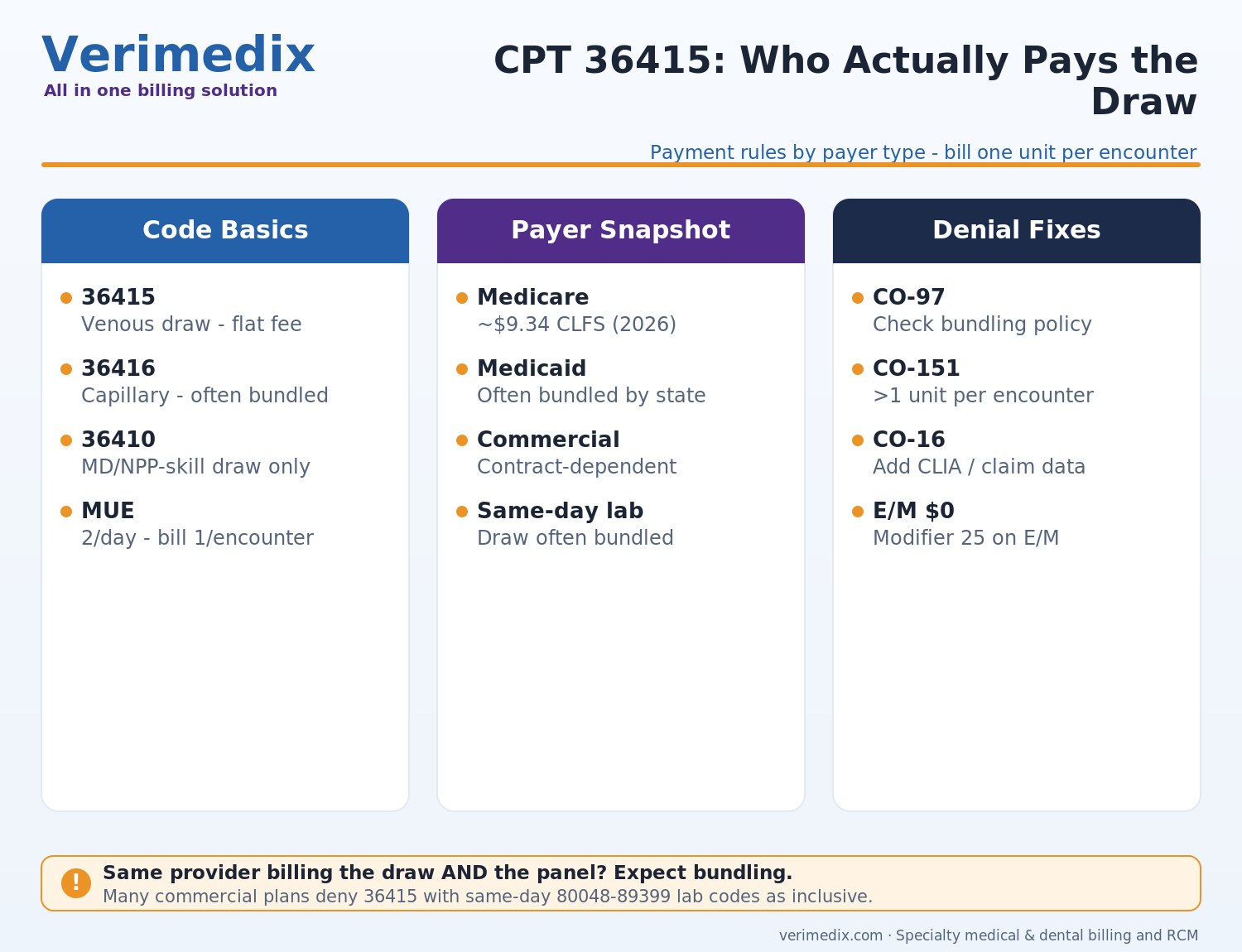
- CPT 36415 (collection of venous blood by venipuncture) pays a flat specimen-collection fee — roughly $9.34 nationally on the 2026 Medicare Clinical Laboratory Fee Schedule, with no patient deductible or coinsurance.
- Medicare pays it under the CLFS, not the Physician Fee Schedule — 36415 carries no RVUs, and its MUE is 2 per day, but you should bill only 1 unit per encounter.
- Many commercial plans and state Medicaid programs bundle 36415 into same-day lab codes (80048–89399) or the E/M visit — the classic CO-97 denial.
- 36416 (capillary/finger stick) is generally not separately payable by Medicare; 36410 is reserved for draws requiring a physician's or NPP's skill.
- Whether to appeal a 36415 denial is a contract question: if the payer's published policy bundles it, appealing wastes more than the $3–$10 at stake.
- At routine draw volumes, correct 36415 billing is worth five figures a year — small code, real money.
What CPT 36415 is — and the codes around it
Code 36415 reports the routine collection of venous blood by venipuncture — the standard needle-and-tube blood draw a phlebotomist, nurse, or medical assistant performs dozens of times a day. It covers the draw itself, not the testing, and it is intentionally priced as a nominal specimen-collection fee. Because it looks trivial, practices tend to bill it on autopilot; because payers treat it inconsistently, autopilot produces a steady drip of denials. Neighboring codes are a frequent source of miscoding:
| Code | Describes | Payment reality (verify per payer) |
|---|---|---|
| 36415 | Routine venipuncture, venous blood | Flat CLFS fee from Medicare; bundled by many commercial/Medicaid plans |
| 36416 | Capillary specimen (finger, heel, ear stick) | Generally not separately payable by Medicare; most payers bundle it |
| 36410 | Venipuncture age 3+ requiring a physician's/NPP's skill (e.g., difficult access) | Payable when skill requirement is documented; not for routine draws |
| 99000 | Specimen handling/conveyance to an outside lab | Bundled by Medicare (status B); a few commercial plans allow small amounts |
| G0471 | Draw by a lab from an SNF/HHA patient | Medicare-specific; facility scenarios only |
One draw, one unit: bill 36415 once per encounter no matter how many tubes you fill or how many tests the sample feeds. Medicare's Medically Unlikely Edit allows 2 units per date of service only to accommodate two genuinely separate encounters on the same day, such as a morning fasting draw and an unplanned afternoon recheck.
How Medicare pays 36415
Medicare is actually the friendliest payer here. 36415 has status indicator X on the Physician Fee Schedule — no RVUs — because payment flows through the Clinical Laboratory Fee Schedule instead. After years at the long-standing $3.00 specimen-collection amount, CLFS updates raised the national rate to about $9.09 in 2025 and roughly $9.34 in 2026 (per the CLFS annual updates; confirm your MAC's current file). Two practical perks follow from CLFS payment: Part B lab services carry no deductible or coinsurance, so there is nothing to collect from the patient, and no modifier is normally needed on the 36415 line itself when billed with same-day E/M or lab services for Medicare.
Who bills it depends on who draws it. If your office draws the specimen and sends it to a reference lab that bills Medicare for the testing, your office bills 36415 for the draw and the lab bills the tests. If the patient walks to the lab's own draw station, the lab bills the collection — not you. Billing 36415 when you neither drew the blood nor incurred the cost is a small-dollar compliance problem that scales badly across thousands of claims.
Bundling with E/M visits and lab panels
Here is where 36415 earns its denial rate. Three distinct bundling scenarios get conflated:
1. With an E/M visit. Medicare pays 36415 alongside an office visit without special handling. Some commercial payers, though, run edits that treat the draw as part of the visit, and a few adjudicate better when modifier 25 is on the E/M line to mark it as significant and separately identifiable — a quirk worth knowing before you appeal a zero-paid visit (see our modifier 25 billing guide). When the E/M denies rather than the 36415, check line order and edits before assuming the visit itself was the problem.
2. With lab tests you also perform in-house. When the same provider bills both the draw and the tests, many commercial plans consider collection integral to the lab service. Published policies from payers such as Moda Health and Premera Blue Cross, for example, deny 36415 when billed with codes in the 80048–89399 range by the same provider on the same day. Under those contracts the denial is correct adjudication, not an error.
3. With a venipuncture-only visit. A blood-draw-only encounter supports 36415 alone — not 36415 plus a 99211 nurse visit, unless a separately documented, medically necessary evaluation actually occurred. Pairing 99211 with every draw is a well-known audit target across payers.
Payers that pay, bundle, or never pay 36415
| Payer type | Typical treatment of 36415 | What to do |
|---|---|---|
| Medicare Part B | Paid — CLFS flat fee (≈$9.34 in 2026), no cost-sharing | Bill 1 unit per encounter; no modifier needed on the line |
| Medicare Advantage | Usually mirrors Medicare, but plan edits vary | Confirm in the plan's reimbursement policy; appeal only if policy supports payment |
| State Medicaid | Frequently bundled into the lab or visit; several states never pay it separately | Check your state fee schedule once, then set a billing rule — do not rebill what the state has priced at $0 |
| Commercial (varies by contract) | Mixed — some pay $3–$10, others (e.g., Moda, Premera per published policies) bundle with same-day 80048–89399 labs | Pull each major payer's venipuncture policy; load bundling rules into your scrubber |
| Workers' comp / auto | State fee schedule dependent | Verify per jurisdiction before writing off |
The strategic point: 36415 is a code where "fight every denial" is the wrong policy. Build a payer matrix once, then let it decide — automatically — which denials are contractual (adjust and move on) and which are errors (rebill or appeal).
The CO-97 denial on 36415 — appeal or accept?
CO-97 ("the benefit for this service is included in the payment/allowance for another service") is the signature 36415 denial. Work it with a three-question triage. First, does the payer's published policy bundle venipuncture with the codes on this claim? If yes, the denial is correct — post the contractual adjustment and suppress future billing or expect the same result. If no, second question: did a claim edit misfire because of line sequencing, a missing modifier 25 on the E/M, or duplicate draw billing from the reference lab? Fix and resubmit as a corrected claim. Third: is the dollar volume material? Ten denied draws a week at $8 is roughly $4,000 a year — worth one systemic fix, never worth 500 individual appeals. Our CO-97 denial code guide walks through the general bundled-service playbook, including when a written appeal actually changes the outcome.
What 36415 is worth at volume (illustrative)
Take a primary care group that performs 20 draws a day, 250 days a year — 5,000 draws. Suppose the payer mix is 50% Medicare, 40% commercial, 10% Medicaid. Medicare: 2,500 draws × $9.34 ≈ $23,350, collected cleanly if billed once per encounter. Commercial: 2,000 draws at an illustrative $8 average allowable, but half fall under bundling policies → 1,000 × $8 = $8,000. Medicaid: mostly bundled, call it $500. Total: about $31,850 a year from a code many practices either forget to bill or burn AR time appealing where policy makes payment impossible. The two failure modes cost real money in opposite directions — underbilling leaves ~$30K uncollected; blind appealing spends staff hours chasing the unpayable ~40%. All figures are illustrative; your rates and mix will differ.
Bill-it-or-skip-it: a 36415 decision checklist
- Did your staff perform a venous draw? Capillary stick → 36416 (expect bundling). Lab's own draw station → you bill nothing.
- One encounter? Bill exactly 1 unit, regardless of tube count.
- Who runs the tests? Sent out → bill 36415 with the draw. In-house → check whether this payer bundles collection into 80048–89399.
- What does this payer's policy say? Payer pays → bill it. Payer bundles → still report it if the contract requires reporting, but post the adjustment without appeal.
- Physician-skill draw? Documented difficult access by MD/NPP → consider 36410, not 36415.
- Denial received? Run the CO-97 triage above before touching an appeal letter.
Quick Answers
What is CPT code 36415? Collection of venous blood by venipuncture — the routine blood draw. It pays a flat specimen-collection fee and is billed once per encounter, separately from the lab tests themselves.
How much does Medicare pay for 36415? About $9.34 nationally in 2026 under the Clinical Laboratory Fee Schedule (up from the long-standing $3 fee after recent CLFS updates), with no patient deductible or coinsurance.
Why was my 36415 denied as CO-97? The payer bundled the draw into another same-day service — most often lab codes 80048–89399 billed by the same provider, or the E/M visit. If the payer's published policy bundles it, the denial is contractual; adjust rather than appeal.
Can you bill 36415 with an E/M visit? Yes for Medicare with no special modifier on the 36415 line; some commercial plans bundle it or adjudicate better with modifier 25 on the E/M code, so check the payer policy.
Can you bill 36415 twice in one day? Only for two separate, medically necessary encounters — the MUE of 2 exists for that scenario. Multiple tubes or tests during one draw are still 1 unit.
Does 36415 need a CLIA number? The draw itself is not a test, but claims that include in-office lab testing need your CLIA certification details — missing CLIA data commonly triggers CO-16 rejections on the same claim.
Frequently asked questions
Yes. Medicare pays 36415 under the Clinical Laboratory Fee Schedule rather than the Physician Fee Schedule \u2014 the code carries no RVUs. The national rate is roughly $9.34 in 2026 per recent CLFS annual updates, and because it is a Part B lab benefit, no deductible or coinsurance applies to the patient.
Several state Medicaid programs price routine venipuncture at $0 or bundle it into the visit or lab payment, and a number of commercial payers \u2014 Moda Health and Premera Blue Cross among those with published policies \u2014 deny 36415 when the same provider bills same-day lab codes in the 80048\u201389399 range. Treatment varies by contract, so confirm each major payer's reimbursement policy rather than assuming.
Medicare does not require it \u2014 36415 and an E/M pay together normally. Some commercial payer edits, however, bundle the visit and the draw unless modifier 25 is on the E/M line showing a significant, separately identifiable service. If the E/M line zero-pays on a claim that included a draw, check that payer's edit logic before appealing the visit.
36415 is a routine draw performed by any trained staff member. 36410 applies when the venipuncture (age 3 or older) requires a physician's or qualified NPP's skill \u2014 documented difficult access, for example. Using 36410 for routine draws to capture its higher allowable is a compliance risk, not a billing strategy.
No. If the payer's published policy bundles venipuncture with the services on the claim, the denial is correct contractual adjudication and appeals are wasted labor on a sub-$10 line. Appeal or rebill only when the denial contradicts policy \u2014 wrong edit, duplicate lab billing, or missing modifier on the E/M \u2014 and fix root causes in your scrubber instead of touching claims one at a time.