
- CPT 80053 is the code to investigate for a comprehensive metabolic panel (CMP); AAPC describes the test as measuring 14 chemicals listed in the descriptor.
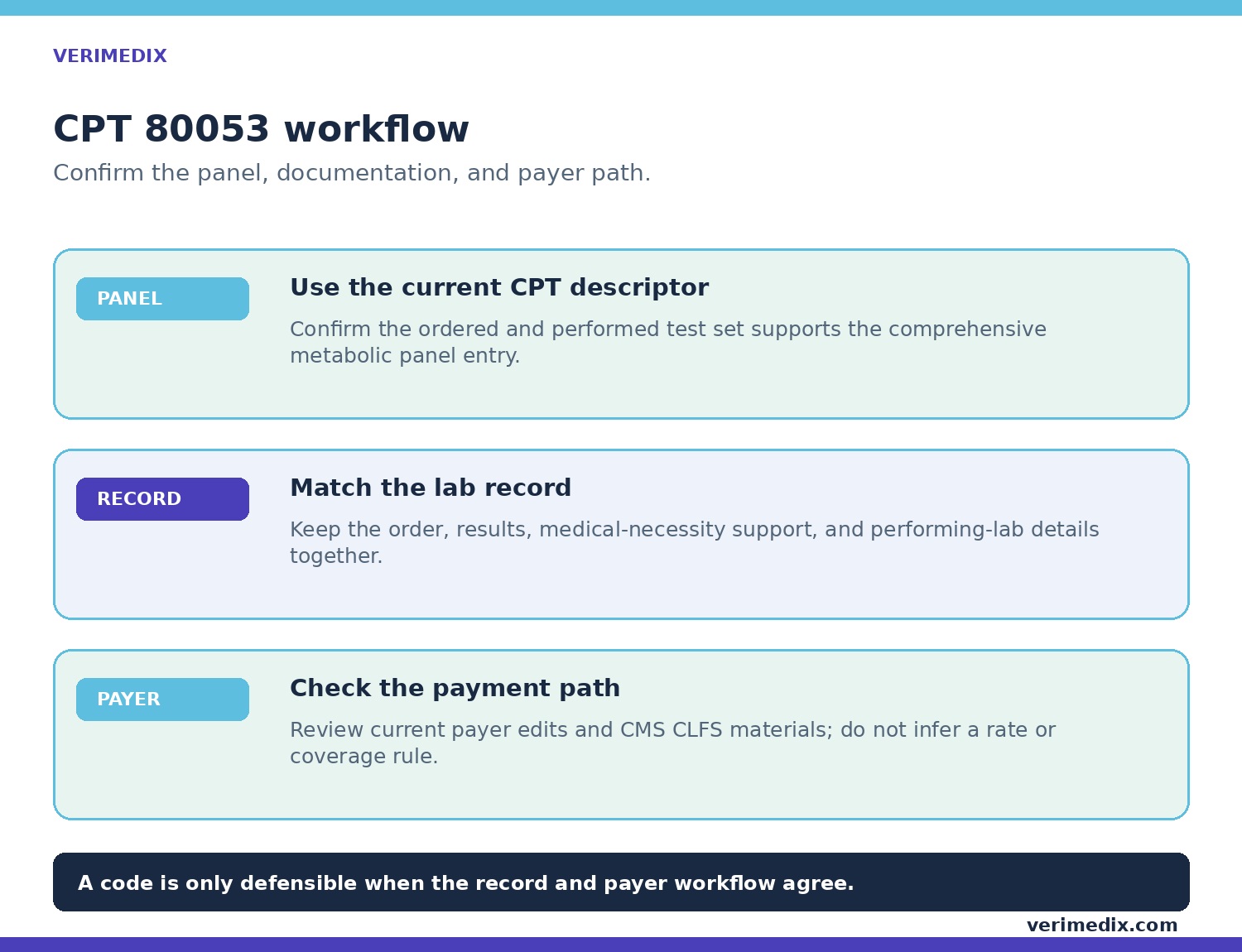
- Code selection must follow the current CPT descriptor and the tests actually ordered and performed—not the shorthand “CMP” label alone.
- Keep the order, results, medical-necessity support, performing-laboratory details, and payer-specific instructions together before claim submission.
- CMS says most clinical diagnostic laboratory tests are paid under the Clinical Laboratory Fee Schedule (CLFS), with rates and reporting cycles that change; do not reuse an old fee or universal coverage rule.
- Use current payer edits and claim history to control panel/component billing, diagnosis support, and repeat-test denials.
What is CPT 80053?
CPT 80053 is the laboratory billing code associated with a comprehensive metabolic panel. The AAPC code reference describes a CMP in which the lab analyst measures the blood level of 14 chemicals listed in the code descriptor. Because CPT content is maintained and licensed by the American Medical Association, use the current code-set reference available to your organization rather than relying on a copied descriptor or a search snippet.
The practical billing question is not simply whether an order says “CMP.” Confirm that the test set ordered and performed supports the current 80053 definition, that the claim’s diagnosis information supports medical necessity under the payer’s policy, and that the performing laboratory details are present when required. If the record does not support the code, pause the claim and resolve the mismatch instead of selecting a code from the expected payment amount.
What does the 80053 panel include?
Start with the current descriptor and the laboratory record. A panel code is not a shortcut for any group of chemistry tests that happens to be ordered together. Compare the order, accession or test record, and final results; then document the control that confirms the reported panel was actually performed.
| Check | What the biller should confirm | Why it matters |
|---|---|---|
| Descriptor | The current CPT 80053 entry and included test requirements | Code books and payer edits are version- and policy-sensitive |
| Performed work | The final laboratory record supports the ordered panel | An order alone does not prove the service was completed |
| Claim detail | Diagnosis, laboratory identifiers, date of service, and payer fields | Missing claim context can trigger rejection or medical-necessity review |
| Component review | Current payer edits before separately reporting related tests | Component billing can create duplicate or unbundling risk |
What documentation supports 80053?
A defensible 80053 claim connects the patient’s order to the work performed and the reason the payer should process it. The exact requirements vary by payer and setting, but a useful internal checklist includes:
- The ordering provider and order date.
- The date of service, accession or specimen reference, and performing laboratory.
- The final results or a retrievable result record showing the performed work.
- The diagnosis or clinical indication submitted under the payer’s current policy.
- Any CLIA or laboratory identification fields required by the claim workflow.
- A payer-specific edit or benefit check for repeat testing, frequency, and component handling.
Do not convert this checklist into a universal coverage promise. Medicare and commercial plans can apply different medical-necessity, frequency, diagnosis, and documentation rules. When a payer requests records, return the documentation that supports the actual service rather than a generic panel description.
How do payer rules and the CLFS affect 80053?
The CMS Clinical Laboratory Fee Schedule page explains that Medicare pays for most clinical diagnostic laboratory tests using the CLFS and updates payment rates through data-collection cycles. The page also notes that reporting periods and reduction caps can change by year. That is why a lab should check the current fee file and payer instructions for the date of service instead of copying a rate from an older article or contract.
For commercial plans, confirm the member’s benefits, the payer’s laboratory policy, network status, and any authorization or frequency edits that apply. The presence of a valid CPT code does not itself establish coverage or payment. Store the policy version or reference used in the claim review so a denial analyst can reproduce the decision.
How can a lab prevent 80053 denials?
Build a small pre-submission edit around the failure points that are visible in your own remittance data. Confirm the test record, diagnosis mapping, payer and network fields, laboratory identifiers, and any repeat-test or component edits. If a claim rejects, classify the response as a registration, eligibility, medical-necessity, coding, documentation, or payer-processing problem before resubmitting.
Trend 80053 denials by payer and root cause. A recurring diagnosis mismatch needs a provider-query or coding rule; a missing laboratory field needs a claim scrubber edit; a frequency denial needs an eligibility or prior-claim check. This is more reliable than changing the code to a nearby chemistry entry without confirming the actual service.
For the operational side of this workflow, compare Verimedix's laboratory billing services pricing guide and medical coding outsourcing controls before you assign panel edits to a vendor.
Frequently asked questions
CPT 80053 is the code to investigate for a comprehensive metabolic panel. The current CPT descriptor and the laboratory record must support the code before claim submission.
AAPC describes the comprehensive metabolic panel as measuring 14 chemicals listed in the code descriptor. Confirm the current licensed CPT reference and the actual performed work for the date of service.
Medicare payment and coverage depend on current CLFS materials, medical-necessity requirements, diagnosis support, and claim facts. A valid code alone does not guarantee payment.
Do not assume component reporting is appropriate. Review the current CPT guidance, payer edits, and the tests actually performed before separately reporting related services.
Keep the order, date of service, performed-test record or results, diagnosis support, performing-laboratory details, and payer-specific documentation together. Requirements vary by payer.