
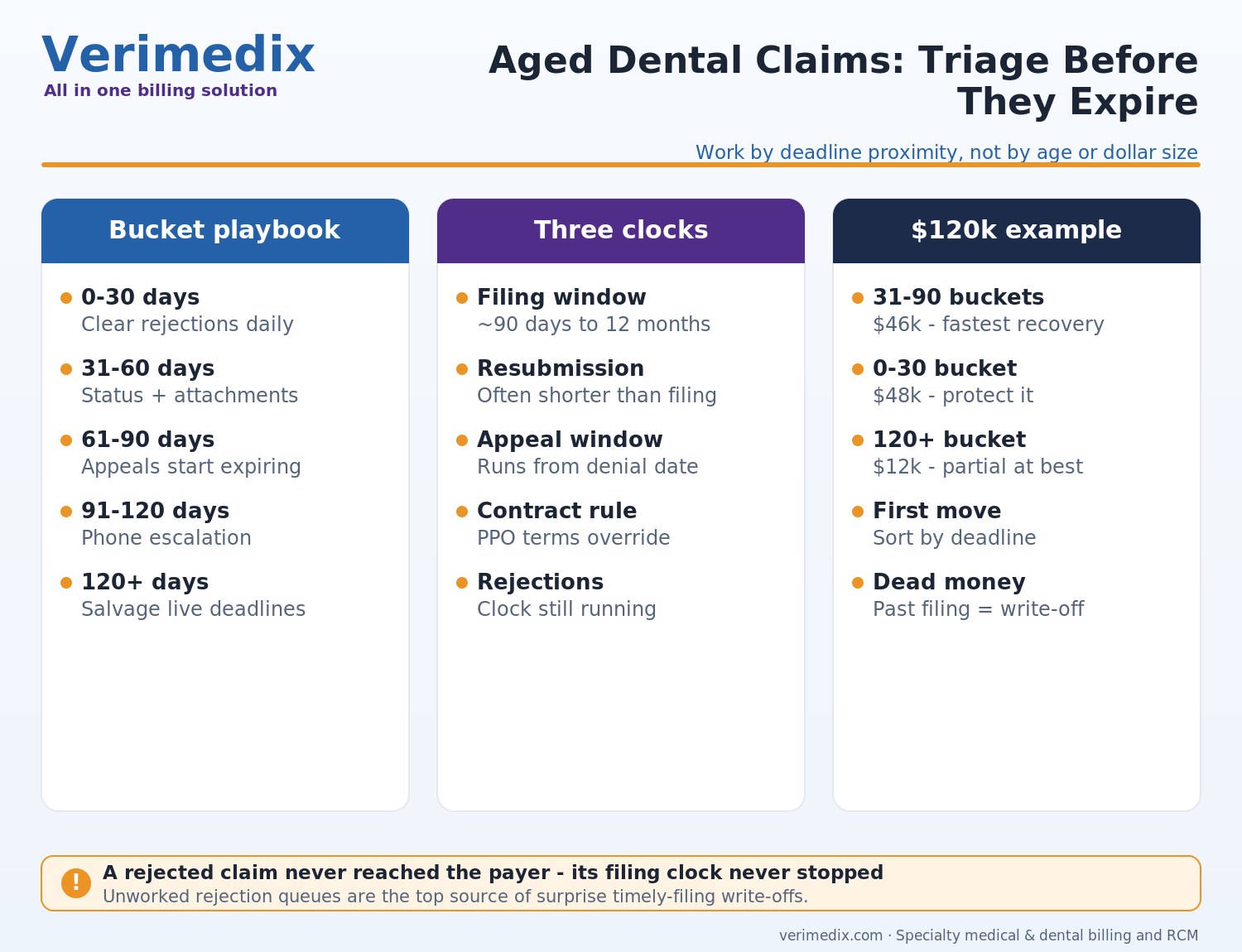
- Aging buckets are not equally valuable: a 45-day claim with a 90-day filing limit is more urgent than a 100-day claim with a 12-month limit. Triage by deadline proximity, not just age.
- Dental timely-filing windows range roughly from 90 days to 12 months depending on the payer and your PPO contract — and resubmission or appeal windows are usually shorter than the original filing window.
- Collectability falls sharply as claims age; industry AR guidance consistently treats the 90-day mark as the point where recovery gets materially harder and more manual.
- Denied and rejected claims are different: a clearinghouse rejection was never received by the payer, so its filing clock is still running silently.
- Set recovery expectations cautiously — a cleanup project typically recovers a meaningful share of 60–120 day claims but far less of 120+–day balances, and anything past timely filing is usually a write-off.
- Outsource cleanup when your team cannot work the backlog and keep new claims clean at the same time — running both with the same understaffed team is how backlogs regrow.
Why dental AR ages in the first place
An insurance aging report never gets ugly overnight. It gets ugly one unworked claim at a time: a claim that needed an attachment nobody sent, a rejection that sat in the clearinghouse queue, a request for narrative that was never answered, an EOB posted without anyone noticing the underpayment. By the time the 90+ column is a five-figure number, the practice is usually short-staffed, and the person who knows the history of those claims may have already left.
Recovery work is therefore different from day-to-day billing. Daily billing is a production line; AR recovery is detective work — each aged claim has a specific reason it stalled, and the fix depends on the reason. This article covers the triage system; for the prevention side (keeping AR from aging again), see our guide to reducing dental AR aging and the fundamentals of days in AR.
Triage by aging bucket: what each bucket really means
Standard aging reports group claims at 0–30, 31–60, 61–90, 91–120 and 120+ days. Here is how to read each bucket as a recovery worklist, with the caution that every payer clock is contract-specific:
| Bucket | What it usually contains | Recovery action | Urgency logic |
|---|---|---|---|
| 0–30 days | Normal in-process claims + early rejections | Work clearinghouse rejections daily; confirm receipt of high-dollar claims | Rejections here are silent clock-runners — the payer never received them |
| 31–60 days | Stalled claims: attachment requests, narratives, pended review | Status every claim with no response by day 30; answer information requests same-week | Cheapest bucket to recover; most claims just need a nudge or a document |
| 61–90 days | Denials needing appeal, COB problems, lost claims | Pull EOBs, categorize denial reasons, file corrected claims and appeals | Appeal windows (often 90–180 days from denial) start expiring here |
| 91–120 days | Complex denials, underpayments, secondary claims | Escalate by phone with reference numbers; involve the payer’s provider relations if stuck | Short-window payers (90-day contracts) are already unappealable for resubmission |
| 120+ days | True problem claims + inevitable write-offs | Triage hardest: recover what has a live deadline, document and write off what does not | Working dead claims here steals time from recoverable ones |
The counterintuitive rule: the 31–90 day buckets usually return more dollars per staff-hour than the 120+ bucket, even though the old bucket looks scarier on the report. A disciplined recovery project starts where money is still fully alive.
The timely-filing race: deadlines you are actually working against
Every aged claim carries up to three separate clocks: the original filing window, the corrected-claim/resubmission window, and the appeal window after a denial. Dental payer filing limits commonly range from 90 days to 12 months from the date of service, and your PPO participation contract can set a different (often shorter) limit than the payer’s published default — the contract controls. Resubmission and appeal windows are frequently shorter than the original filing window, which is why a claim can still be “in time” for filing but already out of time for appeal.
Three operational rules keep you ahead of the clocks:
- Map every payer’s limits once. Build a one-page grid of filing, resubmission and appeal windows for your top 10–15 payers from contracts and provider manuals, and keep it where the AR team works. Our reference on timely filing limits by payer is a starting point — verify against your own contracts.
- Alarm at 50% of the clock. A claim with no payer response at half its filing window gets a phone call, not another electronic status check.
- Treat rejections as unfiled claims. A rejected claim never reached the payer, so it earns no timely-filing protection. Rejection queues are the single most common source of “mystery” timely-filing write-offs.
What recovery rates are realistic?
Be skeptical of anyone quoting a precise universal recovery percentage — recoverability depends on why the claims aged, the payer mix, and how many deadlines have already passed. What can be said cautiously: claims inside 90 days that stalled for administrative reasons (missing attachments, unanswered requests, unworked rejections) recover at high rates because nothing is actually wrong with them; denied claims inside their appeal windows recover at moderate rates depending on denial type; and balances past 120 days recover at progressively lower rates, with anything past its timely-filing limit effectively unrecoverable except through goodwill or proof-of-filing appeals. A vendor promising to recover “90% of your old AR” without seeing an aging report is guessing; a credible one will sample your AR first and give you a bucketed estimate.
Worked example: triaging a $120,000 insurance AR (illustrative)
Suppose a two-doctor practice has $120,000 in outstanding insurance claims distributed like this — all figures illustrative:
| Bucket | Balance | Realistic posture | Recovery focus |
|---|---|---|---|
| 0–30 days | $48,000 | Mostly fine — protect it | Clear rejections; confirm receipt of claims over $1,000 |
| 31–60 days | $27,000 | Highly recoverable | Status calls + attachments; most pays with one touch |
| 61–90 days | $19,000 | Recoverable with appeals | Categorize denials; corrected claims and appeals this week |
| 91–120 days | $14,000 | Partially recoverable | Phone escalation; check which payer clocks are still live |
| 120+ days | $12,000 | Salvage what has live deadlines | Proof-of-filing appeals where evidence exists; document write-offs |
The triage insight: roughly $46,000 (the 31–90 buckets) is where focused effort converts fastest, while the $12,000 in 120+ — the bucket everyone stares at — may realistically yield only a fraction. A team that spends its first two weeks on the old bucket instead of the middle buckets lets live claims age into the next bucket while chasing partially dead ones.
A recovery workflow that does not regrow the backlog
Use this five-step loop for the cleanup project itself:
- Snapshot and sort. Export the full insurance aging, then sort by deadline proximity (days remaining on the shortest applicable clock), then by dollar value within that.
- Batch by payer, not by patient. One call or portal session can status 10–20 claims with the same payer; patient-by-patient working wastes hours on hold.
- Categorize every stalled claim into one of five causes: never received, needs information, denied — appealable, underpaid, or past deadline. Each category has one standard play.
- Fix the leak while you mop. Every recovered claim’s root cause feeds a prevention fix — the same discipline that clears a medical billing AR backlog applies to dental: cleanup without process change guarantees a repeat project next year.
- Write off with documentation. Dead balances need a documented reason and, where contractual, cannot be shifted to patients — clean books beat inflated AR that flatters nobody.
When to outsource the cleanup
Outsourcing AR recovery makes sense in three situations: the backlog is large relative to team capacity (a common trigger is insurance AR over 90 days exceeding roughly a quarter of monthly production), the people who created the backlog are gone and nobody knows the claim histories, or every hour spent on old claims is visibly degrading new-claim quality. Cleanup projects are often priced as a percentage of recovered dollars or a fixed project fee — both align better with your interests than hourly billing for this work. A good partner will also hand you a root-cause report at the end, not just checks. Full-cycle dental RCM services typically fold cleanup into onboarding, and our overview of the most common dental claim denials covers the denial categories your recovery team will meet most. Practices that can't spare internal staff for cleanup work often bring in dedicated AR capacity: Verimedix, for example, places aging-focused dental billing specialists who work claims inside the practice's own systems until the backlog clears.
Quick Answers
What is dental AR recovery? It is the systematic follow-up, correction, appeal and collection of dental insurance claims and patient balances that have aged past normal payment timelines — typically anything over 30–60 days — before payer filing and appeal deadlines expire.
Which aged dental claims should be worked first? The ones closest to a live deadline — timely filing, resubmission or appeal — not simply the oldest or largest. A 45-day claim with a 90-day contract limit outranks a 100-day claim with a 12-month limit.
How long do dental practices have to file insurance claims? Commonly between 90 days and 12 months from the date of service depending on the payer, and PPO contracts can impose shorter limits than published defaults. Appeal windows after a denial are usually shorter still.
What percentage of aged dental AR is recoverable? There is no honest universal number. Administrative stalls inside 90 days recover at high rates; appealable denials at moderate rates; 120+–day balances at much lower rates; and claims past timely filing are generally write-offs unless you can prove original timely submission.
When should a practice outsource AR cleanup? When the backlog exceeds what your team can work without neglecting new claims — a practical signal is 90+–day insurance AR above roughly 25% of monthly production, or a backlog created by departed staff whose claim knowledge left with them.
Frequently asked questions
A rejected claim failed clearinghouse or payer front-end edits and was never processed — the payer has no record of it, and its timely-filing clock is still running. A denied claim was received and adjudicated with a no-pay decision, which starts an appeal window. Rejections are fixed and resubmitted; denials are corrected or appealed.
Generally not if you are in-network — most PPO participation agreements make timely-filing losses a provider write-off that cannot be shifted to the patient. Out-of-network situations can differ. Check your contract language before ever balance-billing a filing miss.
Review the full insurance aging at least weekly, and work clearinghouse rejections daily. Any claim with no payer response by day 30 should get an active status inquiry, and claims at half of their filing window deserve a phone call rather than another electronic check.
Yes. Secondary filing clocks typically run from the primary payer's EOB date rather than the date of service, so a slow primary can quietly compress your secondary window. Post primary EOBs promptly and release secondary claims the same week to protect that clock.
Three things: a bucketed recoverability estimate before the project starts, regular reporting of what was recovered versus written off and why, and a root-cause summary at the end showing which process failures created the backlog — so you can fix intake, rejections and follow-up rather than repeat the cleanup next year.