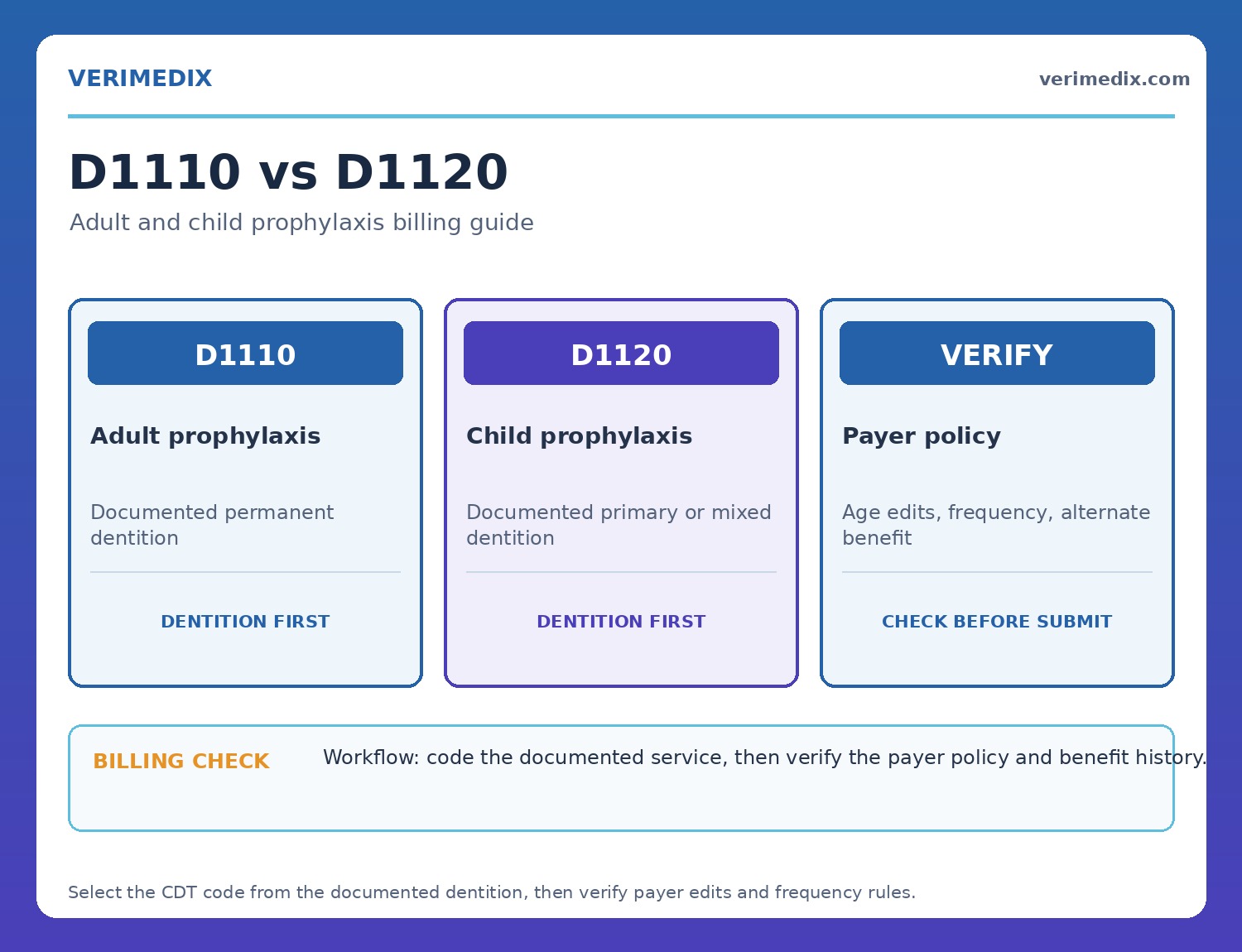
- D1110 (adult) and D1120 (child) prophylaxis are selected by the patient's dentition type, not chronological age — a key ADA distinction.
- Insurance plans set their own age cutoffs and will remap D1110 to D1120 for younger patients, paying the lower child rate.
- Code for clinical reality, then attach an alternate-benefit narrative — never reverse-code to D1120 just to avoid a remap.
- Do not confuse preventive prophylaxis with D4910 periodontal maintenance; using D1110 when D4910 applies is a compliance risk.
- Verify each payer's frequency interval (calendar year vs. benefit year vs. 181-day rule) during eligibility to prevent denials.
The confusion is not random. It stems from a mismatch between how dental insurance plans define "adult" and "child" (by age) and how the ADA defines the same terms (by dentition). Understanding that gap is the entire ballgame.
What the ADA Actually Says
According to the 2026 ADA CDT Code set, the definitions are as follows:
D1110 – Adult Prophylaxis: Removal of plaque, calculus, and stains from the tooth structures and implants in the permanent and transitional dentition. It is intended to control local irritational factors.
D1120 – Child Prophylaxis: Removal of plaque, calculus, and stains from the tooth structures and implants in the primary or transitional dentition. It is intended to control local irritational factors.
The operative phrase is dentition type — not the patient's age. A 9-year-old with a full permanent dentition is correctly coded as D1110. A 14-year-old who still has primary teeth in transitional dentition may be correctly coded as D1120. Chronological age is not the determining factor for code selection.
This is codified in the ADA's official "Age of Child" policy, which states:
"When dental plans differentiate coverage of specific procedures based on child or adult status, this determination should be based on the clinical development of the patient's dentition."
The Insurance Remapping Problem
Here is where the conflict lies: insurance plans determine their own age thresholds for D1110 and D1120 coverage, and they are not required to follow the ADA's dentition-based definition.
Many plans set a cutoff at age 13 or 14. If a plan's system sees D1110 billed for a 12-year-old, it will automatically remap the claim to D1120 and reimburse at the lower child rate — even if the child has a complete permanent dentition that clinically justifies D1110.
This remapping is legal. The plan has the right to establish its own benefit structure. But your obligation is different: under HIPAA, CDT codes are the national standard for reporting dental services, and you must report based on clinical reality, not based on what the plan will pay.
How to Handle Remapping Correctly
When you know a plan will remap D1110 to D1120 for a patient who clinically qualifies for D1110, the correct approach is:
- Bill D1110 — the clinically accurate code based on dentition
- Attach a narrative: "Patient presents with permanent dentition. D1110 performed per ADA CDT definition. If benefits are not available for D1110, please pay the alternate benefit of D1120."
- Document dentition status in the clinical notes
This approach protects you legally (you coded what you did) and maximizes reimbursement (you requested the alternate benefit). Do not reverse-code to D1120 simply to avoid remapping — that creates a compliance exposure.
Quick Reference: D1110 vs D1120
| D1110 – Adult Prophylaxis | D1120 – Child Prophylaxis | |
|---|---|---|
| ADA Dentition Criteria | Permanent or transitional dentition | Primary or transitional dentition |
| Typical Insurance Age Limit | 14+ years (varies by plan) | Under 14 years (varies by plan) |
| Includes Implants? | Yes (per 2026 CDT update) | Yes |
| Typical Frequency | 2x per year / per benefit period | 2x per year / per benefit period |
| Reimbursement Rate | Higher | Lower |
| ADA Code Set | CDT (not CPT) | CDT (not CPT) |
D1110 and D1120 vs D4910 — The Most Costly Confusion
D1110 and D1120 are preventive procedures. D4910 (Periodontal Maintenance) is a therapeutic procedure. The distinction is not semantic — it determines whether you are documenting appropriate care or exposing your practice to a compliance audit.
| Scenario | Correct Code | Why |
|---|---|---|
| Patient has healthy gums, no history of perio treatment | D1110 or D1120 | Preventive prophylaxis, no active disease |
| Patient has completed SRP (D4341/D4342) | D4910 | Therapeutic maintenance, history of perio treatment |
| Patient has moderate-severe gingivitis, bleeding >30% of sites, NO bone loss | D4346 | Scaling in presence of inflammation — not a prophylaxis |
| Patient had SRP but periodontal health has resolved, clinician determines prophylaxis appropriate | D1110 + narrative | Per ADA: codes are not mutually exclusive; clinician determines appropriate code |
| Patient had SRP on only one quadrant, no ongoing perio disease | Clinical judgment | Code based on the actual procedure performed |
The ADA's 2026 Coding Companion explicitly states that D4910, D1110, and D1120 are not mutually exclusive. A patient who has had SRP can receive a prophylaxis if the treating clinician determines that is the appropriate service — but if subgingival instrumentation and site-specific scaling is performed, D4910 is the correct code regardless of what the insurance plan prefers.
A practical workaround when D4910 benefits are exhausted: include a narrative requesting the alternate benefit of D1110. "If benefits are not available for D4910, please pay the alternate benefit of D1110." Never change the billed code to get a benefit — include the narrative and let the plan apply its alternate benefit provision.
Frequency Limitations by Payer
Most dental insurance plans cover D1110 and D1120 twice per benefit year, typically at intervals of not less than 5 or 6 months. However, plans vary:
| Frequency Pattern | Common Payer Approach |
|---|---|
| 2 per benefit year | Most commercial dental plans |
| 2 per calendar year | Some Medicaid plans |
| Once every 6 months (date-specific) | Date-based: claim denied if submitted fewer than 181 days after previous D1110/D1120 |
| Combined D1110/D1120/D4910 maximum | Some plans pool all cleaning codes toward a single annual frequency limit |
| 4x per year for periodontal patients | Some plans allow D4910 up to 4x/year and D1110 separately |
Practical tip: Always verify frequency and the specific interval (calendar year vs. rolling 12 months vs. benefit year) during eligibility verification — dedicated insurance eligibility verification services catch these interval traps before the patient is seated. Submitting a prophylaxis 6 months and 1 day after the last one to a plan that uses a date-based interval of 181 days will still result in a denial.
Documentation Requirements for D1110 and D1120
An experienced dental billing services partner builds these checks into every claim. Insurance plans are increasingly requesting supporting documentation for prophylaxis claims, particularly for claims that fall outside expected age parameters. Robust documentation protects against denials and audits:
- Dentition status noted in clinical record — "Patient presents with full permanent dentition" for D1110
- Date of service clearly recorded
- Clinical notes documenting that plaque, calculus, and stain removal were performed from tooth structures
- For implant patients: Note that both D1110 and D1120 include implant cleaning per the 2026 CDT update — no separate code is needed for implants cleaned during a prophylaxis visit
- For D1110 billed to a patient under the plan's age cutoff: Include narrative with dentition justification and request for alternate benefit
Common D1110/D1120 Billing Errors
- Coding D1120 for a patient with permanent dentition to avoid remapping. This is incorrect coding — code for what you clinically provide, document the dentition, and attach a narrative.
- Billing D1110 when D4910 should be used. If you are performing subgingival scaling and site-specific root planing at a maintenance visit, D4910 is the correct code. Using D1110 to collect a benefit when D4910 is appropriate is a compliance risk.
- Missing the frequency interval by one day. Use your practice management software to flag the earliest resubmit date based on the specific payer's interval policy.
- Not verifying combined frequency limits. Some plans pool D1110, D1120, and D4910 into a single annual maximum. Billing D4910 twice and D1110 once in a year can exhaust benefits and generate a denial on the third visit.
- Billing a separate code for implant cleaning. D1110 and D1120 now include implants per the CDT descriptor — no additional code is required.
- Not attaching an alternate benefit narrative when remapping is expected. Document this in the claim narrative every time.
Frequently asked questions
D1110 is adult prophylaxis (permanent or transitional dentition) and D1120 is child prophylaxis (primary or transitional dentition). The ADA determines code selection by the patient's dentition type, not their chronological age. Insurance plans may apply age-based cutoffs for benefit determination, but the biller must code based on clinical reality.
Yes, if the 12-year-old has permanent dentition. The ADA's dentition-based rule applies. Attach a narrative explaining the clinical basis and request the alternate benefit of D1120 in case the plan remaps.
Most plans cover D1110 twice per benefit year at intervals of at least 5-6 months (some plans use a 181-day date-specific rule). Always verify the specific payer's frequency rule, as calendar year vs. benefit year vs. rolling 12-month intervals all affect when the claim will be approved.
If you are performing a prophylaxis only (supragingival cleaning, no subgingival instrumentation), D1110 is appropriate. If you are performing subgingival scaling and site-specific SRP as part of the visit, D4910 is the correct code. Per the ADA, the codes are not mutually exclusive — code for what you clinically perform.
Yes. Per the 2026 CDT descriptor, D1110 and D1120 include removal of plaque, calculus, and stains from tooth structures and implants. No separate code is required for cleaning implants during a prophylaxis visit.