
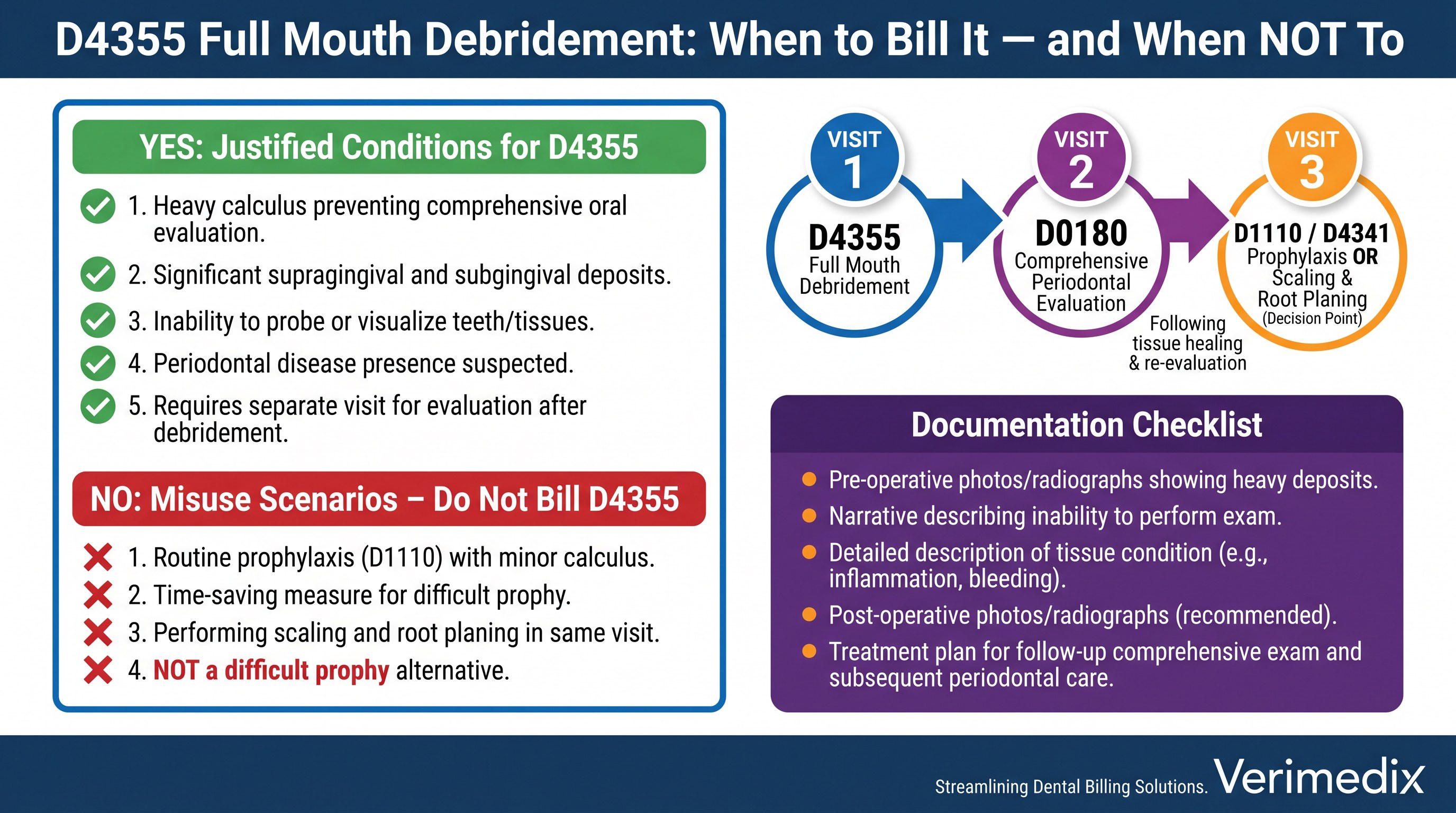
- D4355 — full mouth debridement to enable a comprehensive periodontal evaluation and diagnosis on a subsequent visit.
- Bill D4355 only when the calculus burden is so heavy that it physically prevents a thorough periodontal assessment. The need for debridement must be clinically documented.
- A D0180 (comprehensive periodontal evaluation) cannot be reported on the same date as D4355; it must follow at a later appointment. D0150 or D0120 can be reported same-day if all their components were completed.
- D4355 is not D1110 (adult prophy) — it is a periodontal therapeutic service. It is also not D4341/D4342 (SRP) — it does not treat periodontitis; it removes gross calculus to enable diagnosis.
- Many payers cover D4355 once per lifetime or once every several years; coverage varies significantly by carrier.
The CDT code entry for D4355 reads: "full mouth debridement to enable a comprehensive periodontal evaluation and diagnosis on a subsequent visit." Every word matters. "Full mouth" means the entire dentition, not select quadrants. "To enable" means the debridement is a prerequisite for evaluation — it is not a standalone treatment service. "A subsequent visit" means the comprehensive periodontal evaluation cannot happen until after the debridement, on a different appointment date.
Clinical criteria for D4355
D4355 is appropriate when a patient presents with such heavy supragingival and subgingival calculus deposits that the clinical crown, gingival margin, and subgingival environment cannot be adequately visualized or probed without first removing the gross calculus. The clinical record should document the extent of calculus (e.g., heavy supragingival calculus across all quadrants, subgingival deposits at multiple sites, limited visibility of gingival margins). The purpose stated must be diagnostic preparation, not periodontal therapy. If the clinical picture is clear enough for a comprehensive periodontal evaluation, D4355 is not indicated and D1110, D4341, or D4346 applies instead.
D4355 vs D1110 vs D4341 vs D4346
| Code | Name | Purpose | Diagnosis required |
|---|---|---|---|
| D1110 | Prophylaxis – adult | Preventive removal of plaque and calculus in a healthy or gingivitis patient | Health or mild gingivitis; no periodontitis |
| D4346 | Scaling in presence of gingival inflammation | Therapeutic scaling for generalized/localized gingivitis with no bone loss | Gingivitis (inflammation, bleeding, no bone loss) |
| D4341 | Scaling and root planing – four or more teeth per quadrant | Active periodontal therapy for periodontitis with bone loss | Periodontitis with radiographic bone loss and pocket depths ≥4mm |
| D4355 | Full mouth debridement | Remove gross calculus to enable periodontal evaluation at a future visit | Gross calculus preventing adequate examination — diagnosis deferred to subsequent visit |
Same-day exam rules
The ADA CDT guide on D4355 confirms that D0150 (comprehensive oral evaluation) or D0120 (periodic oral evaluation) can be reported on the same date as D4355 if all components of those evaluations were completed at that visit. However, D0180 (comprehensive periodontal evaluation) cannot be reported the same day as D4355 — by definition, the comprehensive periodontal evaluation is the purpose of the subsequent visit. Reporting D0180 same-day as D4355 contradicts the code's own descriptor and will be denied.
Documentation requirements
- Record the extent and distribution of calculus across all quadrants, documenting why a thorough periodontal assessment was not possible.
- State the clinical objective: debridement performed to enable comprehensive periodontal evaluation at a subsequent appointment.
- Schedule and document the follow-up. The claim is more defensible when a recall or evaluation appointment is scheduled and noted in the record.
- Do not record a periodontal diagnosis at the D4355 appointment — that diagnosis comes at the subsequent evaluation.
Coverage and common denials
| Denial | Cause | Fix |
|---|---|---|
| D4355 not covered / lifetime maximum reached | Many carriers cover D4355 once per lifetime or once every 3–5 years | Verify benefit history; if clinical necessity exists for a repeat, submit with detailed narrative of why another debridement was clinically required |
| D4355 downgraded to D1110 | Claim note reads as a heavy prophy rather than a diagnostic-enabling debridement | Revise documentation to emphasize the calculus extent and the deferred diagnostic purpose; appeal with corrected clinical notes |
| D0180 denied when same-day as D4355 | CDT rules prohibit same-day comprehensive periodontal evaluation | Move D0180 to the subsequent visit; verify it was actually performed at a separate appointment before resubmitting |
| D4355 denied as not medically necessary | Carrier requires documented evidence of inability to probe or evaluate | Appeal with chart notes describing specific sites where calculus prevented measurement; include full-mouth radiographs showing heavy calculus if applicable |
Frequently asked questions
No. D4355 is a diagnostic preparation procedure — it removes enough calculus to allow a meaningful periodontal examination at a subsequent visit. D4341 (scaling and root planing) is the ‘deep cleaning’ that treats periodontitis. D4355 is not a treatment for periodontitis; it is a prerequisite evaluation step.
No. The CDT definition of D4355 specifies that the comprehensive periodontal evaluation occurs at a subsequent visit. D0180 reported on the same date contradicts the code descriptor and will be denied. D0150 and D0120 can be reported same-day if all their components were completed.
Coverage varies widely. Many carriers cover D4355 once per lifetime; others allow once every 3–5 years. Some plans do not cover it at all and instead apply it toward the periodontal benefit category. Always verify the specific plan's coverage language before performing the procedure.
D4346 is a therapeutic scaling procedure performed when a patient has generalized or localized gingivitis with inflammation but no bone loss. The diagnosis is made before or during the visit. D4355 is performed when calculus prevents any adequate examination — the diagnosis is deferred to a later appointment. D4346 treats the condition; D4355 enables the diagnosis.
No. D4355 is a full-mouth procedure billed once per encounter, not per quadrant. Billing multiple D4355 codes per date or attempting to split by quadrant will result in duplicate denials.