
- CPT 97140 (manual therapy techniques) is a timed code billed in 15-minute units — mobilization/manipulation, manual lymphatic drainage, and manual traction, one or more regions.
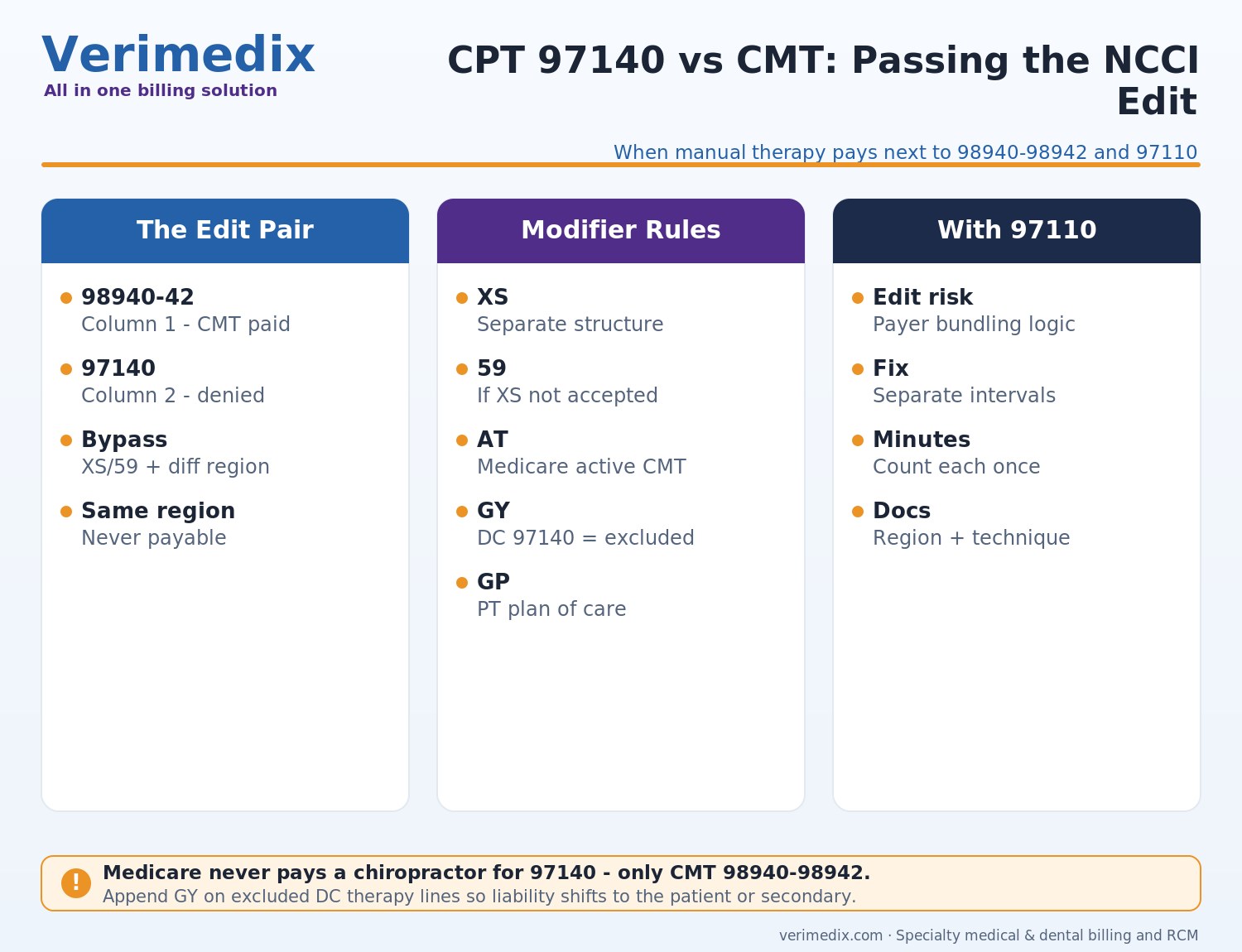
- NCCI bundles 97140 into chiropractic CMT codes 98940–98942; it is payable the same day only with modifier 59/XS and a genuinely different anatomic region.
- Payer edits also pair 97140 with 97530 and 97110 — distinct services in separate timed intervals, documented, are what justify the modifier.
- Medicare never pays a chiropractor for 97140: only CMT 98940–98942 is covered, so DCs append GY to excluded therapy lines and bill the patient or secondary.
- XS (separate structure) is the precise modifier for the different-region scenario; use 59 only when the payer has not adopted X-modifiers.
- The 97140 note must name the technique, the region(s), the minutes, and the objective response — region-level detail is what wins CO-97 appeals.
What CPT 97140 covers — and what it pays
Manual therapy techniques — joint mobilization and manipulation, manual lymphatic drainage, manual traction, soft tissue mobilization — are reported under 97140, defined as "one or more regions, each 15 minutes" of direct one-on-one care. Physical therapists, occupational therapists, chiropractors, and some physicians bill it, and it follows the same 8-minute-rule unit math as every other timed rehab code (see our CPT 97110 guide for the full minutes-to-units chart).
Under the 2026 Medicare Physician Fee Schedule a unit of 97140 generally allows in the high $20s to low $30s depending on locality, usually a couple of dollars below 97110, with the multiple procedure payment reduction shaving the practice-expense portion of second and subsequent same-day therapy procedures. Reimbursement is rarely the problem with this code. Edits are. 97140 appears as the column-two (denied) code in National Correct Coding Initiative pairs with chiropractic manipulative treatment, and in payer-level bundling logic with 97530 and sometimes 97110 — which means the difference between paid and denied is almost always a modifier decision you must be able to defend.
Massage (97124) is a separate code with its own NCCI relationship to 97140: the two describe different services and are generally not reportable together for the same region in the same session, a distinction that matters for both compliance and medical-necessity review.
97140 with chiropractic CMT 98940–98942
The chiropractic edit is the one that generates the most denials. CMT codes are region-based — 98940 covers 1–2 spinal regions, 98941 covers 3–4, 98942 all 5, and 98943 is extraspinal — and NCCI treats manual therapy as inherent to the adjustment in any region that was manipulated. The edit carries a modifier indicator of 1, meaning it can be bypassed, but only in one situation: the manual therapy was performed on a different, non-overlapping anatomic region from every region adjusted that day.
| Same-day scenario | Payable? | Coding |
|---|---|---|
| 98941 (adjusted C-T-L spine) + 97140 soft tissue work to the lumbar spine | No — same region | 97140 denies; no modifier rescues it |
| 98940 (adjusted lumbar) + 15 min myofascial release to the shoulder | Often yes | 97140 with XS (or 59), region documented |
| 98942 (all five spinal regions) + 97140 to any spinal region | No | Nothing is "separate" from an all-region CMT |
| Medicare patient, chiropractor bills 97140 (any region) | Never — statutorily excluded | Append GY; AT goes on the covered CMT line only |
The Medicare row deserves emphasis because it is not an NCCI issue at all. Medicare's chiropractic benefit covers exactly one thing: spinal CMT (98940–98942) for active treatment, flagged with modifier AT. Everything else a DC performs — 97140, 97110, exams, X-rays — is statutorily excluded, so the GY modifier tells Medicare to issue the denial that shifts liability to the patient or a secondary plan. Commercial payers and personal-injury carriers, by contrast, often do pay DCs for 97140 under the region rules above; our chiropractic billing guidelines for 2026 covers the full modifier stack.
97140 with 97110 and 97530 in the same visit
PT and multidisciplinary clinics hit a different wall: edits pairing 97140 with therapeutic activities (97530) and, under some payer policies, therapeutic exercise (97110). These combinations are clinically routine — ten minutes of joint mobilization followed by twenty minutes of loaded exercise is a textbook session — and they are billable together when three things are true. The services were distinct interventions, not relabeled minutes of the same activity; they occupied separate timed intervals (sequential is fine, simultaneous is not); and the minutes were counted once — the same ten minutes can never feed two codes. When an edit fires, the distinct-service modifier goes on the edit's column-two code, and your total units must still reconcile to total timed minutes under the 8-minute rule. A claim reporting 97140 × 2 plus 97110 × 2 on a 38-minute session is arithmetic fraud regardless of modifiers.
Modifier 59 vs XS: which one, on which line
CMS created the X-modifiers to say precisely what 59 says vaguely, and payers increasingly prefer them. For 97140 the decision is short:
| Situation | Modifier | Notes |
|---|---|---|
| Manual therapy to a different anatomic region than the CMT/procedure it is edited against | XS | "Separate structure" — the exact fact pattern; append to 97140 |
| Distinct service in a separate timed interval, same region (e.g., 97140 then 97530) | 59 (some payers accept XU) | Documentation must show sequence and minutes |
| Payer has not adopted X-modifiers | 59 | Functionally equivalent; never report 59 and an X-modifier together |
| No edit exists for this payer/code pair | None | Adding 59 "just in case" is an audit flag, not protection |
Two discipline notes: therapy providers still append GP (or GO) ahead of any edit modifiers, and modifier order should put payment modifiers before informational ones. For the full logic tree across specialties, see modifier 59 and the X-modifiers: NCCI edits and unbundling.
Documentation: region, technique, minutes, response
A 97140 line survives review when the note answers four questions without inference. Which technique — "manual therapy" alone is insufficient; name it (grade III posterior glide, myofascial release, manual traction). Which region — specific enough that a reviewer can verify it does not overlap the CMT or other manual work that day. How many minutes — one-on-one time for this intervention, feeding the session's timed-minute total. What changed — objective response tied to plan-of-care goals (ROM gain, pain scale, functional measure). The region element is the one that wins or loses CO-97 appeals on CMT claims: "97140 — 12 min myofascial release, right shoulder; CMT L3–L5" is appealable; "manual therapy 15 min" is not.
The cost of getting the edit wrong (illustrative)
Consider a chiropractic-plus-rehab clinic averaging 12 same-day CMT + 97140 claims per day. Billed naively — no region separation documented, no XS — every 97140 line denies CO-97. At an illustrative $28 allowable, that is $336/day, roughly $84,000 a year in denied manual therapy. Now the other direction: the clinic blanket-appends 59 to every 97140 and collects — until a payer audit finds same-region treatment behind the modifier and extrapolates repayment across two years of claims, with interest. The profitable-and-compliant middle: treatment templates that capture region per intervention, a scrubber rule that blocks 97140-with-CMT unless regions differ, and XS applied only when the note proves separation. Same clinic, properly documented with (say) 60% of sessions genuinely involving a separate region: about $50,000 a year of defensible 97140 revenue. All figures illustrative.
Top 97140 denials and how to fix them
| Denial | Root cause | Fix |
|---|---|---|
| CO-97 (bundled) with CMT on the claim | NCCI pair 98940–98942 + 97140, no valid bypass | If a separate region is documented, resubmit with XS/59; if same region, adjust off — do not appeal |
| CO-97 with 97530/97110 | Payer bundling edit, missing distinct-service support | Rebill with 59/XU and interval-level documentation; verify minutes reconcile |
| CO-4 (modifier inconsistent) | 59 and XS reported together, or GP missing on a therapy plan of care | One edit modifier per line; scrub therapy claims for discipline modifiers |
| PR/CO-96 or GY-driven non-coverage | Chiropractor billed 97140 to Medicare | Expected outcome — bill secondary or patient; use an ABN-style financial conversation up front |
| CO-151 (units) | Units exceed timed-minute math or MUE | Recompute under the 8-minute rule; appeal only with a minutes grid that supports the units |
Quick Answers
What is CPT code 97140? Manual therapy techniques — joint mobilization/manipulation, manual lymphatic drainage, manual traction — billed in 15-minute one-on-one units, one or more regions.
Can you bill 97140 with 98940, 98941, or 98942? Only when the manual therapy targeted a different anatomic region than every region adjusted, with modifier XS (or 59) on the 97140 line and region-specific documentation. Same-region combinations deny under NCCI and are not appealable.
Can you bill 97140 and 97110 together? Yes, when they are distinct services in separate timed intervals with minutes counted once; some payers require modifier 59/XU on the edited line, and total units must still match total timed minutes.
Does Medicare pay chiropractors for 97140? No — Medicare's chiropractic benefit covers only spinal CMT 98940–98942 with the AT modifier. A DC's 97140 is statutorily excluded; append GY so the denial transfers liability to the patient or a secondary payer.
Should I use modifier 59 or XS on 97140? XS is the precise choice when the justification is a separate anatomic structure/region; use 59 where the payer has not adopted X-modifiers. Never use both on the same line.
How much does 97140 reimburse? Roughly high-$20s to low-$30s per unit under the 2026 Medicare fee schedule depending on locality, before MPPR; commercial rates vary by contract.
Frequently asked questions
NCCI bundles 97140 into CMT codes 98940\u201398942 because manual therapy to an adjusted region is considered part of the adjustment. The edit can only be bypassed with modifier XS or 59 when the manual therapy was performed on a completely separate, non-overlapping region \u2014 and the note must name both regions. If the regions overlap, the denial is correct and should be adjusted off, not appealed.
XS (separate structure) is the more precise modifier for the different-region scenario and is preferred by payers that have adopted the X-modifier subset. Use 59 only where a payer has not implemented X-modifiers, and never report both on the same line \u2014 that combination itself triggers CO-4 denials.
No. Medicare covers only spinal manipulation (98940\u201398942 with the AT modifier) when furnished by a chiropractor; all other DC services, including 97140, are statutorily excluded. Append GY to generate the exclusion denial so the balance can go to the patient or a secondary plan, and set that financial expectation before treatment.
Add all timed minutes across both codes, convert the total to units (8\u201322 minutes = 1, 23\u201337 = 2, 38\u201352 = 3), then assign units by full 15-minute blocks and largest remainders. Each minute counts toward exactly one code, and simultaneous techniques cannot be double-counted. Units that exceed the minute math draw CO-151 denials and audit attention.
Four elements per session: the named technique (e.g., grade III joint mobilization), the specific region treated, the one-on-one minutes, and the objective response tied to plan-of-care goals. Region-level specificity is what makes a CO-97 appeal winnable when 97140 is billed alongside CMT or other manual work \u2014 a bare 'manual therapy 15 min' entry is effectively unbillable under review.