
- CO-109 is a "wrong door" denial: the payer you billed has no jurisdiction — it does not mean the service is non-covered everywhere.
- Common triggers include Medicare Advantage patients billed to Original Medicare, hospice carve-outs, DME sent to an A/B MAC instead of the DME MAC, Railroad Medicare, and commercial carve-out vendors.
- CO-109 is not appealable in any meaningful sense — the fix is identifying the correct payer or contractor and rebilling there.
- MAC jurisdiction follows geography and claim type; DME jurisdiction follows the beneficiary's permanent address, not the supplier's location.
- Days at the wrong payer burn timely filing time with the right one — diary the correct deadline immediately.
- Root-cause fix: correct the payer record in your practice management system so the same account doesn't bounce again next month.
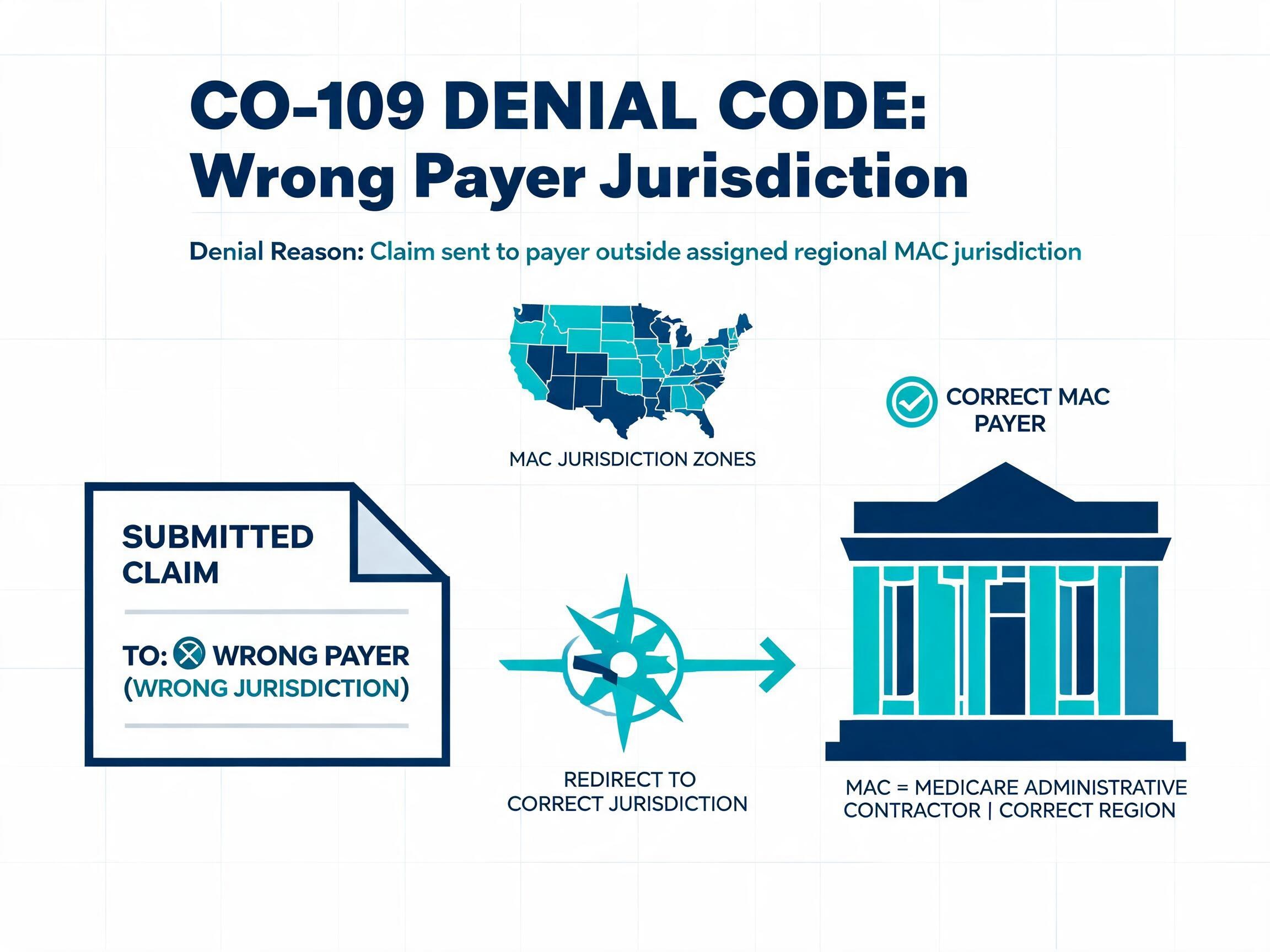
The CO-109 denial code reads "Claim/service not covered by this payer/contractor. You must send the claim/service to the correct payer/contractor." It is Medicare's — and many commercial payers' — way of saying the claim arrived at an entity that cannot process it, no matter how clean the coding is. The service may be fully covered; it simply is not covered here. That distinction changes everything about your next step: there is nothing to argue, only a correct destination to find.
This guide maps how Medicare routes claims, the scenarios behind most CO-109s, a redirection workflow, and the timely-filing trap that turns a routing error into a write-off.
What the CO-109 denial code means
Medicare fee-for-service claims are processed by Medicare Administrative Contractors (MACs), each holding a defined jurisdiction by geography and claim type. Commercial payers create the same effect through carve-out vendors and delegated entities. When a claim lands outside the receiving entity's jurisdiction — wrong MAC, wrong benefit, wrong plan — CARC 109 comes back. Because the denying contractor legally cannot pay the claim, an appeal to that contractor is pointless; per CMS contractor structure, jurisdiction is not discretionary. The productive response is always identification and redirection: figure out who actually holds the claim's jurisdiction, then submit a new claim there. Our CARC/RARC guide covers how these codes are grouped on the remittance.
Medicare's contractor map: A/B MACs and DME MACs
Twelve A/B MAC jurisdictions process Part A and Part B claims by state. Per the current CMS "Who are the MACs" listing, the assignments are:
| Jurisdiction | Contractor | States/territories |
|---|---|---|
| JE / JF | Noridian Healthcare Solutions | JE: CA, HI, NV, Pacific territories · JF: AK, AZ, ID, MT, ND, OR, SD, UT, WA, WY |
| J5 / J8 | WPS Government Health Administrators | J5: IA, KS, MO, NE · J8: IN, MI |
| J6 / JK | National Government Services | J6: IL, MN, WI · JK: CT, ME, MA, NH, NY, RI, VT |
| JH / JL | Novitas Solutions | JH: AR, CO, LA, MS, NM, OK, TX · JL: DE, DC, MD, NJ, PA |
| JJ / JM | Palmetto GBA | JJ: AL, GA, TN · JM: NC, SC, VA, WV |
| JN | First Coast Service Options | FL, PR, USVI |
| J15 | CGS Administrators | KY, OH |
Durable medical equipment routes separately, to four DME MAC jurisdictions — and the beneficiary's permanent address, not the ordering practice or supplier location, decides which one:
| DME jurisdiction | Contractor | Region |
|---|---|---|
| Jurisdiction A | Noridian | Northeast (CT, DE, MA, MD, ME, NH, NJ, NY, PA, RI, VT, DC) |
| Jurisdiction B | CGS Administrators | Midwest (IL, IN, KY, MI, MN, OH, WI) |
| Jurisdiction C | CGS Administrators | South (AL, AR, CO, FL, GA, LA, MS, NC, NM, OK, PR, SC, TN, TX, USVI, VA, WV) |
| Jurisdiction D | Noridian | West (AK, AZ, CA, HI, IA, ID, KS, MO, MT, ND, NE, NV, OR, SD, UT, WA, WY, Pacific territories) |
Note the traps hiding in this structure: a Kentucky office visit goes to CGS (J15), but a Kentucky patient's wheelchair goes to CGS as DME Jurisdiction B — a different contract, different payer ID, different claim system. And a snowbird patient who winters in Florida but keeps an Ohio permanent address routes DME through Jurisdiction B, not C.
Common CO-109 scenarios: cause and fix
| Cause | What happened | Fix |
|---|---|---|
| Medicare Advantage misbill | Patient enrolled in an MA plan; claim went to the Original Medicare MAC (often denied CO-109 or CO-24) | Check eligibility for the MA plan name and payer ID; bill the MA plan |
| Hospice enrollment | Service related to the terminal illness billed to the A/B MAC instead of through the hospice benefit | Route related services through the hospice; use GV (attending physician) or GW (unrelated) modifiers where they apply |
| DME to the wrong contractor | Equipment claim sent to the A/B MAC, or to the wrong DME jurisdiction | Rebill the DME MAC for the beneficiary's permanent address |
| Railroad Medicare | RRB beneficiary's Part B claim sent to the local MAC | Bill Palmetto GBA, the nationwide Railroad Specialty MAC, per the RRB |
| Wrong A/B MAC geography | Claim filed to a MAC that doesn't cover the service state | Confirm jurisdiction on CMS's MAC lookup; resubmit to the right MAC |
| Commercial carve-out | Behavioral health, lab, PT, or vision benefits delegated to a separate vendor | Identify the carve-out vendor from the eligibility response or plan documents; bill the vendor |
Two edge cases deserve a note. Railroad Medicare is the classic one: Palmetto GBA processes Part B claims for Railroad Retirement Board beneficiaries nationwide, so a patient whose red-white-and-blue card says "Railroad Retirement Board" will bounce at your local MAC every time. United Mine Workers of America (UMWA) Health and Retirement Funds beneficiaries similarly have dedicated payment arrangements — when a card references UMWA Funds, verify routing with the Funds before filing anywhere else.
Step-by-step: redirect, don't appeal
- Read the remittance in full. Remark codes often name the correct payer type or say "submit to the entity with jurisdiction."
- Re-run eligibility for the date of service. The 271 response or portal will reveal MA enrollment, hospice election dates, and plan payer IDs — this single step explains most CO-109s.
- Identify the correct contractor. Use CMS's MAC lookup for A/B jurisdiction, the DME MAC map for equipment, Palmetto GBA for Railroad Medicare, or the plan's eligibility response for carve-out vendors.
- Correct the claim before resubmitting — new payer ID, and hospice modifiers (GV/GW) if the patient is hospice-enrolled and the service qualifies for separate Part B billing.
- Submit as a new claim to the correct payer. Do not send a "corrected claim" or an appeal to the denying contractor — it has nothing to reprocess.
- Diary the correct payer's timely filing deadline from the date of service, and attach proof of the original timely submission and the CO-109 remittance in case you need to argue good cause.
- Fix the source record. Update the payer, plan, and payer ID in your PM system so every future claim for this patient routes correctly the first time.
The timely-filing trap
CO-109 becomes expensive when it is worked slowly. Medicare's filing limit is 12 months from the date of service, and commercial limits are often far shorter — see our timely filing limits by payer guide. Filing with the wrong payer does not automatically stop the correct payer's clock. Many commercial payers will honor proof that you originally filed on time with the wrong payer, and Medicare recognizes limited good-cause exceptions, but none of that is guaranteed — cautious practices treat the original deadline as live. If the redirected claim does get denied for late filing, the remittance and submission reports from the first payer become your evidence; our step-by-step appeal guide covers how to package that argument.
Worked example: a $2,750 wheelchair at the wrong MAC
Illustrative numbers. A Georgia supplier bills a $2,750 power wheelchair claim to Palmetto GBA JJ — the A/B MAC it uses for everything else. The claim returns CO-109: equipment belongs to the DME MAC, and for a Georgia beneficiary that is CGS Jurisdiction C. The biller catches the denial in 12 days, confirms the beneficiary's permanent address, and files a new claim with CGS. It adjudicates at an allowed amount of $2,310, paying $1,848 with $462 patient coinsurance — about five weeks later than a correctly routed claim would have paid.
Now run the same error through a worse timeline: the denial sits in a work queue for months and resurfaces at day 340 after the date of service. With Medicare's 12-month limit, the biller has under four weeks to identify the correct contractor, rebuild the claim, and get it accepted — or the practice writes off the full $2,750. Same mistake, same code; the only variable was how fast the "wrong door" claim got redirected.
Quick Answers
What does the CO-109 denial code mean? CO-109 means the claim or service is not covered by the payer or contractor that received it, and must be sent to the correct payer or contractor. It is a routing denial, not a coverage determination.
Is CO-109 appealable? Not usefully. The denying contractor has no jurisdiction to pay regardless of the appeal's merits, so the correct action is identifying the right payer and submitting a new claim there.
How do I find the correct MAC jurisdiction? Use CMS's MAC lookup and jurisdiction maps: A/B MAC jurisdiction follows the state where the service was rendered, while DME MAC jurisdiction follows the beneficiary's permanent address.
Why do hospice patients trigger CO-109? Once a patient elects hospice, services related to the terminal illness are paid through the hospice benefit rather than standard Part B, so claims billed to the A/B MAC bounce. Attending-physician services may still be billed to Part B with modifier GV, and unrelated services with GW, depending on the situation.
What is the difference between CO-109 and CO-24? Both signal "wrong payer" for Medicare Advantage misbills, but CO-24 specifically indicates charges covered under a capitation agreement or managed care plan, while CO-109 is the general wrong-payer/contractor code. Either way, the fix is billing the patient's actual plan.
What to check before billing
- Eligibility run for the date of service — MA enrollment, hospice election, and payer IDs confirmed
- Medicare card checked for Railroad Retirement Board wording (routes to Palmetto GBA nationwide)
- Correct A/B MAC confirmed for the service state; correct DME MAC for the beneficiary's permanent address
- Hospice status verified; GV/GW modifiers applied where appropriate
- Carve-out vendors identified from the eligibility response for behavioral health, lab, PT, and vision
- Payer file in the PM system updated after any CO-109 so the error doesn't repeat
Related denial codes and guides
CO-109's siblings are worth knowing on sight: CO-24 (capitation/managed care) covers most Medicare Advantage misbills, CO-B9 flags hospice enrollment specifically, and CO-22 means the payer you billed exists in the patient's stack — just not first in line. Persistent routing denials are usually a payer-file hygiene problem, the kind a structured denial management program paired with disciplined eligibility verification eliminates at the source.
Frequently asked questions
No. The denying payer or contractor lacks jurisdiction over the claim, so resubmitting or appealing to it accomplishes nothing. Identify the entity that actually processes the claim — the correct MAC, the patient's Medicare Advantage plan, the hospice, or a carve-out vendor — and file a new claim there.
No. CO-109 says nothing about coverage or medical necessity — it only means the entity you billed does not process this claim. In most cases the service is fully payable once it reaches the payer or contractor with jurisdiction.
Use CMS's published MAC lookup and jurisdiction maps. A/B MAC jurisdiction is based on the state where services were furnished, while DME MAC jurisdiction is based on the beneficiary's permanent address. Railroad Medicare Part B claims go to Palmetto GBA nationwide regardless of state.
Part B claims for Railroad Retirement Board beneficiaries are processed by Palmetto GBA, the Railroad Specialty MAC, for the entire country — not by your local MAC. The patient's Medicare card will reference the Railroad Retirement Board, which is the cue to route the claim to Palmetto GBA.
Not automatically. Many commercial payers accept proof of timely filing with the wrong payer as good cause, and Medicare recognizes limited exceptions, but none of this is guaranteed. Keep the original submission report and the CO-109 remittance as evidence, and treat the correct payer's original deadline as still running.