
- POS codes are two-digit codes entered in Box 24B of the CMS-1500 form that identify where a service was rendered.
- CMS pays non-facility rates (higher RVUs) for services in physician offices and patients' homes; facility rates (lower RVUs) for services in hospitals and ASCs where the facility already receives a separate facility payment.
- POS 11 (office) vs POS 22 (on-campus outpatient hospital): choosing wrong cuts the physician's reimbursement by 20–50%.
- POS 02 (telehealth other than home) and POS 10 (telehealth in patient's home) replace the pandemic-era POS 11 workaround for telehealth — updated rules apply in 2026.
- Wrong POS codes trigger CO-4 (modifier required) and CO-16 (missing/invalid information) denials and can generate payer audits for facility-rate fraud.
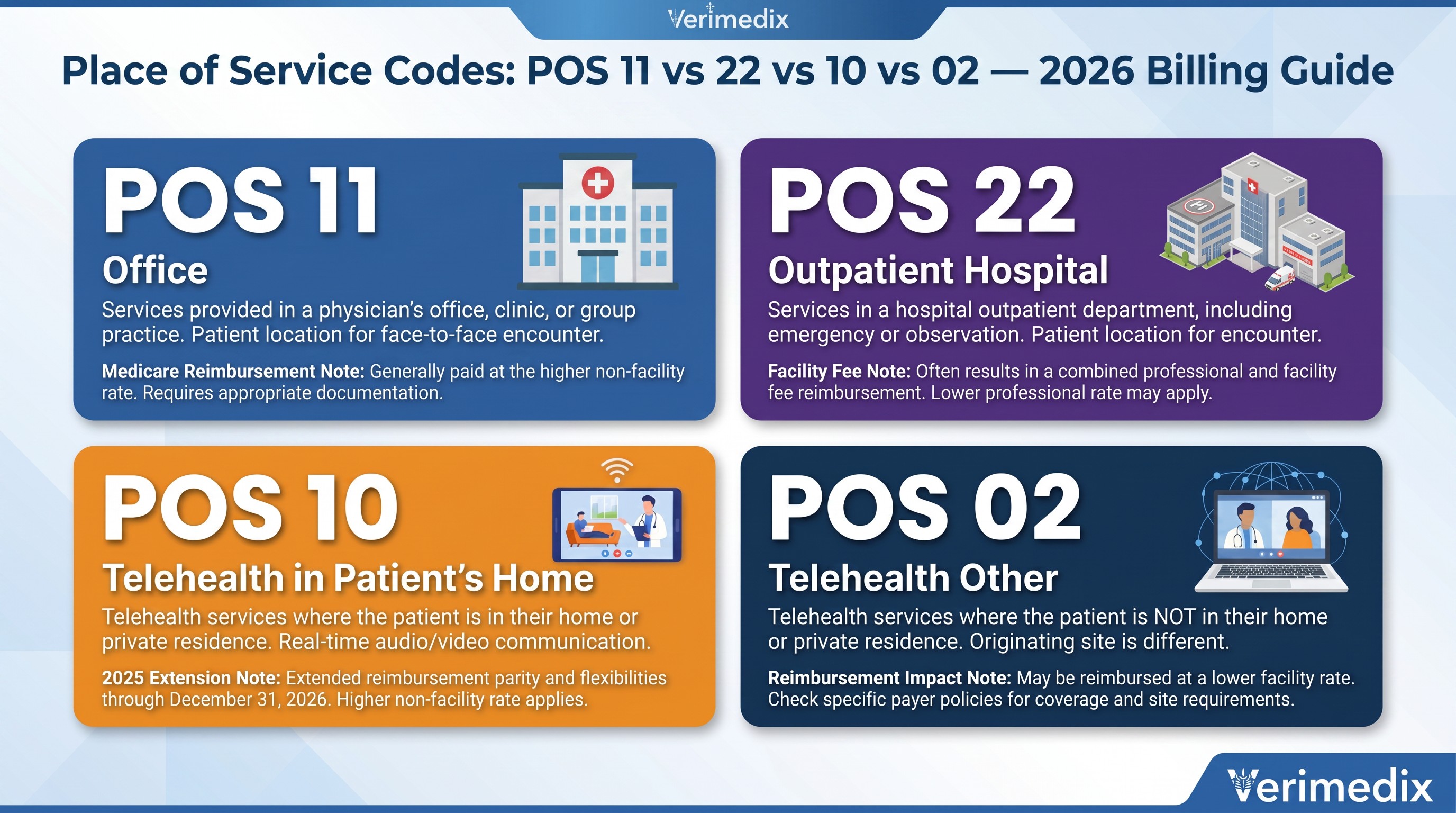
CMS maintains the official POS code list, which is updated as new care settings emerge. For 2026, the most operationally significant changes affect telehealth: POS 02 (telehealth other than patient home) and POS 10 (telehealth in patient home) are now the standard codes replacing the pandemic-era POS 11 workaround. Practices running virtual visits should mirror these POS rules across their telehealth billing setup. Using POS 11 for telehealth in 2026 results in facility vs non-facility rate mismatches, denials, and potential overpayment recovery.
Facility vs non-facility reimbursement
CMS assigns every CPT procedure two RVU values: a non-facility (practice expense) value and a facility value. Non-facility RVUs are higher because the physician absorbs overhead costs when services are performed in their own office. Facility RVUs are lower because the hospital or ASC receives a separate facility payment from CMS to cover overhead. Surgical practices splitting time between office and surgery center face this on every case — it is a core competency of specialized ASC billing services. When a wrong POS code designates a non-facility setting as a facility setting, the physician is underpaid. When it designates a facility setting as non-facility, the physician is overpaid — a compliance issue that triggers audits and repayments.
Key POS codes for 2026
| POS Code | Setting | Rate Type | Common services |
|---|---|---|---|
| 11 | Physician Office | Non-facility | Office visits, minor procedures, injections, imaging in private practice |
| 12 | Patient Home | Non-facility | Home health services billed by physician; house calls |
| 21 | Inpatient Hospital | Facility | Hospital admissions, inpatient consults, inpatient procedures |
| 22 | On Campus – Outpatient Hospital | Facility | Outpatient hospital visits, hospital-based clinic services |
| 23 | Emergency Room – Hospital | Facility | ER evaluation and management, ER procedures |
| 24 | Ambulatory Surgical Center (ASC) | Facility | Outpatient surgery billed by surgeon (ASC bills separately) |
| 31 | Skilled Nursing Facility | Facility | Physician services to SNF patients (not considered patient home) |
| 32 | Nursing Facility | Facility | Long-term care, custodial nursing facility visits |
| 33 | Custodial Care Facility | Facility | Physician services at custodial/assisted living facilities |
| 34 | Hospice | Facility | Physician services to hospice patients |
| 49 | Independent Clinic | Non-facility | Freestanding clinic services (community mental health, dialysis, etc.) |
| 02 | Telehealth – Other Than Patient Home | Typically facility (mirrors the service location) | Telehealth when patient is at a clinic, school, or office hub site |
| 10 | Telehealth – Patient Home | Non-facility | Telehealth when patient is at home; most common telehealth POS in 2026 |
POS 11 vs POS 22: the most costly mix-up
POS 11 (Physician Office) is a non-facility setting. A physician who owns their office and sees patients there bills POS 11 and receives the higher non-facility reimbursement rate. POS 22 (On Campus – Outpatient Hospital) is used when a physician sees patients in a hospital-owned clinic that is physically on the hospital campus. Even if the visit feels identical to an office visit, CMS considers it a facility setting and pays the lower facility rate. The practical impact: billing POS 11 for a hospital campus clinic visit overpays the physician; billing POS 22 for an independent office underpays. The rule is simple — follow the facility ownership, not the physical appearance of the space.
Telehealth POS codes in 2026
For 2026, CMS requires POS 02 when the patient is at a location other than their home (e.g., a clinic hub site, physician office, school, or non-home facility) and POS 10 when the patient is physically located in their home (including a hotel, shelter, or temporary dwelling). Modifier 95 (synchronous real-time audio-video telehealth) or modifier FQ (audio-only telehealth) is also required depending on modality. Using POS 11 for telehealth — the workaround used during the COVID public health emergency — will result in rate mismatches and denials in 2026.
POS-related denials and fixes
| Denial | Cause | Fix |
|---|---|---|
| CO-4 (modifier required) | Telehealth CPT requires modifier 95 or FQ; POS 02/10 without correct modifier | Add required telehealth modifier and resubmit corrected claim |
| CO-16 RARC N657 (invalid POS) | POS code missing, or POS does not match the service type | Verify service setting; correct POS code and resubmit |
| Rate mismatch / underpayment | POS 22 used for a service that qualifies as non-facility (POS 11) | Confirm facility ownership of the clinic; appeal with documentation of independent office status |
| Overpayment demand | POS 11 used for a hospital-campus clinic; facility rate should have applied | Rebill at POS 22 with facility rate; refund overpayment to avoid False Claims Act exposure |
Frequently asked questions
POS 11 (Physician Office) is a non-facility setting that pays higher physician reimbursement because the physician absorbs overhead. POS 22 (On Campus – Outpatient Hospital) is a facility setting where the hospital receives a separate facility payment and the physician is paid at the lower facility rate. The key is who owns the clinic, not what it looks like.
Use POS 10 when the patient is physically in their home during the telehealth visit. Use POS 02 when the patient is at a location other than their home (e.g., a clinic hub, school, or office). POS 11 is no longer the correct telehealth POS code in 2026.
Both. A wrong POS code may cause an outright CO-4 or CO-16 denial. It may also pay at the wrong rate without denying — either underpaying the physician (if non-facility service billed as facility) or overpaying (if facility service billed as non-facility). Overpayments from incorrect POS codes are a compliance risk subject to payer recovery and OIG scrutiny.
Yes. A corrected claim (frequency code 7) can include a corrected POS code. Submit the corrected claim with the accurate POS and any applicable modifiers. If the incorrect POS resulted in an overpayment, voluntarily repay the difference to avoid extended recovery actions.
POS 49 (Independent Clinic) is a non-facility setting. Services rendered at a freestanding, independently owned clinic are paid at the non-facility physician rate because there is no separate facility payment from CMS.