
- CPT 99203 is an office or other outpatient E/M code for a new patient; the current AMA reference describes low-level medical decision making or 30–44 minutes of total time on the date of the encounter.
- New-patient status is a coding question, not simply a first visit at a location. Validate the current CPT definition, same-group history, specialty rules, and payer instructions before selecting the code.
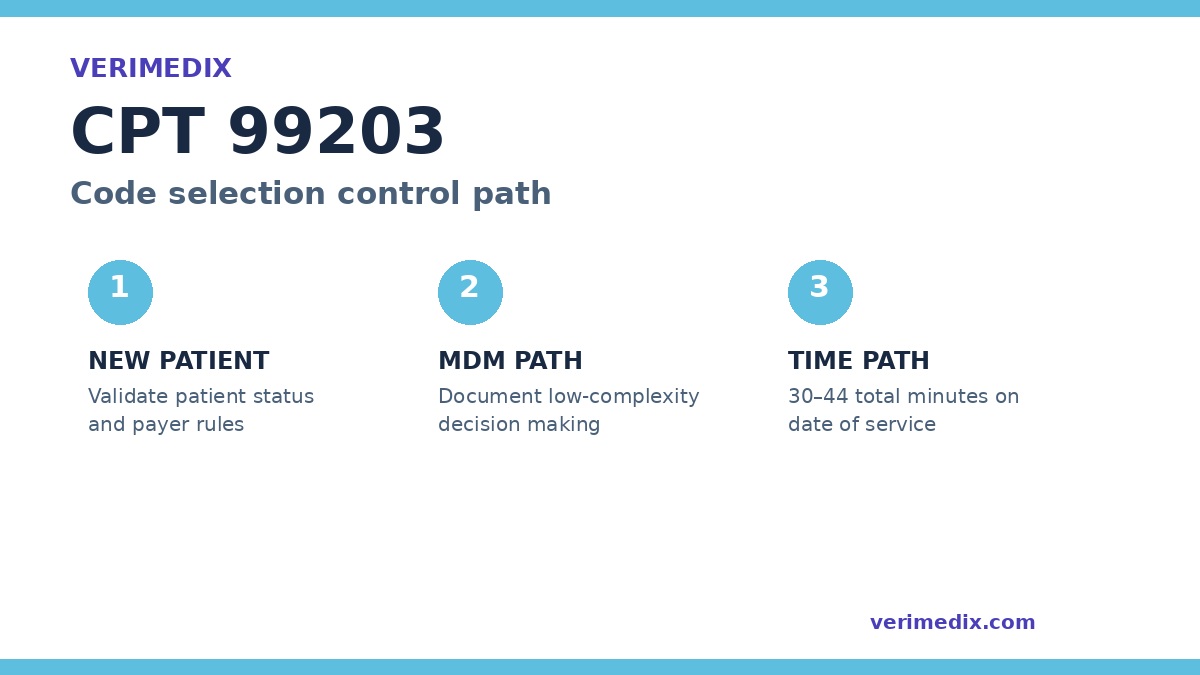
- Choose the pathway the documentation supports: low-complexity medical decision making or qualifying total time. Do not add time that was not performed or use a template to imply MDM that is not present.
- Keep the signed note, patient status check, diagnosis support, time or MDM evidence, provider identity, place of service, and payer edits together before transmission.
- A correct code does not guarantee payment. Eligibility, network status, medical necessity, authorization, claim edits, and plan policy can still control adjudication.
What is CPT 99203?
CPT 99203 describes an office or other outpatient evaluation and management visit for a new patient that requires a medically appropriate history or examination and low-level medical decision making. When time is used for code selection, the AMA describes 30–44 minutes of total time on the date of the encounter. The AMA’s code reference is a useful orientation point, but it does not replace the licensed CPT Manual or dictate coverage and reimbursement policy.
The practical billing question is whether the record supports 99203 through a valid selection pathway. A label such as “new patient consult” or “level 3 visit” is not enough. Reconcile the patient-history check, the provider’s signed assessment and plan, the work performed on the date of service, and the payer’s claim rules. For practices that need operational support, Verimedix provides primary care billing services and medical coding services.
How should a biller validate new-patient status?
Start with the current CPT definition and the payer’s implementation guidance. A patient is not automatically “new” because the appointment is at a different clinic, the provider is newly hired, or the patient has a new insurance card. The group should check its prior professional-service history and document the rule used for the claim. When the history is incomplete, hold the line for verification rather than allowing a scheduling label to determine the E/M level.
| Check | Evidence to reconcile | Why it matters |
|---|---|---|
| Patient status | Prior professional services, same group, specialty and applicable time window | A status error can invalidate the entire new-patient code family |
| Provider identity | Rendering provider, billing provider and group identifiers | Payers may apply group and specialty rules differently |
| Date of service | Encounter date, note signature and service location | Eligibility, policy and code-set instructions are date-sensitive |
| Payer policy | Plan guidance, edits, authorization and network status | The CPT description alone does not establish payment |
Keep the verification result in the billing record. If the patient was previously seen under the applicable new-patient rule, review the established-patient code family instead of forcing 99203. If the payer’s definition or group history is ambiguous, query the payer or coding lead and preserve the response.
Should 99203 be selected by MDM or time?
Office and outpatient E/M code selection can use the pathway that the documentation supports. The AMA reference describes 99203 as requiring low-level medical decision making, or 30–44 minutes of total time when time is used for selection. The record does not need to manufacture both pathways, but it must make the selected basis reviewable.
| Selection path | What the reviewer should see | Common control |
|---|---|---|
| Medical decision making | Problems addressed, data reviewed or analyzed, and management risk reflected in the note | Do not infer complexity from a long problem list that was not addressed |
| Total time | Qualifying provider time on the date of service, recorded under the current CPT and payer guidance | Do not use appointment length or room time as a substitute for documented total time |
| Either pathway | A clear statement or note structure showing why the selected level fits | Store the supporting evidence with the claim or audit trail |
When the visit is selected by MDM, review the three MDM elements under the current guidance and make sure the documented problems, data, and risk support the level. When selected by time, reconcile the activities counted under the current CPT guidance and the provider’s time statement. Do not copy a time phrase into a note after the fact or use a default 99203 for every intake.
What documentation supports 99203?
A defensible 99203 claim connects the patient status decision to the service delivered. A practical pre-submission checklist includes:
- Patient status verification and the source or date of the check.
- Rendering provider, group, place of service and date of service.
- A medically appropriate history and examination when performed and required by the current code description.
- The assessment and plan showing the problems addressed, data reviewed or analyzed, and management decisions relevant to the encounter.
- The documented total time and activities when time is the selected basis.
- Diagnosis support, medical necessity, eligibility, authorization and payer-specific claim fields.
Templates can help standardize capture, but a completed field is not evidence by itself. The note should distinguish problems addressed from historical conditions, data actually reviewed from data merely available, and care delivered from care planned for a later date. If the record is ambiguous, query the provider before changing the code.
How do payer and setting rules affect 99203?
Medicare and commercial plans may differ in coverage, documentation, telehealth, place-of-service, authorization, provider enrollment, and claim-edit requirements. CMS’s Evaluation & Management Visits page provides Medicare guidance and links to related resources, while the CMS Evaluation and Management Services reference includes current program instructions. Use these materials as policy references, not as a universal promise for every plan.
Do not publish or reuse a universal 99203 fee. Payment depends on the payer, locality, setting, provider status, contract and date of service. If a team needs a rate, check the current CMS Physician Fee Schedule tool or the commercial contract and store the version used in the claim review. A code may be valid while a claim is still nonpayable because of benefit, network or medical-necessity rules.
Telehealth and split/shared or teaching-provider situations require their own current payer instructions. Do not attach a modifier or place-of-service value because it appeared on a neighboring claim. Verify the service setting, who performed the work, the payer’s policy and the documentation before finalizing the claim.
How can a practice prevent 99203 denials?
| Denial pattern | Likely control gap | First correction step |
|---|---|---|
| New-patient status rejected | Prior group or specialty history was not checked | Reconcile the patient ledger and payer definition before resubmission |
| Level not supported | MDM or time evidence is missing or inconsistent | Compare the signed note to the selected pathway |
| Eligibility or network denial | Coverage or provider enrollment was not confirmed | Verify eligibility, network, rendering provider and effective date |
| Authorization or medical-necessity denial | Payer policy and diagnosis support were not reviewed | Check the current plan article and documentation request |
| Place-of-service or modifier edit | Claim fields were copied from a different setting | Validate the actual setting and the payer’s current edit file |
Trend denials by payer, provider, location, selection pathway and root cause. A high “new patient” rejection rate may indicate a registration-history problem; a high “level not supported” rate may indicate documentation or coder-training drift. Correct the process that created the error instead of changing 99203 to a neighboring code without evidence.
How can billing support improve E/M controls?
Medical practices can reduce rework by separating patient-status verification, documentation review, coding, claim edits and denial follow-up. Ask a billing partner to show how it audits new-patient status, preserves the MDM or time basis, tracks payer-specific edits and reports root causes by provider. A useful partner explains exceptions rather than promising that every 99203 claim will pay.
Frequently asked questions
CPT 99203 is an office or other outpatient E/M code for a new patient when the record supports low-level medical decision making or 30–44 minutes of total time on the date of service. Verify the current CPT definition and payer rules.
It may be selected using the pathway supported by the documentation: low-level medical decision making or 30–44 minutes of total time on the date of the encounter. Do not manufacture evidence for either path.
Not automatically. Validate the current new-patient definition, prior group and specialty history, applicable time window and payer instructions.
No. Eligibility, network status, medical necessity, authorization, setting, documentation and payer edits can affect payment even when the code is valid.
Hold the claim, compare the signed record with the selected MDM or time pathway, query the provider when necessary, and use the current code and payer guidance rather than guessing.