
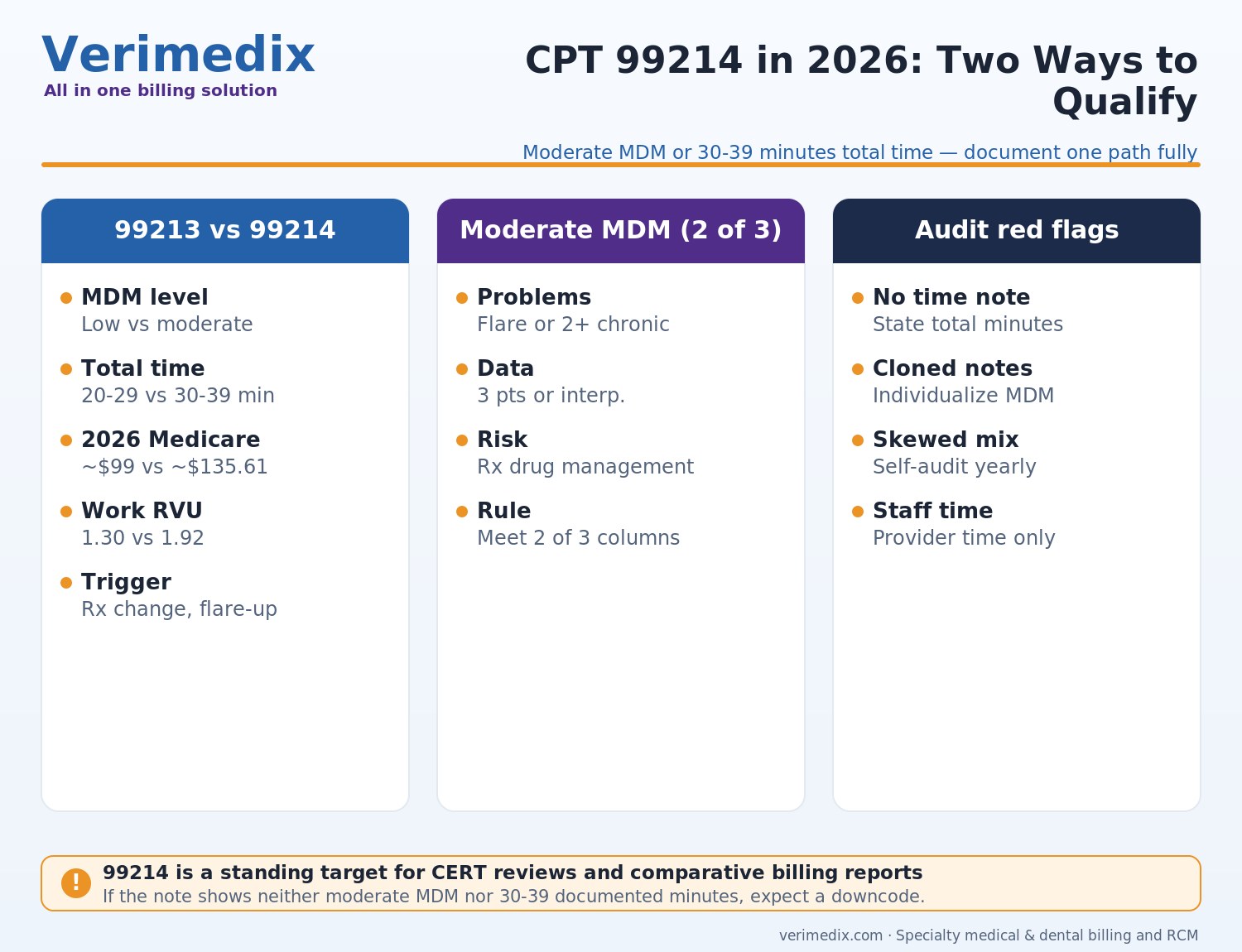
- CPT 99214 requires either moderate medical decision making (MDM) or 30-39 minutes of total time on the date of the encounter — one pathway is enough; you never need both.
- Moderate MDM means meeting two of three columns: problems addressed, data reviewed, and risk. Prescription drug management by itself satisfies the moderate-risk column.
- Under the 2026 Medicare fee schedule (conversion factor $33.4009), 99214 pays about $135.61 nationally in the office setting versus roughly $99 for 99213 — a gap of about $36 per visit before locality adjustment.
- 99214 is one of the most frequently billed codes in all of Medicare, which keeps it on the radar for comparative billing reports, CERT reviews, and commercial payer audits.
- Time-based 99214 claims fail audits when the note lacks a total-time statement, counts clinical staff time, or double-counts time spent on separately billed services.
- A one-line MDM summary — problems addressed, data reviewed, risk drivers — is the cheapest audit protection a practice can add to its templates.
Where 99214 fits in the E/M family
Every established-patient office visit in the 99211-99215 family is leveled by just two variables since the AMA rewrote outpatient E/M rules in 2021: the complexity of medical decision making, or the total time the billing provider spends on the encounter date. History and exam still need to be clinically appropriate, but they no longer score the visit. That single change is why the 99213/99214 boundary — once a matter of counting review-of-systems bullets — now comes down to what you managed and what you documented about it.
We cover the whole ladder in our guide to CPT codes 99211-99215. This article goes deep on one decision: when a visit legitimately crosses from 99213 into 99214, and how to keep that higher level defensible when a payer asks for the chart.
Pathway 1: qualifying with moderate MDM
The AMA MDM grid has three columns — number and complexity of problems addressed, amount and complexity of data reviewed and analyzed, and risk of complications or morbidity from patient management. To reach a given level you must meet or exceed it in two of the three columns. For 99214, that level is "moderate."
| MDM element | 99213 (low) | 99214 (moderate) |
|---|---|---|
| Problems addressed | 2+ self-limited or minor problems; 1 stable chronic illness; 1 acute uncomplicated illness or injury | 1+ chronic illness with exacerbation or progression; 2+ stable chronic illnesses; undiagnosed new problem with uncertain prognosis; acute illness with systemic symptoms; acute complicated injury |
| Data reviewed | Limited: meet 1 of 2 categories (e.g., 2 points from tests/documents, or use of an independent historian) | Moderate: meet 1 of 3 categories — 3 points from tests/documents/historian; independent interpretation of a test; or discussion of management with an external physician or appropriate source |
| Risk | Low — e.g., over-the-counter drug management, minor procedure without risk factors | Moderate — e.g., prescription drug management; decision about minor surgery with risk factors; diagnosis or treatment significantly limited by social determinants of health |
Two practical cautions. First, "prescription drug management" means you actively managed the drug — started it, stopped it, adjusted a dose, weighed a refill against side effects or labs, and said so in the note. A medication list carried forward with no commentary does not demonstrate management, and auditors downcode on exactly that gap. Second, the problems column counts problems addressed, not problems listed. Two stable chronic illnesses reach the moderate row only if the note shows both were actually assessed and managed at this visit.
Pathway 2: qualifying with 30-39 minutes of total time
If MDM lands at low but the visit consumed real time, 99214 can still be correct: the threshold is 30-39 minutes of total time on the date of the encounter. Total time includes both face-to-face and non-face-to-face work personally performed by the billing provider that day:
- Reviewing the chart, external notes, and test results before the visit
- Obtaining history and performing the examination
- Counseling and educating the patient, family, or caregiver
- Ordering medications, tests, or procedures, and making referrals
- Documenting in the EHR and communicating results the same day
- Care coordination that is not separately reported
What never counts: clinical staff time (the MA rooming the patient), time on services billed separately (a procedure, a separately reported test interpretation), travel, general teaching, and any work performed on a different calendar date. When billing on time, write an explicit statement — "Total time on date of service: 34 minutes, including chart review, counseling on insulin titration, and documentation." Notes that merely imply length do not survive review.
For a focused established-patient level guide, see CPT 99213 billing controls before finalizing the claim.
99213 vs 99214: side-by-side comparison
| Factor | 99213 | 99214 |
|---|---|---|
| MDM level | Low | Moderate |
| Total time (date of encounter) | 20-29 minutes | 30-39 minutes |
| Work RVU (2026) | 1.30 | 1.92 |
| 2026 Medicare national, office (approx.) | ~$99 | ~$135.61 |
| Classic scenario | One stable chronic condition, meds unchanged, routine labs | Two chronic conditions addressed with a medication adjustment, or a new problem worked up with a prescription |
| Audit posture | Rarely challenged; frequent undercoding refuge | Heavily reviewed; must show moderate MDM or documented time |
The pattern worth internalizing: a visit where you changed, started, or seriously weighed a prescription for a condition that is not fully controlled is usually a 99214 on MDM alone — moderate problems plus moderate risk covers two of three columns. A visit where everything is stable and nothing changed is usually a 99213 no matter how thorough the note looks.
2026 reimbursement and the cost of undercoding
For 2026, CMS finalized a conversion factor of $33.4009 for most clinicians ($33.5875 for qualifying APM participants). At 1.92 work RVUs and roughly 4.06 total non-facility RVUs, 99214 pays about $135.61 nationally before geographic adjustment; 99213 pays in the neighborhood of $99. Commercial allowables are typically higher than Medicare for both codes, so the per-visit gap often exceeds $40 on private contracts.
Worked example (illustrative): an internist bills 4,800 established-patient visits a year, 55% of them as 99213. A self-audit of 60 charts finds that one in five of those 99213 visits documented moderate MDM — typically prescription management across two chronic conditions. That is roughly 528 visits a year undercoded by about $36 each on Medicare-level rates: about $19,000 in earned revenue left unbilled annually by a single provider, with zero additional compliance risk because the documentation already supported 99214. Many Medicare visits in that panel would also qualify for the G2211 complexity add-on, which adds about $16 more per eligible visit.
Audit risk: why 99214 draws scrutiny
99214 sits in a strange position: it is simultaneously the most undercoded and the most audited code in outpatient E/M. The pressure lands hardest on high-volume E/M practices — primary care billing and internal medicine billing teams see their 99213/99214 mix benchmarked before any other code. Medicare contractors publish comparative billing reports that benchmark your E/M distribution against specialty peers, CERT reviewers pull 99214 claims routinely, and commercial payers run analytics on level mix, time patterns, and note similarity. The red flags are consistent across payers:
| Red flag | What the auditor sees | Fix |
|---|---|---|
| Level distribution far above peers | 90%+ of established visits at 99214/99215 | Self-audit 30-60 charts yearly; correct in whichever direction the charts point |
| Time templating | Every note states 30-39 minutes, often the same number | Record actual time per visit; vary with reality; prefer MDM when MDM is stronger |
| Cloned MDM language | Identical assessment/plan text across patients and dates | Individualize the one-line MDM summary per encounter |
| Rx management claimed, none shown | Med list unchanged, no dosing or monitoring rationale | State the drug decision: continued, adjusted, monitored, and why |
| Time counted alongside separately billed services | E/M time overlaps a same-day procedure | Carve procedure time out; if billing E/M with a procedure, review modifier 25 rules |
If an external reviewer ever does request records, respond from a prepared position — our medical billing audit checklist walks through what to assemble before a payer asks.
A 60-second code-selection framework
Run these five questions at the end of every established-patient encounter:
- Did I manage a prescription today? If yes, the risk column is moderate. One more moderate column makes it 99214.
- How many problems did I actually address? Two or more stable chronic illnesses, or one chronic problem that is flaring or progressing, puts the problems column at moderate.
- Did I review or discuss meaningful data? Three points of tests/records/historian, an independent interpretation, or a discussion with an external clinician makes data moderate.
- Do two columns reach moderate? Bill 99214 on MDM and summarize the two columns in one sentence.
- If MDM is only low, what was my total time? 30-39 documented minutes on the encounter date still supports 99214; 20-29 minutes means 99213.
Quick Answers
What does CPT 99214 require in 2026? An established-patient office visit with moderate medical decision making, or 30-39 minutes of total provider time on the date of the encounter. Only one of the two pathways must be met.
How much does 99214 pay in 2026? About $135.61 under the national Medicare physician fee schedule in the office setting, before geographic adjustment. Commercial payers typically pay more.
What is the main difference between 99213 and 99214? 99213 requires low MDM or 20-29 minutes; 99214 requires moderate MDM or 30-39 minutes. Prescription drug management is the most common driver that moves a visit to 99214.
Does prescription drug management alone justify 99214? Not alone — it satisfies the moderate-risk column, but MDM requires two of three columns at moderate, so the problems or data column must also qualify.
Can clinical staff time count toward the 30-39 minutes? No. Only time personally spent by the billing provider on the date of the encounter counts, and time on separately billed services is excluded.
Frequently asked questions
Yes. If total time on the date of the encounter reaches 30-39 minutes, 99214 is supported regardless of MDM level. Document an explicit total-time statement listing the activities performed, and remember that only the billing provider's own time counts.
No — the pathways are alternatives, not cumulative requirements. Pick whichever is stronger for that encounter and document it fully. Most coders default to MDM and reserve time for counseling-heavy visits with simple decision making.
Only if the note shows a management decision — that you evaluated the condition and consciously continued the drug, considered dose, side effects, or monitoring. A refill line with no clinical commentary is routinely downcoded on audit.
Under current CPT rules for office E/M, total time is limited to the date of the encounter, so prior-day review generally does not count toward the 30-39 minutes. Some payers interpret edge cases differently, so document dates clearly.
Because it is among the highest-volume codes in Medicare, contractors benchmark each provider's E/M mix against specialty norms. Distributions skewed heavily toward 99214/99215, templated time statements, and cloned notes are the patterns that most often trigger comparative billing reports and prepayment review.