
- Urinalysis CPT codes sit in the 81000–81099 range, but the correct line depends on the documented method, microscopy, automation, and service actually performed.
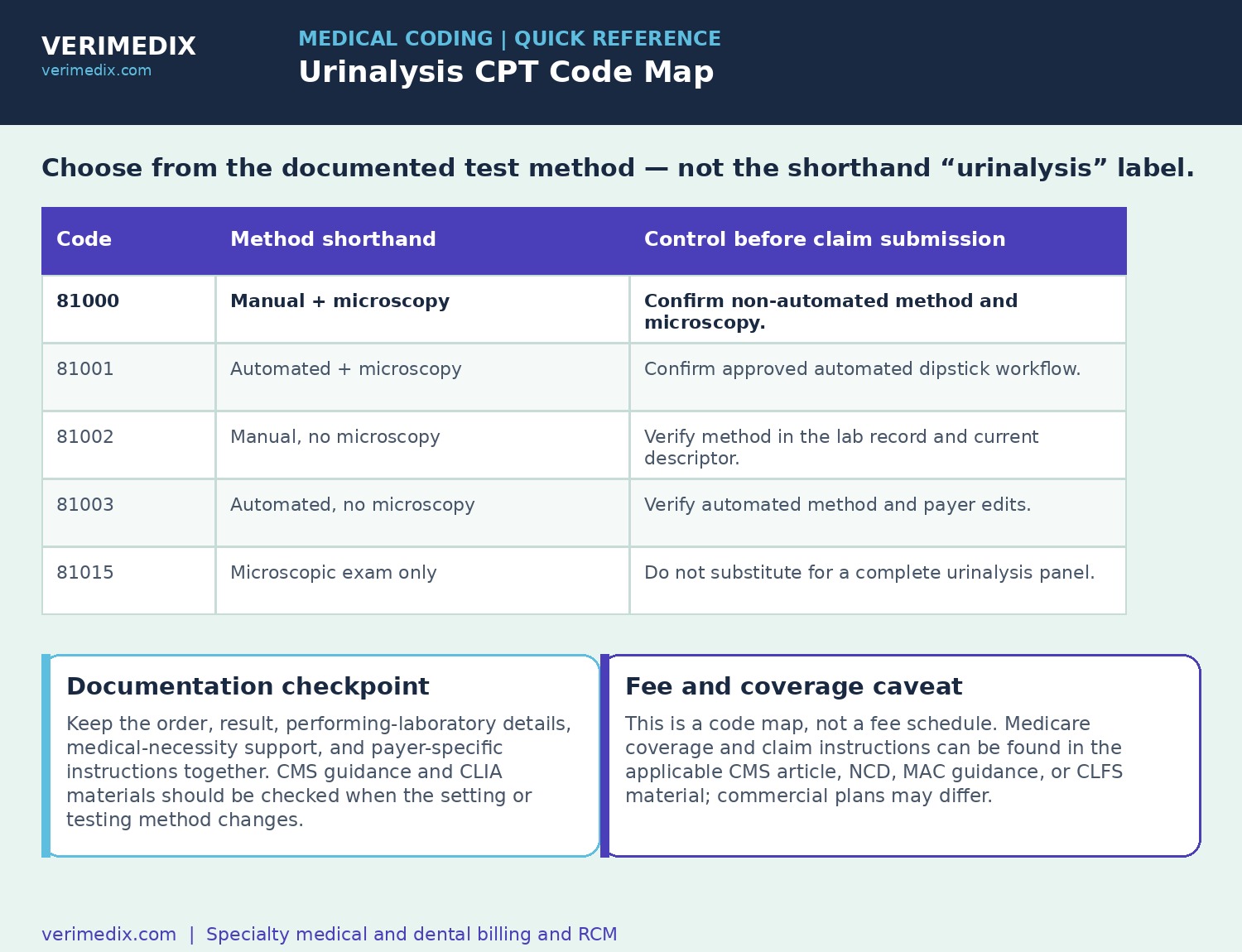
- CMS materials distinguish manual and automated urinalysis workflows; do not choose 81000, 81001, 81002, or 81003 from a generic “UA” label alone.
- Keep the order, result, performing-laboratory details, medical-necessity support, and payer instructions together before submitting the claim.
- Medicare coverage and claim instructions are policy-specific. Check the applicable CMS article, MAC guidance, CLFS material, and current payer edits rather than reusing an old fee.
- When a urinalysis claim denies, reconcile the method, code descriptor, diagnosis support, CLIA setting, units, and payer policy before changing the code.
What are the CPT codes for urinalysis?
Urinalysis CPT codes are the procedure codes used to report urine testing. The relevant range is 81000–81099, but a biller still has to match the line to the method and components documented by the laboratory or office. AAPC publishes the CPT range as a reference point; CMS laboratory and CLIA materials provide operational context, not a universal payment promise.
For a claim review, start with the test order and the actual result. “Urinalysis” can describe more than one workflow, so the shorthand in an EHR or requisition is not enough to select a code. If your practice outsources laboratory billing, give the billing team the full order, performing-lab information, and payer requirements. Verimedix supports laboratory billing workflows through clinical laboratory billing services and laboratory billing services pricing guidance.
How do 81000, 81001, 81002, 81003, and 81015 differ?
| Code | Workflow to verify | Claim-control question |
|---|---|---|
| 81000 | Non-automated urinalysis with microscopy | Does the record show the manual method and microscopy? |
| 81001 | Automated urinalysis with microscopy | Was the automated dipstick workflow performed as documented? |
| 81002 | Non-automated urinalysis without microscopy | Does the method support a manual, no-microscopy line? |
| 81003 | Automated urinalysis without microscopy | Does the lab record support automation and the current descriptor? |
| 81015 | Microscopic examination of urine only | Is this a microscopic-only service rather than a complete urinalysis? |
The table is a workflow summary, not a replacement for the current CPT book, payer edit file, or a laboratory’s validated test menu. The CMS Medicare Claims Processing Manual and Provider-performed Microscopy Procedures materials are useful references for the method distinctions. Confirm the descriptor and reporting rules for the date of service.
What documentation supports a clean urinalysis claim?
A clean claim is built from a traceable order-to-result record. At minimum, reconcile:
- the ordering provider and date of service;
- the test ordered and the method actually performed;
- the result or laboratory report tied to the patient encounter;
- the performing laboratory, location, and applicable CLIA information;
- the diagnosis or medical-necessity support required by the payer; and
- units, repeat-service edits, and any payer-specific attachment or modifier requirement.
Do not add a modifier simply because a claim rejected. First determine whether the rejection is a method mismatch, missing diagnosis support, invalid place of service, duplicate service, or a payer edit. If a code or modifier is not supported by the current descriptor and policy, omit it and document the reason for the correction.
How do Medicare, CLIA, and payer rules affect urinalysis billing?
CMS materials should be read by policy layer. Medicare coverage and claims-processing instructions may appear in an NCD, a MAC article, or related guidance, while CLIA materials address laboratory testing requirements and provider-performed microscopy. A billing guide should point the reader to those sources without turning one MAC’s coverage decision into a national rule.
For fee questions, check the current Clinical Laboratory Fee Schedule or the applicable payer contract. Do not publish a dollar amount unless you have verified the payer, locality, date, setting, and code. A code can be correct and still be nonpayable when medical necessity, frequency, benefit, or laboratory requirements are not met.
Authoritative reference points: Use the AAPC CPT range reference to orient the 81000–81099 family, then verify Medicare processing in the CMS Medicare Claims Processing Manual. For laboratory and provider-performed microscopy requirements, consult CMS CLIA PPM materials and the applicable CMS urinalysis billing guidance.
What are common urinalysis billing denials?
| Denial pattern | Likely control gap | First correction step |
|---|---|---|
| Method does not support code | Generic UA order or incomplete lab record | Compare the performed method with the current descriptor. |
| Medical necessity not established | Diagnosis or documentation does not meet policy | Review the applicable CMS/MAC or commercial payer article. |
| Duplicate or repeat service | Same-day testing not reconciled | Match the claim to the order, result, and payer edit. |
| Laboratory requirement issue | Performing-lab or CLIA detail missing | Validate the location, enrollment, and test workflow. |
| Fee or coverage mismatch | Old schedule or wrong plan assumption | Check the current fee schedule and member benefit. |
Worked example: correcting a method mismatch
Illustrative only: a clinic sends a claim labeled “UA” with 81001, but the laboratory record shows a manual dipstick without microscopy. The biller should not force the automated-with-microscopy code to match the order label. Reconcile the performed method, review the current descriptor, confirm the payer’s policy, and correct the claim or query the laboratory before submission.
The same control applies when a result contains microscopy but the billed line represents a different method. Keep the audit trail: who reviewed the record, which source was checked, and why the final line was selected.
How can a practice improve laboratory billing controls?
Choose a billing workflow that separates order capture, coding review, claim submission, denial work, and fee-schedule maintenance. Ask whether the team can reconcile the laboratory information system with the practice management system, retain the order-to-result trail, and report denials by payer and code. The right partner should explain exceptions rather than promise that every urinalysis line will pay.
For broader revenue-cycle support, review medical coding services, denial management services, and the clinical laboratory billing specialty page.
Quick Answers
What is the urinalysis CPT code range? The commonly referenced urinalysis range is 81000–81099, but the correct code depends on the documented test method and current descriptor.
What is the difference between 81001 and 81003? Both are automated urinalysis workflows, but 81001 includes microscopy while 81003 is reported without microscopy. Confirm the actual service and current payer rules.
Can a practice use an old fee schedule? No. Fee schedules and coverage policies change by payer, locality, setting, and date of service. Check the current schedule or contract.
Does a correct urinalysis code guarantee payment? No. Medical necessity, benefit limits, laboratory requirements, duplicate edits, and payer policy can still affect payment.
Frequently asked questions
The commonly referenced urinalysis range is 81000–81099, but the correct code depends on the documented method and current CPT descriptor.
Both are automated urinalysis workflows, but 81001 includes microscopy while 81003 is reported without microscopy. Confirm the performed service and current payer rules.
No. Fee schedules and coverage policies change by payer, locality, setting, and date of service. Check the current schedule or contract.
No. Medical necessity, benefit limits, laboratory requirements, duplicate edits, and payer policy can still affect payment.
Hold the claim and reconcile the order, result, and laboratory record. Query the laboratory or provider rather than guessing a code or modifier.