
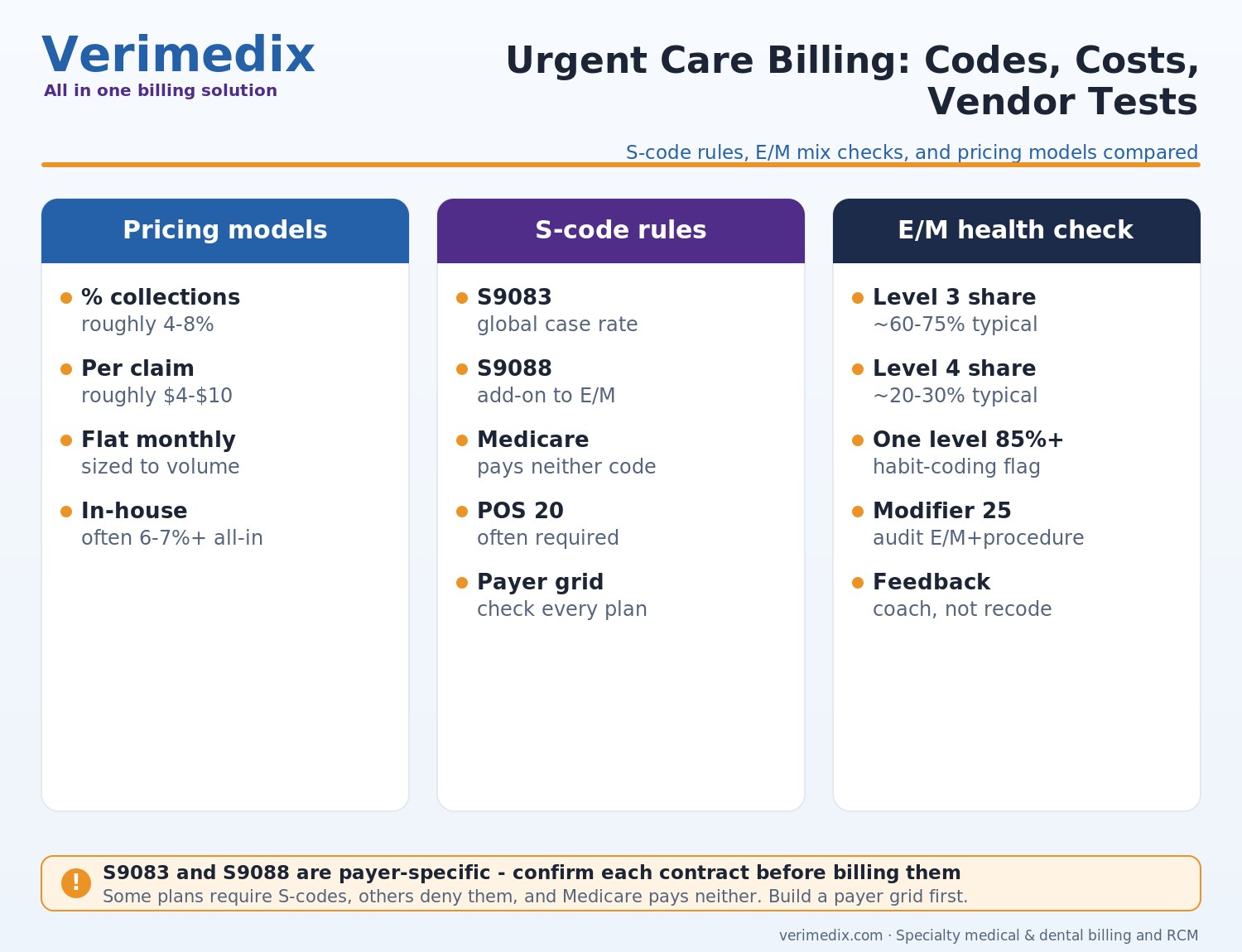
- Urgent care billing service pricing clusters around 4-8% of collections; per-claim fees of roughly $4-$10 and flat monthly retainers are common alternatives for high-volume clinics.
- S9083 (global case rate) and S9088 (urgent care add-on to an E/M) are payer-specific HCPCS S-codes: some commercial and Medicaid managed-care contracts require them, others deny them, and Medicare pays neither.
- Place of service 20 identifies the urgent care facility on claims, and some payers reimburse S-codes only with POS 20 -- your biller needs a payer-by-payer grid, not one universal rule.
- E/M leveling is where urgent care revenue is won or lost: distribution audits (level 3 vs level 4 share), modifier 25 discipline, and MDM documentation coaching should be in scope.
- Judge vendors on urgent-care-specific proof -- clean claim rate, days in AR, denial rate by payer, and a live sample report -- not on generic RCM marketing.
- Fee and reimbursement figures in this guide are illustrative industry ranges; confirm quotes and payer policies in writing.
What urgent care billing services include
Walk-in medicine has a billing profile unlike almost any other outpatient setting: high daily volume, thin margin per encounter, a rotating provider roster, and a payer mix that changes with every patient who walks through the door unscheduled. A billing operation built for a scheduled primary care office tends to buckle under that combination -- which is why urgent-care-specific services exist as a category at all.
Scope to expect from a full-service vendor:
- Real-time eligibility verification tuned for walk-ins -- checked at registration, not the night before, since there is no "night before."
- E/M coding review and leveling audits across 99202-99215, comparing documentation to MDM criteria (see our 99211-99215 guide for the leveling logic).
- Payer-specific S-code handling -- knowing which contracts want S9083 or S9088, and which deny them.
- Procedure and modifier capture -- laceration repairs, splinting, injections, and point-of-care testing billed alongside the visit with modifier 25 where a significant, separately identifiable E/M is documented.
- Claim submission, denial management, and AR follow-up with payer-level denial reporting.
- Credentialing maintenance for a roster that often includes rotating physicians, PAs, and NPs -- an uncredentialed provider on a walk-in shift is unbillable revenue.
- Occupational medicine and workers' comp billing, which follow employer-protocol and state fee-schedule rules rather than standard payer logic.
This article is a buyer's guide; for the 2026 rule changes themselves -- CMS and CPT updates affecting urgent care coding -- see our companion piece on urgent care billing guidelines for 2026.
What urgent care billing services cost
| Pricing model | Typical range (industry-published) | Best fit | Risk to manage |
|---|---|---|---|
| Percentage of collections | Roughly 4-8%; urgent care quotes often cited near 5-7% | Most centers; vendor paid only on collected dollars | Definition of "collections" -- confirm whether patient payments and refunds are in the base |
| Per-claim / per-visit fee | Roughly $4-$10 per claim | High-volume centers with strong charge capture | Vendor is paid on submission, not outcome -- add denial-rate and AR benchmarks to the contract |
| Flat monthly retainer | Varies widely by visit volume; quoted per site | Multi-site operators wanting predictable cost | Volume growth makes flat fees cheap for you or unprofitable for the vendor -- both cause service decay |
A useful crossover check: multiply your average monthly visit volume by the per-claim quote and divide by expected monthly collections. If the result is below the percentage quote, per-claim pricing is cheaper at your current volume -- but re-run the math at your growth projection, because the two models diverge fast. In-house billing is the third option; industry discussions generally put fully loaded in-house cost at 6-7%+ of collections once salaries, benefits, software, and turnover are counted.
S9083 and S9088: payer-specific, handle with a grid
Two HCPCS Level II S-codes are unique to the urgent care setting, and both are creatures of contract rather than universal coding rules:
| Code | What it is | How it is used | Key cautions |
|---|---|---|---|
| S9083 | Global fee for urgent care centers | A single case-rate payment replacing itemized billing for the visit; required by some Medicaid managed-care and commercial contracts (historically common in some states' MCO contracts) | Can underpay complex visits badly -- a case rate pays the same for a sore throat and a complex laceration. Bill it only where the contract requires it |
| S9088 | "Services provided in an urgent care center" -- listed in addition to the code for the service | An add-on some commercial payers reimburse alongside the E/M to recognize urgent care overhead | Never billed alone; payment varies by contract and some payers deny it outright |
Three rules keep S-codes from becoming a denial factory. First, Medicare does not pay S-codes -- Medicare claims go out with standard E/M codes and applicable POS. Second, several payers tie S-code reimbursement to place of service 20 (urgent care facility); some plans have announced they will reimburse S9083/S9088 only with POS 20, so POS discipline matters (see our POS code guide). Third, policies change and vary by state and plan -- a competent billing service maintains a payer-by-payer S-code grid for your specific contracts and updates it as bulletins land. Ask to see one.
E/M leveling: the revenue lever that compounds
Most urgent care revenue arrives through 99202-99215, so small systematic coding errors scale into large annual losses. Industry benchmarking discussions commonly describe urgent care E/M distributions with level 3 visits around 60-75% and level 4 around 20-30%, though the right mix depends entirely on your acuity. The pattern to fear is not any specific percentage -- it is compression: when 85%+ of visits land on a single level, someone is coding by habit rather than by documentation.
A billing service earning its fee should provide:
- Quarterly E/M distribution reports by provider, benchmarked against the center's own acuity mix.
- MDM documentation feedback -- telling providers what was missing when a visit was down-coded, not silently changing codes.
- Modifier 25 audit trails for visits with procedures, since payers increasingly scrutinize E/M + procedure pairs.
- After-hours code guidance (99050/99051), which -- like S-codes -- pays under some commercial contracts and not others.
Worked example: undercoding at volume (illustrative)
Take a center seeing 1,400 visits per month. Suppose a leveling audit finds 8% of visits (112/month) documented to level 4 MDM but billed as level 3, with an illustrative $35 average difference between the two levels across the payer mix:
- Undercoding leak: 112 visits x $35 = $3,920/month, roughly $47,000/year -- from one coding habit.
- Add a 6% denial rate on $180 average charges with weak follow-up (half never recovered): 84 visits x $90 = $7,560/month unrecovered.
- A billing service charging 6% on ~$210,000 monthly collections costs ~$12,600/month -- and in this illustration would need to close roughly $11,500 of the identified leakage just to break even, which is precisely the question to put to them: show me the audit that finds this in my data.
All numbers are illustrative; the exercise -- leak quantification before vendor selection -- is the point.
How to choose an urgent care billing partner
Score candidates 1-5 on each of these, and weight the first three double:
- Urgent care client base -- how many centers, at what visit volumes, on your PM/EHR (Experity, eClinicalWorks, etc.)?
- S-code competence -- can they produce a payer grid showing where S9083/S9088 apply for a sample contract list?
- E/M audit program -- ask for a redacted sample distribution report and a down-coding feedback example.
- Denial metrics -- clean claim rate (benchmark 95%+), first-pass resolution, denial rate by payer, days in AR.
- Credentialing support -- who tracks new-provider enrollment across your payer list?
- Workers' comp / occ med capability -- state fee schedule familiarity and employer-invoice workflows.
- Contract hygiene -- defined "collections," exit notice period, data handover, no long auto-renewals.
Then compare the shortlist against a specialty option like Verimedix's urgent care billing services, which is built around exactly these volume-and-payer-grid problems.
Quick Answers
How much do urgent care billing services cost? Commonly about 4-8% of collections, roughly $4-$10 per claim, or a flat monthly retainer sized to visit volume. Scope and volume move quotes more than vendor branding does.
What is S9083? A HCPCS S-code paying a single global case rate for an urgent care visit, used only where specific commercial or Medicaid managed-care contracts require it. Medicare does not reimburse it.
What is S9088? An S-code for "services provided in an urgent care center," billed in addition to the E/M code; some commercial payers reimburse it as an urgent care add-on and others deny it. It is never billed alone.
What place of service code does urgent care use? POS 20 (urgent care facility) on professional claims; some payers tie S-code payment specifically to POS 20. Payer-employed exceptions exist, so follow each contract.
Does Medicare pay urgent care S-codes? No. Medicare claims from urgent care settings use standard E/M and procedure codes with the applicable place of service.
Should an urgent care outsource billing or keep it in-house? Compare fully loaded in-house cost (often estimated at 6-7%+ of collections) against quotes at your volume, then weigh audit capability and denial performance -- not just the fee.
Frequently asked questions
S-codes are HCPCS Level II codes created for commercial and Medicaid managed-care use, so their payment status is set contract by contract rather than by a national rule. Some plans built urgent care case rates around S9083; others require itemized E/M billing. Your billing partner should maintain a current grid for your specific contracts.
It cuts both ways: case rates simplify billing and pay quickly, but they pay the same amount whether the visit was a five-minute recheck or a complex multi-procedure encounter. Centers with higher acuity generally collect more under itemized E/M billing. Model your mix before agreeing to case-rate contract terms.
There is no mandated distribution -- the right mix follows your documented acuity. Industry discussions often describe level 3 visits around 60-75% with level 4 around 20-30%, and heavy compression onto one level (85%+) is a red flag for habit coding. Quarterly per-provider distribution audits are the fix.
Yes -- procedures such as laceration repair, splinting, and injections frequently accompany a significant, separately identifiable E/M visit. Payers audit modifier 25 pairs aggressively, so the E/M documentation must stand on its own apart from the procedure note.
The urgent-care-focused ones do. Workers' comp follows state fee schedules and employer authorization rules, and occ med work is often invoiced directly to employers under negotiated protocols -- both need workflows separate from standard insurance claims.