
- Add capacity in 2-resource increments; a minimum embedded pod (2 dedicated resources) typically runs $2,000–$3,000+/month combined depending on role mix.
- Growth without overhead means matching headcount to signed client volume, not hiring ahead of it.
- Client-retention risk rises fastest when existing staff are stretched thin on AR follow-up and denial management — the two areas that most directly affect client-perceived performance.
- 12 billing-side roles (biller, coder, AR specialist, denial specialist, eligibility rep, and more) can each be added individually or combined into a pod with optional team-lead oversight.
- The AI Overview for this query currently cites 21 domains, including Reddit at #3 organic — a signal the topic is under-served by structured, data-backed guides.
Step 1: Calculate Your Real Capacity Gap
Before hiring anyone, quantify the gap: claims per biller per month, current denial-rate trend, and days-in-AR trajectory. A billing company adding clients without adding execution capacity typically sees denial rates and AR aging creep upward within 60–90 days — the earliest warning sign that growth is outrunning staffing.
Step 2: Choose How to Add Capacity
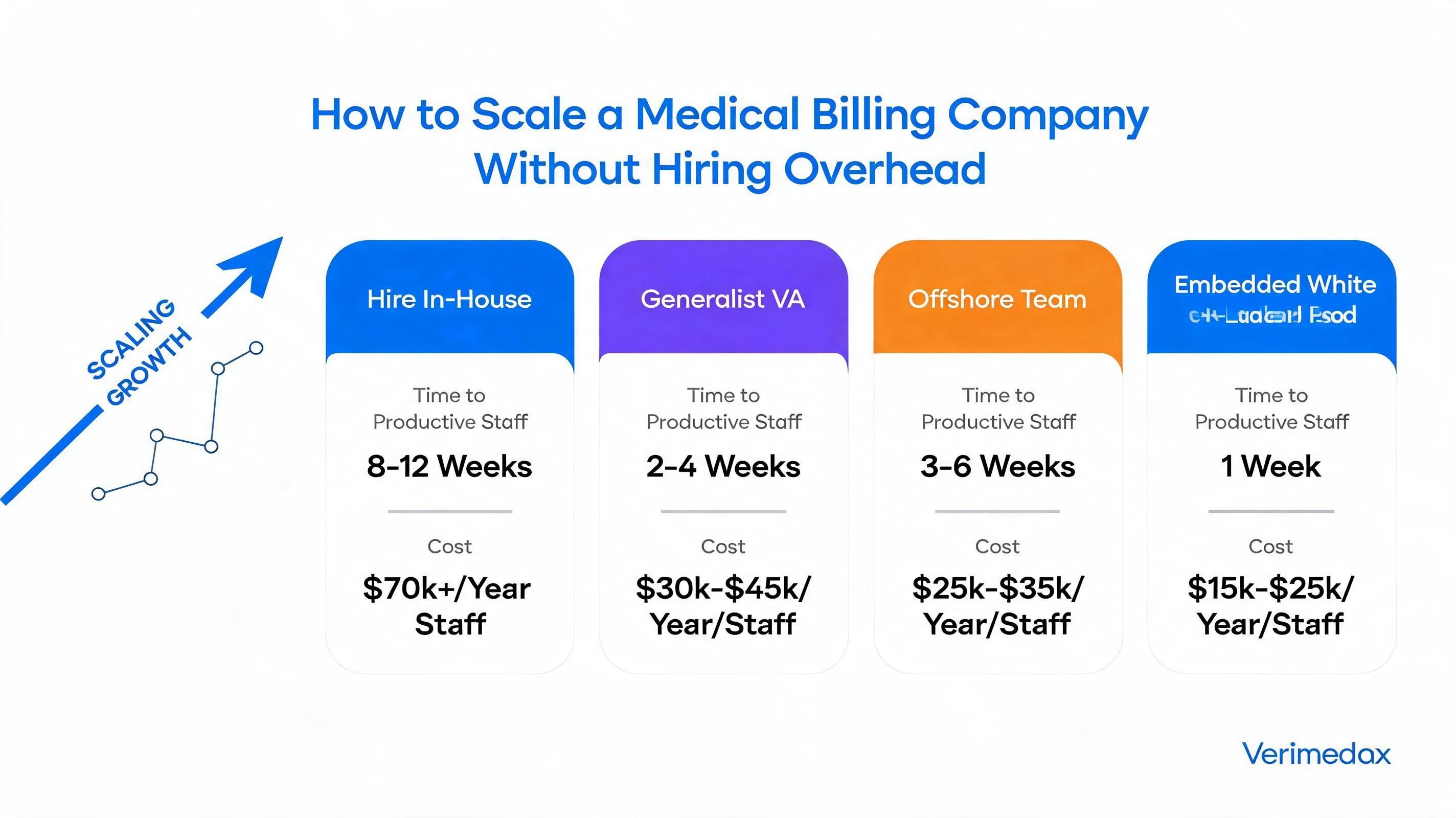
| Option | Time to productive staff | Cost | Retention risk if wrong |
|---|---|---|---|
| Hire in-house | Weeks to months (recruiting + training) | ~$75,000–$110,000+/year fully loaded per hire | High — turnover restarts the cycle |
| Generalist VA | Days to weeks | $500–$1,500/mo, often shared | Medium — limited to admin tasks |
| Offshore team (own brand) | Weeks | Varies, often lower base cost | Medium-high — quality/oversight variance |
| Embedded white-label pod | Days to a few weeks after scoping | $500–$700/mo (admin) to $1,000–$1,500+/mo (specialized), min. 2 resources | Low — provider manages continuity and replacement |
Step 3: Add a Pod, Not a Department
Providers of white-label medical billing staffing such as Verimedix place dedicated, trained billers who work inside the client's systems under the client's brand, starting at two resources — letting a billing company add a functioning pod (e.g., one biller plus one AR specialist) sized to a specific client contract, then scale up as volume grows.
Step 4: Protect Client Retention While You Scale
The fastest way to lose clients during growth is letting AR aging or denial follow-up slip while attention goes to onboarding new accounts. Assign new capacity to the highest-risk existing accounts first, not just new business — a lesson visible in 7 Signs Your Medical Billing Company Is Hurting Your Revenue.
The Capacity Math: When to Add Headcount
Most billing companies discover they're under-staffed from their clients' metrics, which is the expensive way. Instead, watch three internal ratios. Claims per biller: sustainable full-cycle volume varies by specialty and system, but when a biller's monthly claim load grows quarter over quarter while their follow-up touches per claim shrink, capacity is already short. Follow-up lag: measure days between a denial posting and the first corrective action; when it drifts past a week, backlog is forming regardless of what your dashboard says. AR >90 creep: if the over-90 share of AR rises across two consecutive months on stable client volume, the team is triaging, not working, the queue.
Any one of these trending wrong for 60 days is the trigger to add capacity — before the next client signs, not after the first complaint.
A 90-Day Scaling Plan
- Days 1–30 — measure and scope. Baseline the three ratios above per client. Identify the single role that relieves the most pressure (for most growing companies it's AR follow-up or denial management, the two functions clients feel first). Scope a 2-resource pod against your highest-risk accounts.
- Days 31–60 — onboard against existing accounts. Place the pod on current backlog and at-risk clients first — not new business. This is counterintuitive and it is the retention play: new clients judge you on onboarding attention, existing clients judge you on AR and denial performance, and losing an existing client costs more than delaying a new one.
- Days 61–90 — shift to growth. With existing-account metrics stabilized, point freed-up senior staff at new-client onboarding and sales support, and size the next capacity increment against signed — not projected — volume. Repeat the cycle each time the trigger metrics move.
Real-World Example
A U.S. dental billing company scaling client volume needed dedicated AR capacity without diverting internal staff from active accounts. Verimedix placed a trained aging specialist inside the client's existing systems under the client's brand, and the client reported measurable improvement in aging position while retaining its own end-client relationships.
Frequently asked questions
Add embedded, role-based capacity (e.g., a white-label pod) tied to specific new client contracts instead of committing to full-time hires ahead of signed volume.
Profitability depends heavily on staffing-cost structure relative to client fees; margins compress fastest when in-house overhead scales faster than client revenue, which is why role-based, variable-cost staffing models are common as companies grow.
A 2-resource minimum embedded pod is a common starting increment, giving coverage and continuity without a single point of failure.
No — white-label staff work entirely under your brand, so your end clients see no difference in who's servicing their account.
Timelines depend on role complexity and system access; providers typically scope a specific timeline once the role and platforms are confirmed.