
- Psychiatry billing is high-volume, low-dollar work: fee structures that look cheap per claim can quietly exceed a percentage model, so run the math at your real visit volume.
- 90792 (psychiatric diagnostic evaluation with medical services) is the psychiatrist/PMHNP intake code; 90791 is its non-medical counterpart used by therapists.
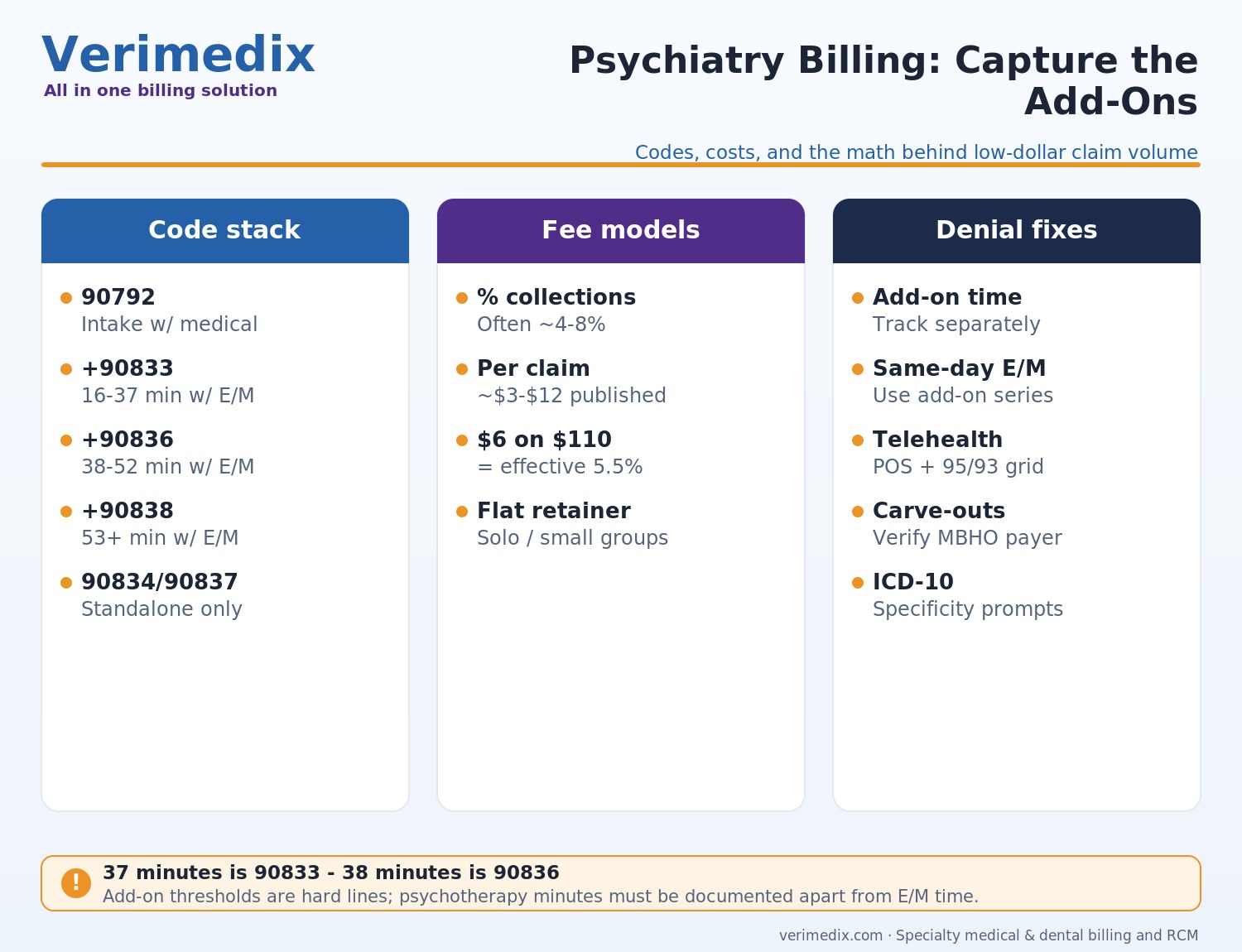
- The biggest revenue lever in psychiatry is add-on capture: 90833 (16–37 min), 90836 (38–52 min), and 90838 (53+ min) bill psychotherapy time alongside the same-day E/M — with separately tracked minutes.
- Standalone psychotherapy codes (90832/90834/90837) cannot be billed with an E/M on the same date; that swap is a classic denial generator.
- Telehealth remains central to psychiatry, which means POS and modifier discipline (95, 93, audio-only rules) on nearly every claim.
- Vet vendors on behavioral-health specifics: add-on capture auditing, telehealth edits, ICD-10 specificity, and payer-by-payer knowledge of session-frequency policies.
What a full-service psychiatry engagement includes
The service scope looks familiar on the surface — eligibility verification, coding review, claim submission, payment posting, denial appeals, patient statements, AR follow-up — but the specialty texture is different. Psychiatric practices generate large numbers of modest claims: a full day might produce twenty 99213/99214 visits with psychotherapy add-ons, a 90792 intake or two, and a telehealth mix that changes modifier and place-of-service requirements claim by claim. A competent psychiatry biller therefore invests in throughput and pattern discipline: scrubber rules tuned to behavioral-health edits, time-documentation checks for add-ons, and payer grids for telehealth and session-frequency policies.
Two scope questions deserve special attention in psychiatry. First, benefits verification: mental health benefits are frequently carved out to a managed behavioral health organization, so the “payer” on the card is not always the payer that processes the claim — a service that skips carve-out verification will chase misdirected claims for months. Second, patient collections: therapy-frequency visit patterns make small balances accumulate quickly, and you want a vendor whose statement cycle and payment-plan handling are humane enough not to damage therapeutic relationships.
The psychiatry code stack: 90792, E/M + add-ons, and time thresholds
Most psychiatric prescriber revenue flows through a small set of codes, which is precisely why systematic errors are expensive — a mistake repeated across a code you bill 300 times a month compounds.
| Code | Description | Key billing rule |
|---|---|---|
| 90791 | Psychiatric diagnostic evaluation (no medical services) | Used by non-prescribers; payer frequency limits often apply |
| 90792 | Psychiatric diagnostic evaluation with medical services | The psychiatrist/PMHNP intake; includes medical assessment — don’t bill an E/M for the same work |
| 99212–99215 | Established patient E/M (medication management) | Level by MDM or total time; the platform code for add-ons |
| +90833 | Psychotherapy 30 min with E/M | 16–37 documented psychotherapy minutes, separate from E/M time |
| +90836 | Psychotherapy 45 min with E/M | 38–52 minutes; 38 is the hard line up from 90833 |
| +90838 | Psychotherapy 60 min with E/M | 53+ minutes; documentation must justify the time |
| 90832 / 90834 / 90837 | Standalone psychotherapy 30/45/60 min | Never billed with a same-day E/M — use the add-on series instead |
The add-on time thresholds are hard lines: 37 documented psychotherapy minutes is 90833, 38 minutes is 90836. Two disciplines make the add-ons audit-proof: psychotherapy time recorded separately from E/M time (the same minutes can never count toward both), and a note that shows genuine psychotherapy content rather than extended med-management conversation. For the standalone series and the medical-necessity scrutiny around hour-long sessions, see our companion guide to 90837 vs 90834 psychotherapy billing.
Telehealth deserves its own line item: psychiatry retains one of the highest virtual-visit shares in medicine, and audio-video versus audio-only distinctions, POS codes, and payer-specific modifier preferences (95 vs 93) change how the same session is billed. Our modifier 95 vs 93 guide covers the mechanics.
Pricing models — and the low-dollar-claim math
Industry pricing guides quote outsourced billing at roughly 4–10% of collections, with behavioral health commonly in the 4–8% band, per-claim fees around $3–$12, and flat retainers for small practices. In psychiatry the model choice is not cosmetic, because average claim values are low. A $6 per-claim fee on a $110 psychotherapy claim is an effective 5.5% — on a $75 claim it is 8% — while the same fee on a procedure-heavy specialty would round to nothing.
| Model | Structure | Psychiatry-specific consideration |
|---|---|---|
| Percentage of collections | Often ~4–8% for behavioral health within the published 4–10% range | Scales naturally with the visit-heavy revenue pattern; confirm patient payments aren’t double-counted in the base |
| Per-claim fee | Roughly $3–$12 per claim per industry guides | Compute the effective percentage at your average claim value before comparing quotes |
| Flat monthly retainer | Fixed fee sized to provider count and volume | Works for solo and small groups with steady schedules |
| Hourly / hybrid | Hourly billing support or retainer plus percentage | Common for cleanup projects and old-AR recovery engagements |
Worked example (illustrative only). A two-psychiatrist practice runs 700 visits a month at an average collected value of $115 — about $80,500 monthly. A 6% vendor costs $4,830; a $6-per-claim vendor costs $4,200, an effective 5.2%. Now add the capture lever: if the service’s documentation prompts and coding audits raise psychotherapy add-on usage from 15% to 35% of eligible med-management visits — 120 additional add-ons at roughly $70 each, figures purely illustrative — that is $8,400 a month of new revenue, dwarfing the fee difference between the two quotes. Buy the capture discipline, not the cheapest rate.
Common psychiatry denials and the structural fixes
| Denial pattern | Root cause | Prevention / fix |
|---|---|---|
| Add-on denied with E/M | Psychotherapy time not documented separately, or content reads as med management | Note templates with distinct time fields; coder audit before submission |
| Standalone psychotherapy + same-day E/M | 90834/90837 billed where 90836/90838 belonged | Scrubber edit blocking the standalone series when an E/M is on the claim |
| Telehealth modifier/POS mismatch | Wrong POS (02 vs 10), missing 95/93, or audio-only billed where video is required | Payer telehealth grid applied at charge entry, updated as policies shift |
| Diagnosis specificity or coverage | Unspecified ICD-10 codes or diagnoses outside the payer’s covered list | Specificity prompts at documentation — see our mental health ICD-10 denial guide |
| Frequency/medical necessity reviews | Long or frequent sessions triggering payer utilization review | Outlier monitoring plus documentation that supports duration and frequency |
| Carve-out misdirection | Claim sent to the medical payer when behavioral health is carved out to an MBHO | Behavioral-health-specific eligibility verification at intake |
How to choose a psychiatry billing partner: a 7-question filter
- What share of your clients are behavioral health? A vendor with two therapy practices among 60 surgical clients will learn on your denials.
- How do you audit add-on capture? The right answer describes comparing E/M-only visits against documentation that would have supported 90833/90836/90838.
- Show me your telehealth edit grid. POS, modifier, and audio-only rules by payer, with a change log — not “we keep up with the rules.”
- How do you verify carved-out benefits? Listen for MBHO names and claims-address verification, not generic eligibility talk.
- What is your effective cost at my volume? Make per-claim vendors express their fee as a percentage of your average claim value.
- How do you handle patient balances? Statement cadence, payment plans, and escalation policy — in writing, given the sensitivity of the clinical relationship.
- What reporting will I see? Expect add-on utilization, denial categories, days in AR, net collection rate, and telehealth denial trends monthly.
For a deeper look at how these controls run inside a dedicated behavioral-health engagement, the psychiatry billing services page breaks down the workflow, and our guide to mental health billing services for therapists shows how the market segments by practice size.
Quick Answers
What are psychiatry billing services? Outsourced revenue cycle management specialized for psychiatric practices: coding review for 90792 evaluations and E/M-plus-psychotherapy add-on claims, telehealth modifier and POS edits, behavioral-health eligibility verification, denial appeals, and AR follow-up.
What is the difference between 90791 and 90792? Both are psychiatric diagnostic evaluations, but 90792 includes medical services — prescribing-capable clinicians such as psychiatrists and PMHNPs use it, while 90791 is the non-medical evaluation used by therapists and psychologists.
How do the psychotherapy add-on codes work? When a prescriber performs psychotherapy in the same visit as an E/M service, add-ons 90833 (16–37 minutes), 90836 (38–52), or 90838 (53+) are billed alongside the E/M, with psychotherapy time documented separately from E/M time.
How much do psychiatry billing services cost? Behavioral health engagements are commonly quoted around 4–8% of collections within the published 4–10% industry range, or $3–$12 per claim; because psychiatric claims are low-dollar, always convert per-claim quotes into an effective percentage.
Why was my psychotherapy add-on denied? The usual causes are psychotherapy time not documented separately from E/M time, a standalone code (90834/90837) billed instead of the add-on series, or payer policies requiring specific diagnosis support — each is preventable at charge entry.
Practices whose caseload leans toward therapy hours rather than medication management should price the work as behavioral health billing services instead — same time-based code discipline, a slightly different fee band, and credentialing handled for non-prescribing clinicians.
Frequently asked questions
Generally no — 90792 already includes the medical assessment, and payers treat billing both as duplicative for the same encounter. Practices typically choose the code that best represents the service; subsequent visits then flow through E/M codes with psychotherapy add-ons as appropriate.
No. Only face-to-face psychotherapy minutes count toward 90833/90836/90838, and they must be documented separately from E/M time — the same minutes can never support both services. This separation is the first thing auditors check on combined visits.
Often, yes — solo psychiatrists lose the most to under-coding and unbilled add-ons because there is no billing staff double-checking capture. Compare the quoted fee against your current denial write-offs plus an honest estimate of add-on revenue you are leaving undocumented.
Virtual sessions bill the same CPT codes but with telehealth-specific place-of-service codes and modifiers (95 for audio-video, 93 for audio-only where permitted), and payer rules differ on which services qualify. A billing service should maintain a payer-by-payer telehealth grid and update it as policies change.
Well-run behavioral health billing typically targets a net collection rate in the mid-90s percentage range, days in AR under about 35, and a first-pass clean claim rate above 95% — with add-on utilization tracked as a capture metric rather than left invisible. Ask vendors which of these they will commit to reporting monthly.