
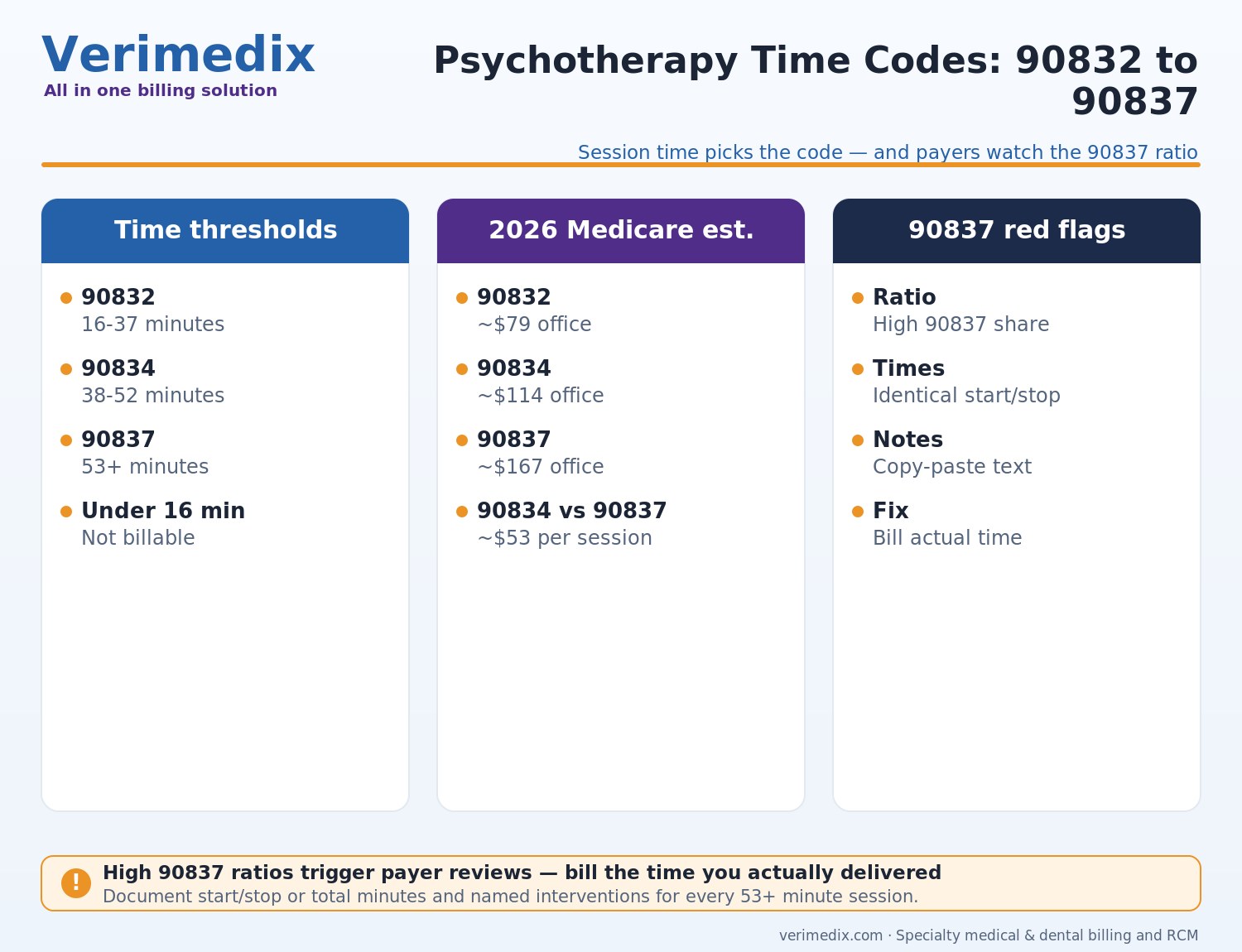
- Psychotherapy codes are chosen by documented face-to-face session time: 90832 covers 16-37 minutes, 90834 covers 38-52 minutes, and 90837 covers 53 minutes or more. Sessions under 16 minutes are not separately billable.
- Under the 2026 Medicare fee schedule, 90837 pays roughly $167 nationally in the office setting versus about $114 for 90834 — a gap of about $53 per session that payer analytics watch closely.
- High 90837-to-90834 ratios, identical start and stop times, and copy-forwarded notes are the three patterns most often cited in payer outlier letters and audits.
- Prescribers billing an E/M visit with same-day therapy use the add-on codes 90833, 90836, or 90838 — and psychotherapy time can never count toward the E/M level.
- Telehealth sessions bill the same time-based codes with modifier 95 (video) or 93 (audio-only) and the correct place-of-service code, subject to payer policy.
- The defensible position is simple: bill the time you actually delivered, document start/stop or total minutes, and let session length follow clinical need.
The psychotherapy time codes: 90832, 90834, 90837
Individual psychotherapy billing runs on a three-rung ladder, and the rung is determined by face-to-face time with the patient (and/or family member when the patient is present for part of the service) — not by the length of the scheduled slot, and not by time spent writing the note afterward. CPT assigns each nominal code a billable range:
| Code | Nominal length | Billable time range | 2026 Medicare national, office (approx.) |
|---|---|---|---|
| 90832 | 30 minutes | 16-37 minutes | ~$79 |
| 90834 | 45 minutes | 38-52 minutes | ~$114 |
| 90837 | 60 minutes | 53+ minutes | ~$167 |
Three boundary rules cause most of the confusion. A session shorter than 16 minutes of psychotherapy is not separately reportable at all. A 52-minute session is 90834, not 90837 — there is no rounding up at the boundary. And the widely used "50-minute therapy hour" lands squarely in 90834 territory; 90837 begins only at minute 53. Rates above are national estimates from the 2026 physician fee schedule and vary by locality; commercial allowables differ by contract, often ranging well above Medicare for in-network outpatient therapy.
Choosing between 90834 and 90837
The honest answer is that you do not choose the code — you choose the clinically appropriate session length, and the code follows the clock. Where practices get into trouble is treating 90837 as a default because it pays more, or treating 90834 as a default because it feels safer. Both habits create billing patterns that diverge from the actual clinical work.
Longer sessions are clinically defensible when the treatment itself requires them: trauma-focused protocols such as prolonged exposure and EMDR that need setup and stabilization time, severe symptom exacerbations, complex family dynamics reviewed with the patient present, or high-acuity patients who decompensate with shortened contact. When that is the case, say so — the treatment plan should reflect why this patient needs extended sessions, and each note should show what filled the time. For a patient in active crisis, note that the crisis codes 90839 and 90840 may be more accurate than 90837, depending on the presentation and payer policy.
2026 reimbursement and what the gap is worth
The roughly $53 Medicare spread between 90834 and 90837 compounds quickly at caseload volume, in both directions.
Worked example (illustrative): a full-time therapist completes about 1,100 sessions a year. Suppose 30% of them genuinely run 53 minutes or longer, but the practice bills everything as 90834 out of audit anxiety. That is 330 sessions underbilled by about $53 each — roughly $17,500 a year in delivered-but-unbilled work at Medicare-level rates, more on many commercial contracts. Now invert it: a practice that bills 90837 on sessions that actually ran 45 minutes faces the same math as recoupment exposure, plus interest and the cost of responding to record requests. Accurate timekeeping is worth five figures a year either way.
Why payers flag 90837 — and what triggers reviews
Because 90837 pays materially more for the same encounter type, payer analytics treat its utilization rate as a screening statistic. Several large commercial payers have historically sent outlier letters to clinicians whose 90837 share sat far above peers — Optum's letters to high-90837 providers were widely reported in the behavioral health community — and some plans have at times required justification or applied prepayment review to the code. Billing consultants consistently report that practices with unusually high 90837 ratios draw record requests first. None of this makes 90837 improper; it makes weak documentation expensive.
| Red flag | What the payer sees | Fix |
|---|---|---|
| 90837 share far above specialty peers | Utilization outlier on claims analytics | Bill actual time; be able to explain the clinical model (e.g., trauma protocols) driving longer sessions |
| Identical start/stop times across sessions | 3:00-3:53 on every claim, every patient | Record real times per session; natural variation is expected |
| Sessions clustered at exactly 53 or exactly 60 minutes | Threshold-driven rather than clinically driven lengths | Document what occupied the time, not just that it elapsed |
| Copy-forwarded progress notes | Text-similarity algorithms flag near-duplicate notes | Individualize interventions, patient response, and plan each session |
| No time documentation at all | Nothing in the record supports the code selected | Start/stop times or total minutes in every note |
If a payer letter does arrive, respond with data rather than defensiveness: session-time distributions, treatment plans supporting extended sessions, and complete notes. Practices that outsource this work should confirm their billing partner tracks 90837 ratios proactively — it is a standard metric in our behavioral health billing services service line, and a routine topic in the payer audits we help therapy practices answer.
Billing psychotherapy with E/M: 90833, 90836, 90838
Psychiatrists and psychiatric NPs who provide medication management and therapy in the same encounter do not bill 90834 or 90837 alongside the E/M code. Instead, CPT provides add-on codes reported with 99212-99215:
| Add-on code | Psychotherapy time | Reported with |
|---|---|---|
| 90833 | 16-37 minutes | E/M code 99212-99215 |
| 90836 | 38-52 minutes | E/M code 99212-99215 |
| 90838 | 53+ minutes | E/M code 99212-99215 |
Two rules keep these claims clean. The psychotherapy must be a distinct, documented service — time-based, with its own interventions — and that time is carved out separately from the E/M work. And because psychotherapy minutes cannot count toward the E/M level, the safest practice is to select the E/M level on medical decision making rather than time. Payers reviewing these combination claims look first for double-counted time.
Telehealth sessions: modifiers 95 and 93
Teletherapy bills the same time-based codes. Synchronous video sessions carry modifier 95; audio-only sessions, where covered, carry modifier 93 — Medicare permits audio-only behavioral health services in defined circumstances, while commercial and Medicaid rules vary by plan and state. Use the place-of-service code the payer expects (POS 10 for the patient's home, POS 02 otherwise, for most payers). Time thresholds and documentation standards are identical to in-person care; see our full guide to telehealth CPT codes in 2026 for platform and consent requirements.
A 90837 documentation checklist
Before a 53+ minute session leaves the billing queue, the note should answer yes to each of these:
- Start and stop times (or total face-to-face minutes) recorded, and they support 53+
- Diagnosis on the claim matches the active treatment plan — see our guide to mental health ICD-10 codes for specificity pitfalls
- Therapeutic modality named (CBT, EMDR, psychodynamic, etc.)
- Specific interventions used this session, in this patient's context
- Patient response and progress toward measurable treatment-plan goals
- Clinical rationale for extended session length, when the pattern is recurring
- Plan for the next session, individualized rather than templated
Quick Answers
What is the difference between CPT 90837 and 90834? Session time. 90834 covers individual psychotherapy of 38-52 minutes; 90837 covers 53 minutes or more. The documented face-to-face time, not the scheduled length, determines the code.
Can I bill 90837 for a 50-minute session? No. A 50-minute session falls in the 38-52 minute range and is billed as 90834. 90837 begins at 53 minutes.
How much does 90837 pay in 2026? Approximately $167 under the national Medicare physician fee schedule in the office setting, versus about $114 for 90834. Actual rates vary by locality and by commercial contract.
Why do insurance companies flag 90837? Because it pays more for the same encounter type, payers monitor each clinician's 90837-to-90834 ratio. Outlier ratios, identical session times, and duplicated notes trigger records requests and audits.
Is 90837 covered by telehealth? Generally yes for video sessions billed with modifier 95, and Medicare covers audio-only behavioral health with modifier 93 in defined circumstances. Commercial coverage varies, so verify per plan.
What if a session runs under 16 minutes? Individual psychotherapy under 16 minutes is not separately billable under CPT time rules. Document the contact, but do not report 90832.
Frequently asked questions
Best practice is yes. CPT technically requires that documented time support the code, and many payers expect start/stop times or explicit total minutes in behavioral health notes. Identical times across every session are themselves an audit flag, so record real values.
Usually not, but some commercial plans have required authorization or clinical justification for routine 60-minute sessions at various times, and plan rules change. Verify benefits for extended sessions during eligibility checks rather than discovering the policy through a denial.
Yes — the code should match each session's actual length, so natural variation across a course of treatment is normal and even protective. What draws scrutiny is a uniform pattern that suggests the code was chosen before the session happened.
Family psychotherapy uses 90847 (patient present) or 90846 (without the patient), which are not part of the 90832-90837 individual time ladder. Billing 90837 for what was functionally a family session is a common and avoidable coding error.
Respond with evidence: your session-time distribution, treatment plans supporting extended sessions, and complete progress notes. Do not abruptly change billing behavior to mask the pattern — payers can see that too. A billing partner experienced in behavioral health can manage the response.