
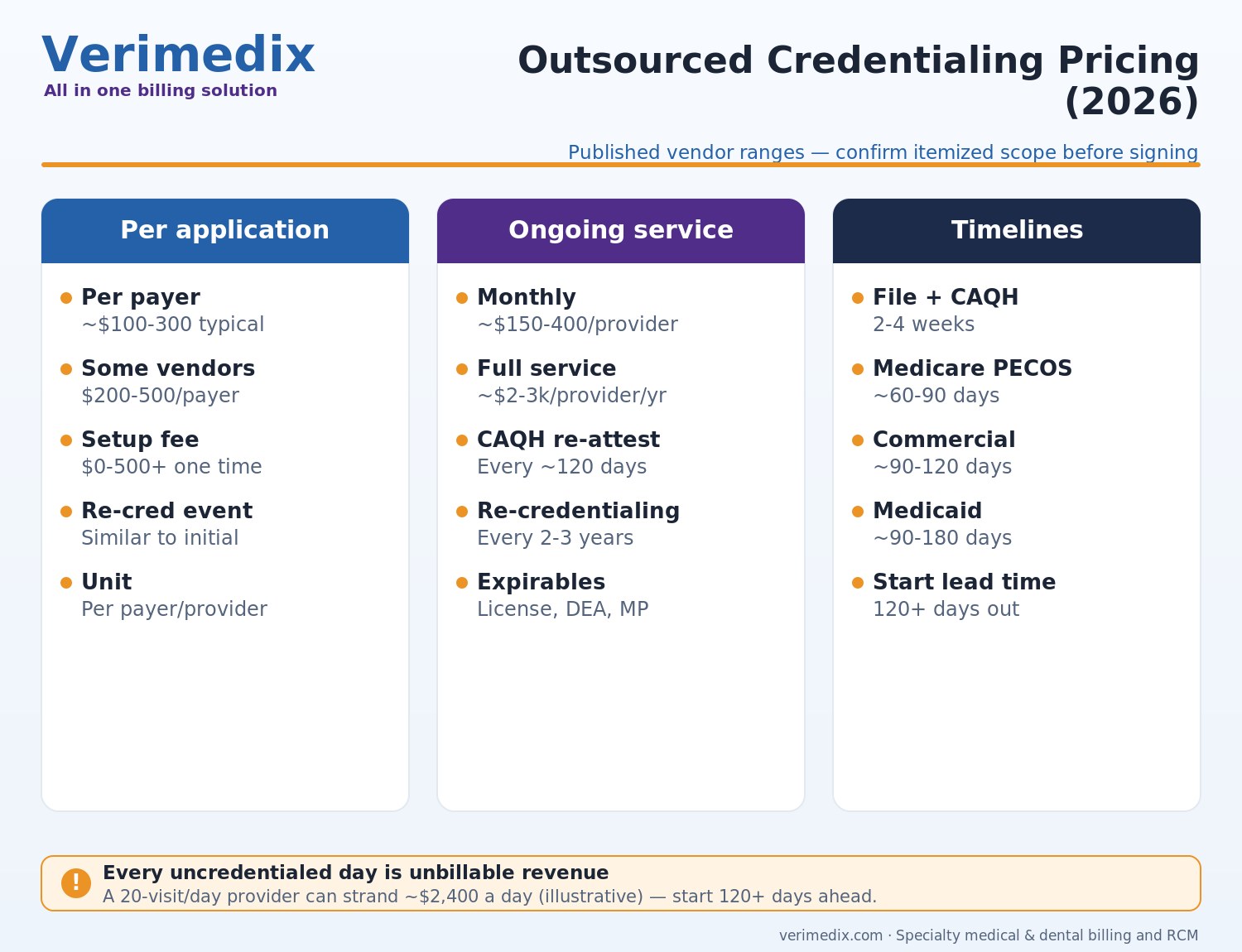
- The most commonly published price for outsourced credentialing is $100-$300 per payer application per provider, with some vendors quoting $200-$500; ongoing maintenance is often $150-$400 per provider per month.
- Vendor surveys put full-service credentialing at roughly $2,000-$3,000 per physician per year — always confirm exactly which tasks that covers.
- Core scope should include CAQH ProView setup and 120-day re-attestations, Medicare enrollment via PECOS (CMS-855 forms), commercial and Medicaid applications, and documented payer follow-up.
- Credentialing is not contracting: getting approved by a payer and negotiating your fee schedule are separate services — many vendors only do the first.
- Typical timelines: 2-4 weeks for CAQH setup, roughly 60-90 days for Medicare, 90-120 days for most commercial payers. Start at least 120 days before a provider's first clinic day.
- Every uncredentialed day is unbillable revenue — the cost of the service is usually small against the cost of a provider who can't bill.
What outsourced credentialing services actually include
When a credentialing company quotes you a per-payer fee, you are buying project management of a bureaucratic process — the same work our insurance credentialing services team runs for practices: assembling a provider's file, submitting applications to each payer, and chasing those applications until an effective date lands. A competent full-scope service typically covers:
- Provider file build: licenses, DEA, board certification, malpractice face sheet, work history with gap explanations, hospital privileges, and disclosure questions — the same document set in our provider credentialing checklist.
- CAQH ProView setup and upkeep, including the re-attestation most commercial payers require roughly every 120 days.
- Medicare enrollment through PECOS (CMS-855I/855R for individual providers, 855B for groups) and state Medicaid portal enrollment.
- Commercial payer applications and panel requests, submitted per payer per provider.
- Follow-up and escalation: scheduled status calls with payer reps, correction of returned applications, and documentation of every touch.
- Ongoing maintenance: expirables tracking (licenses, DEA, malpractice), re-credentialing every 2-3 years depending on the payer, Medicare revalidation, and roster updates.
Two boundary lines matter. First, primary source verification is ultimately performed by the payer or its CVO — your vendor's job is to make the file verifiable, not to replace that step. Second, credentialing is not contracting: being approved to join a network and negotiating the fee schedule you'll be paid are different projects, and many vendors quote only the former. If you're new to the process itself, our complete guide to medical credentialing explains the mechanics end to end; this article stays focused on what buying it should cost.
Outsourced credentialing pricing in 2026
Published vendor pricing clusters into three layers. Ranges below reflect figures published by credentialing companies and industry cost surveys — treat them as directional and get scope-itemized quotes in writing. Full-service RCM partners such as Verimedix bundle credentialing with billing — CAQH maintenance, payer enrollment, and revalidation tracking handled by the same team that files the claims, which removes the vendor-handoff gap that delays first billable dates.
| Pricing component | Commonly published range | Billing unit | Notes |
|---|---|---|---|
| Initial application | $100-$300 (some vendors $200-$500) | Per payer, per provider | The headline number — multiply by your payer count |
| Setup / onboarding fee | $0-$500+ | Per provider, one time | Often covers file build and CAQH profile creation |
| Ongoing maintenance | $150-$400 | Per provider, per month | Re-attestations, expirables, roster upkeep |
| Full-service annual | ~$2,000-$3,000 | Per physician, per year | Survey range for soup-to-nuts outsourcing |
| Re-credentialing event | Often similar to initial app | Per payer, per provider | Every 2-3 years depending on payer |
Pricing models vary: some firms bill strictly per application, some bundle unlimited payers into the monthly fee, and some fold credentialing into a broader billing contract. Per-application pricing favors small stable practices; flat monthly pricing favors groups that add providers or payers often.
CAQH, PECOS and payer enrollment: who does what
Buyers get burned when they assume one application feeds every payer. It doesn't — there are three distinct rails, and your vendor should be fluent in all of them:
- CAQH ProView is the shared application database most commercial payers and many Medicare Advantage plans pull from. The vendor builds the profile, authorizes payers, and — critically — re-attests on the roughly 120-day cycle. A missed attestation can stall re-credentialing by weeks.
- PECOS is Medicare fee-for-service enrollment, run on CMS-855 forms; original Medicare does not use CAQH. Expect revalidation cycles (generally every five years for most providers) that the vendor should calendar.
- State Medicaid programs enroll through their own portals with their own document quirks and, in several states, the longest queues of the three rails.
Timelines below are the ranges credentialing vendors and industry guides most often publish. Payers commit to none of them, so build slack into start dates:
| Step | Typical published timeline |
|---|---|
| File build + CAQH ProView setup | 2-4 weeks |
| Medicare enrollment (PECOS) | ~60-90 days |
| Commercial payer credentialing | ~90-120 days per payer |
| State Medicaid enrollment | ~90-180 days, state-dependent |
| Re-credentialing cycle | Every 2-3 years, payer-dependent |
Worked example: credentialing a three-provider practice (illustrative)
A new three-provider group joining 12 payers each, at a mid-range $200 per application:
- Initial applications: 3 providers × 12 payers × $200 = $7,200, plus perhaps a $300 setup fee per provider ($900).
- Maintenance: 3 providers × $250/month = $9,000 per year ongoing.
- The other side of the ledger: a provider seeing 20 visits a day at a $120 average reimbursement generates about $2,400 per clinic day. If credentialing slips 30 business days past the start date, that's roughly $72,000 in visits that are delayed, written off, or billed out-of-network — an order of magnitude more than the entire credentialing spend.
Every figure above is illustrative, but the asymmetry is the point: nobody has ever saved money by letting a $200 application sit unsubmitted.
In-house vs outsourced credentialing
| Factor | In-house coordinator | Outsourced service |
|---|---|---|
| Cost shape | Salary plus software — a fixed cost regardless of volume | Per application or per provider per month — scales with need |
| Payer know-how | Learns your payers deeply; thin bench of one | Sees hundreds of files across payers; knows which reps to call |
| Follow-up persistence | Competes with every other front-office task | Its entire job; ask for documented touch cadence |
| Turnover risk | High — one resignation strands every in-flight file | Vendor absorbs staffing churn |
| Visibility | Total, if tracked well | Depends on reporting — demand a per-payer status grid |
| Usually wins when | 10+ providers with constant onboarding, or heavy delegated credentialing | Small-to-mid groups, new practices, or growth spurts |
The crossover point is scale: once a group is onboarding providers monthly, a dedicated in-house coordinator (roughly a $45,000-$60,000 salary in most markets, before benefits) starts beating per-application fees. Below that, outsourcing usually wins on both cost and speed. There's also a middle path: practices that want in-house control without the hiring risk increasingly staff the credentialing desk through dedicated billing staff under your brand — a trained credentialing specialist who works your files, in your systems, at a flat monthly rate. How that desk fits alongside billers and AR staff is mapped in our guide to medical billing team structure.
Questions to ask before you sign
Score vendors against this checklist — specific, verifiable answers or keep shopping:
- Exactly which payers and how many applications does the quote cover? Per-payer pricing hides fast multiplication.
- Is payer contracting included, or credentialing only? Get the boundary in writing.
- What is your follow-up cadence? Look for scheduled payer contact (weekly or biweekly) with logged notes you can see.
- How do you report status? A live per-payer, per-provider grid with dates — not a monthly email.
- Who owns the CAQH login and the 120-day attestations? You should retain account ownership even if the vendor maintains it.
- What happens on a returned or denied application? Corrections should be included, not billed as new work.
- Do you track expirables and re-credentialing dates after go-live? If not, you're buying a project, not a service.
- Can you name clients my size in my state? Medicaid queues and payer quirks are local knowledge.
Red flags: guarantees of specific approval timelines (payers don't grant them), refusal to itemize per-payer pricing, and "credentialing complete" claims without payer effective dates. If you're also comparing billing partners at the same time, the vetting framework in our guide to choosing a medical billing outsourcing company pairs well with this one — many practices bundle the two decisions.
Quick Answers
How much do outsourced credentialing services cost? The most commonly published range is $100-$300 per payer application per provider, with some vendors quoting $200-$500. Ongoing maintenance typically runs $150-$400 per provider per month, and full-service surveys cluster around $2,000-$3,000 per physician per year.
What's included in outsourced credentialing? Provider file assembly, CAQH ProView setup and 120-day re-attestations, Medicare enrollment via PECOS, Medicaid and commercial payer applications, follow-up until effective dates issue, and usually expirables tracking. Payer contract negotiation is typically a separate service.
How long does credentialing take? Published norms are 2-4 weeks to build the file and CAQH profile, roughly 60-90 days for Medicare, 90-120 days for most commercial payers, and up to 180 days for some state Medicaid programs. Start at least 120 days before the provider's first clinic day.
Is CAQH the same as PECOS? No. CAQH ProView feeds most commercial payers and many Medicare Advantage plans; PECOS is the CMS system for original Medicare enrollment using CMS-855 forms. Providers generally need both maintained.
When should credentialing stay in-house? Generally once a group is large enough to keep a dedicated coordinator busy — roughly 10+ providers with regular onboarding — or when a health system requires delegated credentialing. Smaller practices usually come out ahead outsourcing or using dedicated white-label staff.
Frequently asked questions
Published vendor ranges run $100-$300 per payer application per provider (some quote $200-$500), so a provider joining 12 payers might cost roughly $1,200-$3,600 in initial applications. Full-service surveys cluster around $2,000-$3,000 per physician per year, and maintenance-only plans typically run $150-$400 per provider per month.
File assembly, CAQH ProView setup and 120-day re-attestations, PECOS enrollment for Medicare, Medicaid and commercial applications, documented payer follow-up until effective dates issue, and ongoing expirables and re-credentialing tracking. Confirm whether payer contract negotiation is included — it usually is not.
Commonly published timelines are 90-120 days for commercial payers, about 60-90 days for Medicare through PECOS, and 90-180 days for state Medicaid programs, after a 2-4 week file and CAQH build. Payers don't guarantee timelines, so start at least 120 days before the provider's first scheduled clinic day.
A full-scope service should manage both: building and re-attesting the CAQH ProView profile roughly every 120 days for commercial payers, and enrolling the provider in Medicare through PECOS using the CMS-855 forms. Ask who retains login ownership — the practice should.
Generally at scale: once a group onboards providers frequently enough to keep a dedicated coordinator (roughly $45,000-$60,000 salary plus software) fully occupied, fixed cost beats per-application fees. Small and mid-size practices usually save with outsourcing or a dedicated white-label credentialing specialist.