
- An outpatient therapy billing consultant diagnoses workflow problems; a billing company performs an agreed revenue-cycle scope; software supplies tools. Confirm which role you are buying.
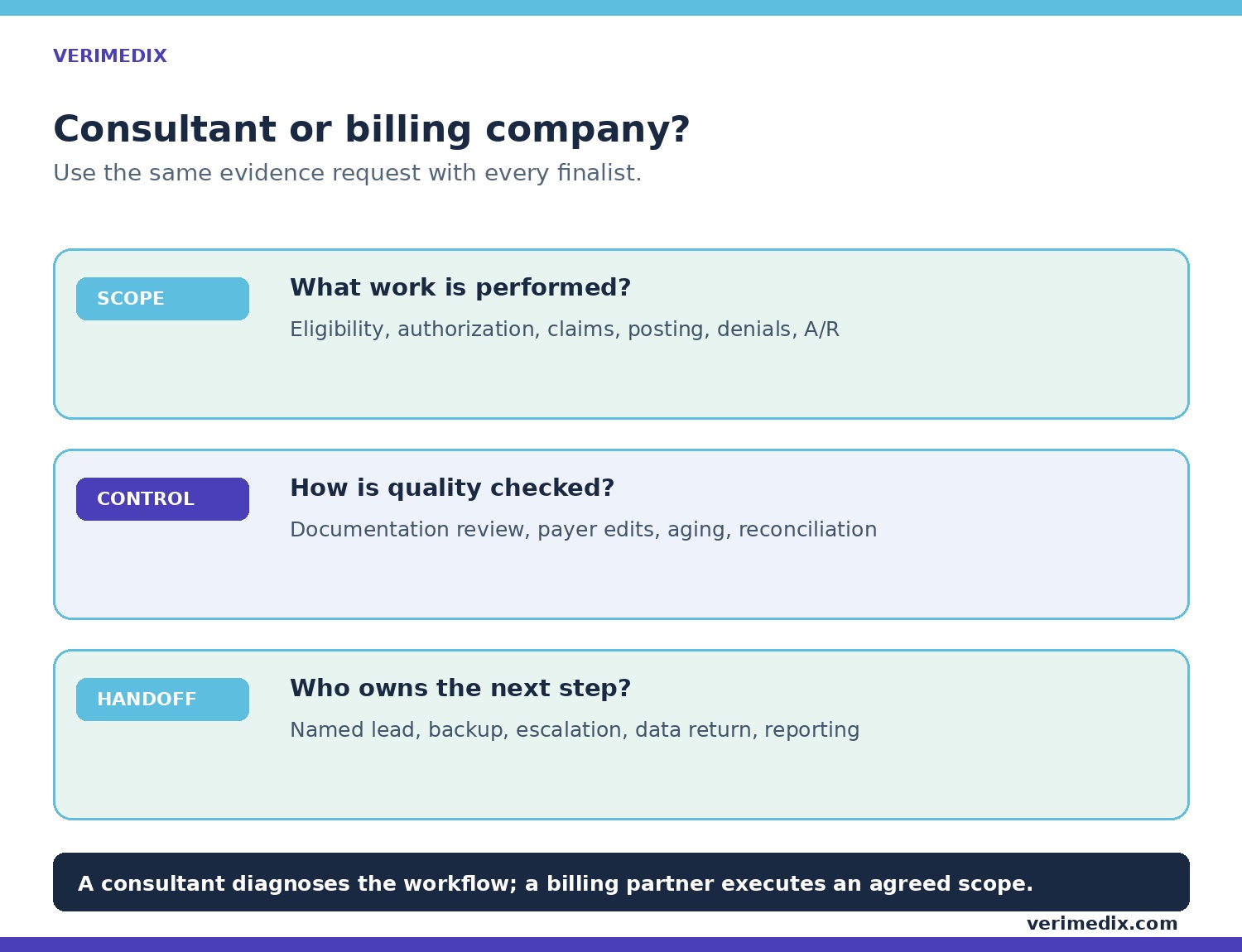
- Ask for a written map of eligibility, authorization, charge capture, claim submission, payment posting, denials, and aged A/R ownership.
- Require PT, OT, or speech-therapy experience that matches your payer mix and documentation workflow, not only a generic medical-billing résumé.
- Use evidence—sample reports, work-queue definitions, reconciliation steps, and a transition plan—to compare finalists.
- For Medicare work, compare the proposed workflow with current CMS therapy-services guidance and the payer instructions that apply to your patients.
What does an outpatient therapy billing consultant do?
An outpatient therapy billing consultant reviews how a practice moves from scheduling and benefits verification to authorization, documentation, charges, claims, payment posting, denials, and follow-up. The deliverable may be a diagnostic report, workflow redesign, staff training, vendor-selection support, or implementation oversight. The scope is not automatic: one consultant may advise your team while another may also perform limited operational work.
That distinction matters because outpatient therapy revenue can stall at several handoffs. An authorization may not reach scheduling, a charge may not reconcile to the daily note, a rejection may sit in an unassigned queue, or an old account may lack a documented next action. A consultant should identify where the handoff breaks and tie each recommendation to an owner, evidence, and due date.
How is a consultant different from a billing company?
| Option | Primary role | Question to ask |
|---|---|---|
| Consultant | Diagnoses, designs, trains, or oversees a workflow | What will be delivered, and who implements it? |
| Billing company | Performs the contracted revenue-cycle tasks | Which team owns claims, posting, denials, and A/R after go-live? |
| Therapy software | Provides documentation, scheduling, reporting, or billing tools | Which work is automated, and which still requires staff review? |
A practice may need one option or a combination. A consultant can help select or transition a billing partner; a billing company can execute the agreed work; an EMR or therapy platform can support the workflow. Do not treat software features or a consultant’s recommendations as proof that claims, denials, or patient balances will be managed by a human team.
Use Verimedix’s physical therapy billing company guide and physical therapy billing services and pricing guide to build a comparison brief before requesting proposals.
What should you ask before hiring?
Send every finalist the same questions. A written answer is more useful than a broad specialty label:
- What is included? Separate assessment, workflow design, staff training, eligibility, authorization tracking, charge review, claim work, payment posting, denial follow-up, patient statements, and A/R.
- Who does the work? Ask for the roles, therapy experience, coverage hours, backup contact, and escalation path for the account.
- How are therapy controls handled? Ask how the team monitors benefits, authorization status, plan-of-care checkpoints, visit limits, documentation exceptions, and payer-specific edits. Do not accept a universal rule in place of payer-aware controls.
- What reports will we receive? Request sample definitions for clean claims, rejections, denials, aging, payments, unresolved accounts, and reconciliation. A metric without a definition is not a service level.
- How does technology connect? Confirm the EMR, clearinghouse, access permissions, export format, claim-status workflow, and the owner of interface failures.
- How does the engagement end? Define data return, open-claim ownership, credential and access removal, documentation handoff, and final reconciliation.
What evidence should a consultant review?
A useful review starts with representative records and work queues, not only a high-level collections report. Ask the consultant to sample:
- Eligibility and authorization records against scheduled and completed visits.
- Daily charges against the therapy documentation and the claim transmission record.
- Rejected and denied claims grouped by root cause, owner, age, and next action.
- Payments and adjustments reconciled to remittance information and the practice ledger.
- Aged A/R with a documented follow-up cadence and escalation threshold.
- Patient-balance workflows, refund controls, and privacy-aware access permissions.
For Medicare therapy context, use the current CMS therapy-services page alongside applicable payer manuals. The consultant should explain how the practice will operationalize current requirements, while clinical documentation remains the treating professional’s responsibility.
How should you structure the engagement?
Start with a fixed discovery scope and a short list of measurable deliverables. For example, require a current-state map, a risk-ranked findings register, a future-state workflow, named owners, a training plan, report definitions, and a 30- or 60-day review cadence. If the consultant will also perform billing work, put that work in a separate statement of work so advisory recommendations and execution responsibilities do not blur.
Protect continuity during a transition. Set read-only access where possible during discovery, document who can change charges or claim status, and agree how open accounts will be handed back if the engagement ends. Confirm security, confidentiality, data retention, and breach-notification responsibilities with counsel and your compliance lead.
Once the workflow is stable, compare the practice’s results with a consistent baseline rather than a single month. Useful review questions include: Are unresolved authorizations falling? Are rejection and denial queues assigned? Are payments reconciled? Are old accounts receiving documented action? Which issues remain payer or documentation dependent?
For a broader operational comparison, see Verimedix physical therapy billing services and therapy billing services guidance. The right engagement is the one that makes responsibilities visible and keeps the practice in control of its records and payer decisions.
Frequently asked questions
A consultant reviews the practice’s therapy revenue-cycle workflow and may provide diagnosis, redesign, training, vendor-selection, or implementation support. Confirm whether the engagement is advisory, hands-on, or both.
No. A consultant typically diagnoses or improves a workflow, while a billing company performs the revenue-cycle tasks in its contract. Some firms offer both, so require a written division of responsibilities.
Ask about therapy-specific experience, authorization and visit-limit controls, documentation review, denial ownership, report definitions, EMR integration, security, named staff, deliverables, and data handoff.
No responsible engagement should promise a universal result. Collections depend on documentation, payer rules, eligibility, authorization, contracts, patient balances, and execution. Require a baseline, defined work, and a review cadence instead.
It depends on the problem and scope. Begin with a defined discovery phase, then set implementation milestones and a follow-up review rather than accepting an open-ended timeline without deliverables.