- Oncology claims carry two components — administration codes and drug J-codes — and most leakage happens on the drug side, where one unit error can cost thousands.
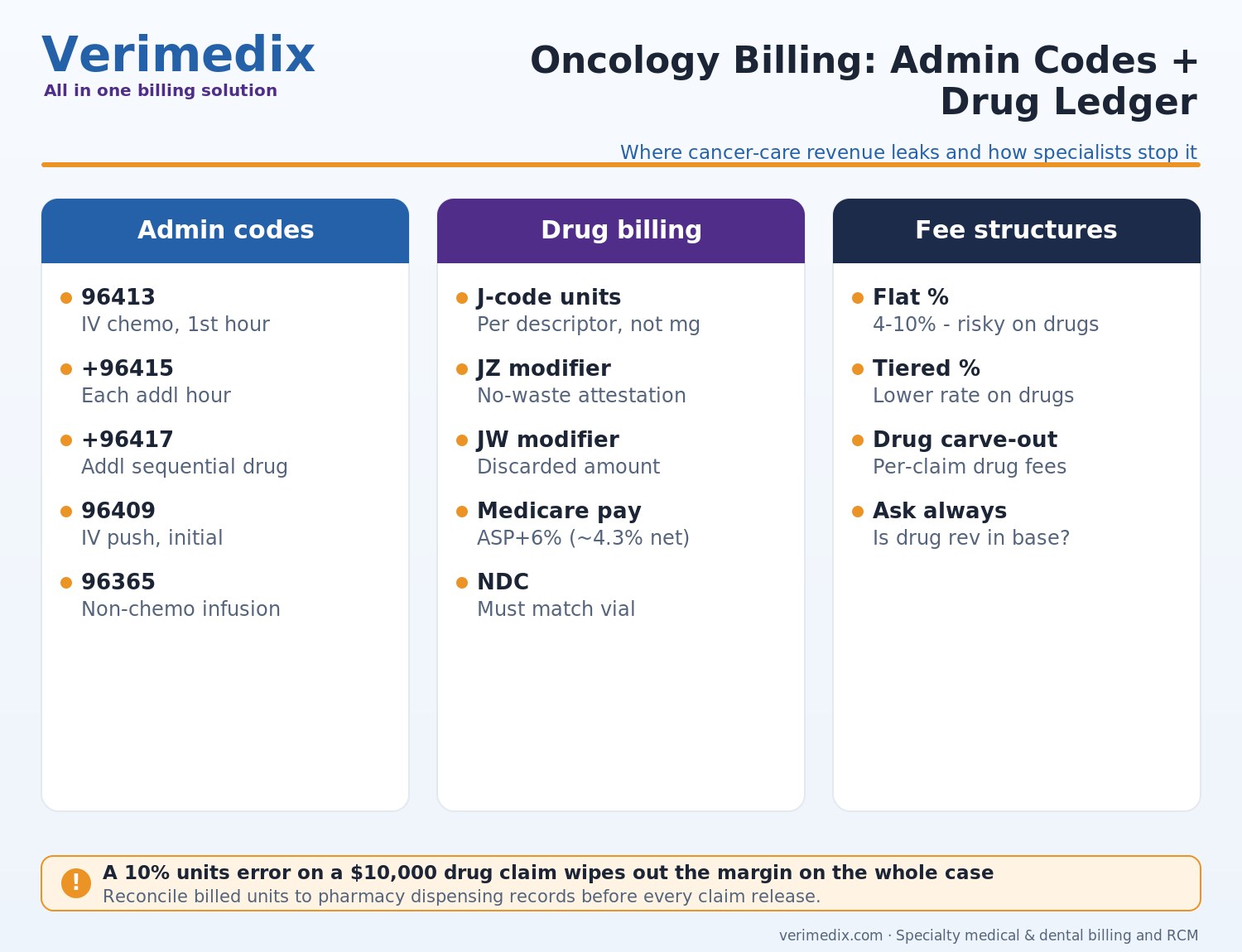
- CPT 96413 reports the first hour of IV chemotherapy; +96415 adds each additional hour; +96417 reports each additional sequential drug. Only one “initial” code per encounter per access under the infusion hierarchy.
- Medicare pays Part B drugs at ASP+6% by statute — effectively nearer ASP+4.3% after sequestration per MedPAC analyses — so buy-and-bill margins leave no room for error.
- JZ is expected on single-dose-vial drugs with no discarded amount; JW reports wastage. Missing modifiers and NDC/unit mismatches are among the most common oncology drug denials.
- Published billing fees run roughly 4–10% of collections; the decisive oncology contract question is whether the percentage applies to drug revenue.
- Vet vendors on oncology-specific proof: infusion-hierarchy coding, drug-unit auditing, prior-auth tracking by regimen and cycle, and denial recovery on high-dollar drug claims.
What you get when you outsource oncology billing
A practice shopping for oncology billing support is buying two intertwined services. The first is conventional revenue cycle work: eligibility, coding, claim submission, posting, appeals, and AR follow-up. The second — the one separating specialists from generalists — is drug-revenue management: verifying J-code units against the dose administered and the HCPCS billing unit, matching NDC numbers on the claim, applying JW/JZ modifiers correctly, tracking prior authorizations by regimen and cycle rather than by visit, and auditing drug reimbursement against ASP-based or contracted rates every quarter when pricing files change.
Ask any prospective vendor to describe their drug-claim audit before anything else: a practice can lose more on one mis-billed drug claim than on a month of E/M errors, and a biller who can’t explain unit reconciliation against administration records is not an oncology biller.
Chemotherapy administration codes and the infusion hierarchy
Administration coding follows a strict hierarchy: one “initial” service per encounter per IV access — chemo outranks therapeutic infusions, which outrank hydration — with everything else on add-on or sequential codes regardless of the order drugs were given. Documented start and stop times are the backbone; without them, additional-hour codes are indefensible.
| Code | Description | Billing rule to watch |
|---|---|---|
| 96413 | IV chemotherapy infusion, up to 1 hour, single or initial drug | One initial code per encounter/access; needs documented infusion time |
| +96415 | Each additional hour of the same chemo infusion | Add-on to 96413; generally requires more than 30 minutes into the next hour per time rules |
| +96417 | Each additional sequential chemo infusion, different drug, up to 1 hour | Add-on to 96413; new drug through the same access |
| 96416 | Initiation of prolonged chemo infusion (>8 hours) via pump | Portable/implantable pump cases |
| 96409 / +96411 | IV push chemo, initial / each additional drug | Push vs infusion is a time-and-technique distinction — document it |
| 96401 / 96402 | Chemo injection, subcutaneous/IM, non-hormonal / hormonal | Frequently under-coded as generic injections |
| 96365 / +96366 | Therapeutic (non-chemo) infusion, initial / each additional hour | Supportive drugs (e.g., monoclonals payers classify as non-chemo) sit here |
| 96360 / +96361 | Hydration, initial / each additional hour | Lowest in hierarchy; not separately billable when running concurrently as a vehicle |
Payer classification matters as much as pharmacology: the same biologic may take chemo administration codes under one payer’s policy and therapeutic-infusion codes under another’s — a specialty biller maintains that grid payer by payer.
J-codes, units, and the JW/JZ modifiers
Every separately billable drug goes on the claim as a HCPCS Level II J-code (or Q-code for newer entries) with units defined by the code descriptor — not by vial, not by milligram unless the descriptor says so. Get the unit math wrong and the claim underpays quietly or overbills in a way auditors love to find. Our primer on what a J-code is in medical billing covers the fundamentals; the oncology layer is volume — dozens of high-dollar drug lines daily, so unit reconciliation must be systematic.
Two modifiers govern discarded drug from single-dose vials: JW reports the discarded amount, and JZ attests that nothing was discarded — CMS has required JZ on applicable no-waste claims since mid-2023, and claims missing the attestation are subject to rejection. The full rules, including which vials qualify and how units split across lines, are in our JW and JZ modifier drug wastage guide. For a billing service, this is table stakes: ask how their claim scrubber enforces JW/JZ before submission, and how they reconcile wastage against pharmacy dispensing records.
Buy-and-bill economics: why billing accuracy is existential
Community practices typically purchase infusion drugs, administer them, and bill payers afterward — buy-and-bill. Medicare Part B reimburses separately payable drugs at ASP plus 6% by statute, but the 2% sequester trims the federal share, so the effective rate is widely cited at roughly ASP+4.3% (documented by MedPAC and community-oncology analyses). Drugs acquired above ASP can be outright “underwater.” Commercial contracts vary — ASP-plus or AWP-based formulas are common — but the margin story is similar: thin and shrinking.
Worked example (illustrative only). Suppose a regimen’s drug cost to the practice is $9,600 and the payer allowable is $10,000, a 4% gross margin of $400. If a units error shorts the claim by 10%, the practice collects $9,000 — a $600 loss on a case that should have made $400. At 200 drug claims a month averaging $5,000, even a 1% net drug-revenue leak is $10,000 a month, before counting carrying costs on inventory the practice already paid for. This asymmetry is why oncology billing quality is measured on the drug ledger, not the visit ledger, and why days in AR matter more in oncology than almost any other specialty.
Pricing models — and the drug-revenue question
Published pricing spans roughly 4–10% of net collections, complex specialties toward the top. Oncology’s wrinkle: drug revenue inflates collections enormously while billing labor per drug dollar is low, so a flat percentage on total collections can massively overpay the vendor.
| Model | Structure | Oncology-specific caution |
|---|---|---|
| % of total collections | One rate on everything, often quoted 4–10% industry-wide | On drug-heavy revenue this can dwarf the work performed — negotiate hard or avoid |
| Split / tiered percentage | Standard rate on professional revenue, reduced rate on drug revenue | The most common fair compromise; define the split in writing |
| Drug carve-out | Percentage on professional collections only; drugs billed at flat per-claim rates | Ensure drug-denial appeals are still in scope — that’s where the money is |
| Flat monthly / per-claim | Retainer or $3–$12 per claim per published guides | Works for stable volume; confirm high-dollar drug appeals aren’t billed as extras |
Whatever the model, the contract must define the fee base, include appeals and prior-auth support, and tie reporting to drug-level metrics.
Top oncology denials and how a specialist prevents them
| Denial pattern | Root cause | Prevention / fix |
|---|---|---|
| Prior authorization missing or exhausted | Auth tracked per visit instead of per regimen, cycle count, or date range | Regimen-level auth calendar; re-auth triggered before cycle limits hit |
| Unit or NDC mismatch | Dose-to-billing-unit conversion errors; NDC not matching the vial dispensed | Automated units audit against pharmacy records before claim release |
| Missing JW/JZ modifier | Single-dose vial claims submitted without wastage reporting or attestation | Scrubber rule blocking applicable claims lacking JW or JZ |
| Medical necessity / off-label | Diagnosis-drug pairing outside payer policy or recognized compendia support | Policy check at treatment-plan entry; clinical documentation attached proactively — see our CO-50 denial guide |
| Infusion hierarchy errors | Two “initial” codes, or hydration billed concurrently | Coder-level hierarchy training plus NCCI edit screening |
| Underpayment on drug lines | Payer pays outdated ASP quarter or wrong contracted rate | Quarterly repricing audit of every drug line against current fee files |
How to choose an oncology billing partner: a 7-question filter
- Show me your drug-unit audit. How are administered doses reconciled to billed units and NDCs, and how often does the audit run?
- How do you track prior auth? The answer must mention regimens, cycles, and expiration dates — not “we check eligibility.”
- What happens when a $12,000 drug claim denies? Ask for their appeal turnaround, escalation path, and recovery rate on drug denials specifically.
- How does your fee treat drug revenue? Any vendor who hasn’t been asked this before hasn’t billed much oncology.
- Who keeps the payer drug-classification grid? Chemo vs therapeutic infusion coding by payer policy should be documented, not tribal knowledge.
- What oncology references can you provide? Medical oncology, radiation oncology, and hematology differ — match references to your mix.
- What reporting will I see monthly? Expect drug-level collections vs expected, denial categories, days in AR, and net collection rate — with a live sample.
The oncology billing services page details how these controls — regimen-level auth tracking, drug-unit audits, and quarterly repricing — run inside a full revenue cycle engagement.
Quick Answers
What are oncology billing services? Outsourced revenue cycle management specialized for cancer care: chemotherapy administration coding under the infusion hierarchy, J-code drug billing with unit and NDC validation, JW/JZ wastage compliance, regimen-level prior authorization tracking, and denial recovery on high-dollar drug claims.
What is CPT 96413? The initial IV chemotherapy infusion code, covering up to one hour of a single or initial drug. Additional hours are billed with add-on 96415, and each additional sequential drug with add-on 96417.
How does buy-and-bill reimbursement work? The practice purchases the drug, administers it, and bills the payer. Medicare pays ASP+6% by statute — effectively about ASP+4.3% after sequestration per MedPAC and industry analyses — so billing errors can turn a thin positive margin negative.
What do oncology billing services cost? Industry guides quote 4–10% of collections for outsourced billing, but in oncology the real question is how drug revenue is treated: common structures include tiered percentages, drug carve-outs with per-claim fees, and reduced rates on drug collections.
Why do oncology drug claims get denied? The most common causes are missing or exhausted prior authorization, unit/NDC mismatches, missing JW or JZ modifiers on single-dose vials, and diagnosis-drug pairings outside payer medical policy.
Frequently asked questions
Sometimes. Hydration (96360/96361) sits at the bottom of the infusion hierarchy and is not separately billable when it runs concurrently as the vehicle for the drug, but medically necessary hydration provided sequentially with its own documented start and stop times may be payable depending on payer policy.
Not automatically. Commercial contracts commonly use ASP-plus formulas, AWP-based percentages, or proprietary fee schedules, and the same drug can reimburse very differently across payers. A billing service should load each contract's drug pricing methodology and audit remittances against it.
Only one initial infusion code is reported per encounter per IV access, so a second chemotherapy drug given sequentially is billed with add-on 96417, not a second 96413. Two initial codes are generally only defensible when protocol requires two separate IV sites.
Many oncology practices negotiate a reduced percentage or full carve-out for drug collections, because drug dollars inflate revenue far faster than billing labor. Any structure can work — what matters is that the contract defines the fee base explicitly and keeps drug-denial appeals in scope.
High-dollar drug denials should enter appeal within days, not billing cycles, because the practice has already paid for the drug and timely filing limits for appeals run quickly. Ask vendors for their average days-to-appeal and recovery rate on drug claims specifically.