
- Medical coding software should make code lookup, edit checking, documentation review, and audit evidence easier; it should not replace a qualified coder's judgment.
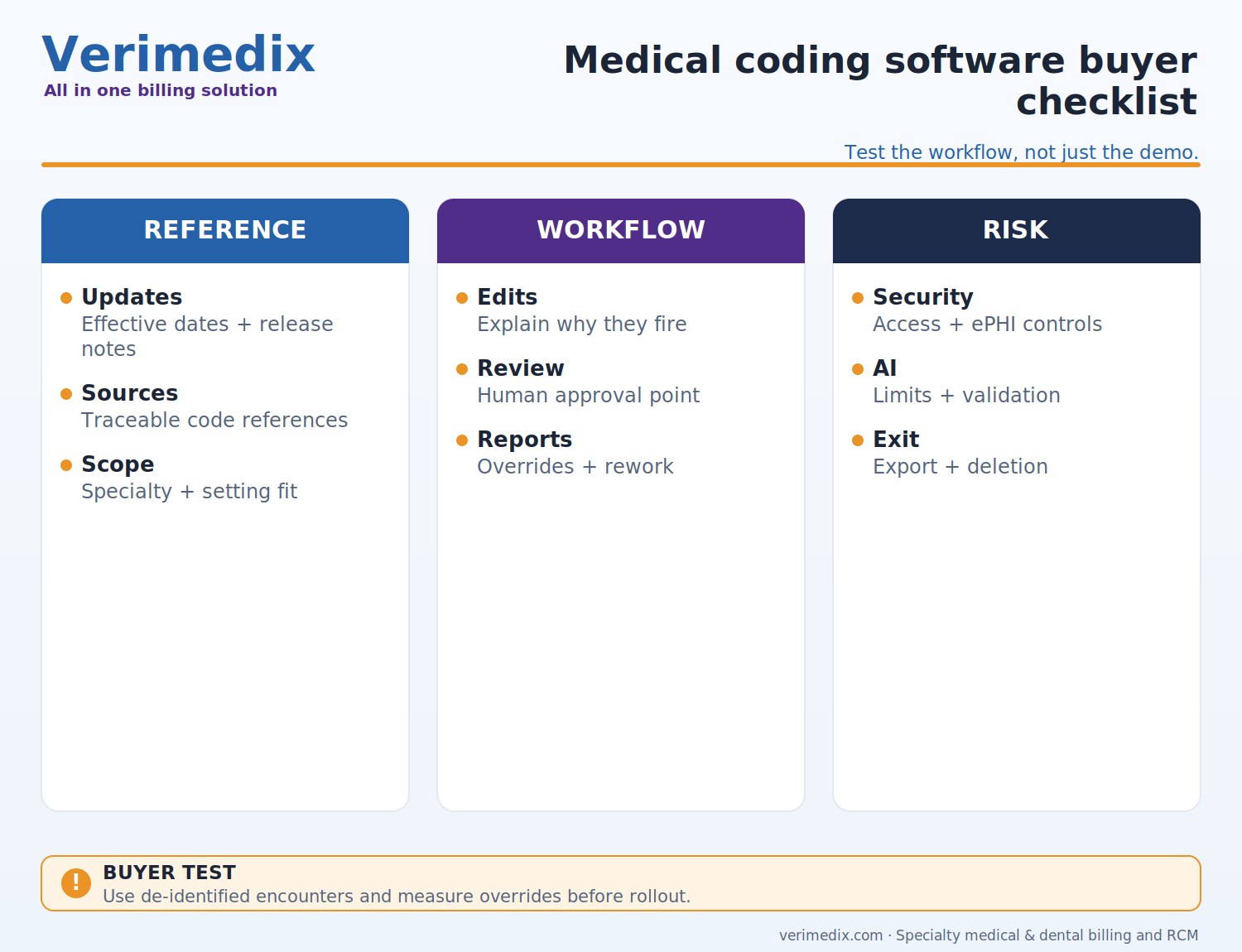
- Prioritize current code-set updates, specialty-specific logic, transparent edit explanations, and an audit trail over a long feature list.
- For software that uses predictive or generative AI, ask how the product handles human review, model changes, validation, access controls, and exportable evidence.
- Test the workflow with your own denials and documentation before signing a long contract. A fast demo is not proof of production accuracy.
- Keep the billing team accountable for final code assignment and payer-specific policy checks, even when software proposes a code.
What is medical coding software?
Medical coding software is a digital tool that helps a coder or billing team find code references, review documentation, apply coding edits, and prepare defensible claim data. It may be a standalone encoder, a coding-reference subscription, an EHR or practice-management module, or an AI-assisted workflow layered onto those systems. The software organizes decisions; the qualified coder remains responsible for validating the final assignment, which is why many practices pair a platform with outsourced medical coding services rather than expecting the tool to code on its own.
That distinction matters because the reference data changes. CMS publishes HCPCS updates on a quarterly schedule, and the ICD-10-CM Official Guidelines for Coding and Reporting are reissued for each federal fiscal year, so a platform must show which edition and code-set update it is applying. A platform that cannot show update dates and affected code sets creates a silent compliance risk.
Which type of medical coding software fits a practice?
Most products sit in one of five categories, and the category decides what you are really buying. Compare within a category first; a reference subscription and an AI-assisted platform are not answers to the same question.
| Software type | What it does well | Where it falls short | Best fit |
|---|---|---|---|
| Coding reference or encoder subscription | Fast lookup of current diagnosis, procedure, and HCPCS references, crosswalks, and edit references with effective dates | Does not own the work queue, the claim, or the audit trail; the coder still moves the decision into another system | Small coding teams that need current references inside an existing practice-management workflow |
| EHR or practice-management coding module | Charge capture tied to the visit, claim-scrubber edits before submission, one login for the whole team | Edit logic is often generic across specialties, explanations are thin, and the roadmap belongs to the EHR vendor | Practices standardizing on one platform that accept the vendor’s coding depth |
| AI-assisted or computer-assisted coding platform | Reads documentation, proposes codes, flags edits, and prioritizes queues at volume | Needs a validation sample, a named human approval step, and governance for model changes; a fast demo proves nothing about production accuracy | High-volume settings with experienced coders who review every suggestion |
| Audit and compliance tooling | Samples claims, tracks edit outcomes and coder accuracy, and produces exportable evidence for payers and auditors | Not a coding workflow on its own; it measures the work rather than doing it | Practices that outsource coding or run internal audits and need evidence, not suggestions |
| Outsourced coding with the partner’s tools | Capacity plus references, edits, and reporting operated by the vendor’s coders; see our guide to outsourced medical coding companies | The practice keeps final responsibility for documentation, oversight, and payer policy; scope and reporting must be written into the agreement | Practices without coders on staff, or teams clearing a backlog while they choose software |
Whichever category you choose, the seven features below decide whether the product improves a coder-led workflow or just adds another screen.
Which medical coding software features matter most?
Buy against the work your team performs, not against a vendor's feature-count slide. These seven capabilities are the ones that change daily coding quality and rework:
| Capability | What to verify in a demo | Why it affects revenue cycle work |
|---|---|---|
| Current reference content | Effective dates, release notes, retired-code handling, and source attribution | Reduces the risk of assigning a stale code or relying on undocumented updates |
| Specialty and setting logic | Professional, facility, dental, behavioral-health, or laboratory workflows that match your claims | Generic suggestions can miss setting-specific documentation and payer edits |
| Edit explanation | Why an edit fired, what documentation it expects, and whether a user can override with a reason | Turns a warning into a teachable, auditable decision instead of a blind stop |
| Workflow integration | Supported EHR/PM connections, role-based access, export format, and queue ownership | Prevents copy-and-paste work and makes responsibility visible across teams |
| Audit and reporting | User, timestamp, source, code suggestion, final decision, and report export | Lets managers measure rework, denials, and training needs with evidence |
| Security and controls | Business-associate terms where applicable, access logs, retention, incident process, and deletion controls | Protects ePHI and gives the practice a reviewable vendor-risk record |
| AI-assisted coding controls | Intended use of any predictive or generative feature, validation results, override controls, and model-change notices | Prevents unreviewed automated code assignment from reaching the claim |
What should you ask about AI-assisted coding?
AI can accelerate chart review, but “AI-powered” is not a quality specification. Ask the vendor to identify exactly what the model does: suggest a diagnosis, extract a procedure, flag an edit, prioritize a queue, or submit a claim. Each use case needs a different validation plan and a clear human approval step.
For certified health IT, the ONC HTI-1 Final Rule established transparency requirements for AI and other predictive algorithms in certified health IT. Even when a tool is outside that certification scope, use the same buyer standard: request documentation about intended use, known limitations, data inputs, update process, and how users can see or challenge a recommendation.
- Run a blind test. Give the vendor a sample of de-identified charts or previously adjudicated encounters and compare its suggestions with your experienced coder's final decisions.
- Measure disagreement, not just agreement. Review false positives, missed secondary diagnoses, unsupported specificity, and edits that create unnecessary work.
- Set the handoff. Define who resolves ambiguous documentation, who signs the final code, and how the decision is recorded.
- Re-test after updates. Require release notes and a regression sample when the model, code set, or edit library changes.
How should a practice vet security and compliance?
Do not treat a “HIPAA compliant” badge as a substitute for vendor due diligence. The HHS HIPAA Security Rule requires covered entities and business associates to use appropriate administrative, physical, and technical safeguards for electronic protected health information. Your contract and risk review should map those safeguards to the actual product, users, integrations, and data flows.
- Confirm whether the vendor receives, stores, or transmits ePHI and whether a business associate agreement is available when required.
- Ask for role-based access, multi-factor authentication, access logs, encryption details, backup and recovery practices, and a documented incident-notification process.
- Identify subcontractors, hosting regions, support access, retention periods, deletion on termination, and how exported data is protected.
- Request the latest independent security assessment or equivalent evidence, then record exceptions rather than accepting verbal assurances.
How much does medical coding software cost to implement?
Vendor pricing varies by seats, specialty modules, chart volume, integrations, and whether the product includes a reference library or an AI feature. Instead of comparing only the subscription line, model the total operating cost: implementation, interface work, training, dual-running, coder review time, audit support, renewal increases, and the cost of correcting an avoidable denial.
A practical pilot uses one specialty, one queue, and a defined sample of historical encounters. Track turnaround time, coder override rate, edit acceptance, documentation queries, post-bill corrections, and denial patterns before and after the pilot. If the vendor will not support a measurable test, treat that as a buying signal in the wrong direction.
Medical coding software buying checklist
- Define the settings, specialties, payers, code sets, and integrations in scope.
- Verify effective dates and update evidence for the code references you actually use.
- Test real workflow steps, including edits, documentation queries, overrides, and export.
- Evaluate AI features with a de-identified sample and document the human approval point.
- Complete security, privacy, access, retention, subcontractor, and incident reviews.
- Negotiate measurable implementation criteria, support response times, data portability, and exit terms.
Quick Answers
What does medical coding software do? It helps a coder or billing team look up current code references, review documentation, apply coding edits, and keep an audit trail of each decision. It organizes the work; a qualified coder still validates the final code assignment.
Which features matter most when comparing medical coding software? Current reference content with visible effective dates, specialty- and setting-specific logic, explainable edits, workflow integration, audit and reporting, security controls, and documented controls for any AI-assisted feature.
Can AI-assisted coding software replace a coder? No. AI can speed up chart review and suggest codes, but the practice remains responsible for the final assignment, payer-specific policy checks, and the documentation that supports the claim. Validate the tool on your own de-identified encounters before relying on it.
How should a practice evaluate security before buying? Confirm whether the vendor handles ePHI and whether a business associate agreement is available when required, then review access controls, logging, encryption, backup, incident notification, subcontractors, retention, and deletion on termination.
How much does medical coding software cost? Pricing varies by seats, specialty modules, chart volume, integrations, and included reference or AI features. Compare total operating cost, including implementation, training, coder review time, and avoidable denials, rather than the subscription line alone.
Frequently asked questions
The best medical coding software is the platform that matches your specialties and settings, keeps code references current, explains edits, integrates with your workflow, and produces an audit trail. A vendor name alone cannot establish fit; test the product with your own de-identified encounters and review the results with an experienced coder.
Usually no. Software can accelerate lookup, extraction, and edit review, but a qualified coder still needs to validate documentation, specificity, payer rules, and the final code assignment. Define the human approval point before enabling automation.
Ask for intended use, input data, known limitations, validation results, update and model-change processes, user override controls, and an exportable audit trail. The vendor should also explain how recommendations are presented and challenged, rather than relying on an accuracy percentage without context.
A product may support HIPAA safeguards, but the practice still has to assess its own use, access, contracts, integrations, and risk controls. Confirm whether the vendor handles ePHI, whether a business associate agreement is available when required, and how access, retention, incidents, and deletion are managed.
Use a representative, de-identified sample and compare software suggestions with adjudicated coder decisions. Track override rate, missed findings, edit usefulness, turnaround time, documentation queries, post-bill corrections, and denial patterns before committing to a full rollout.