
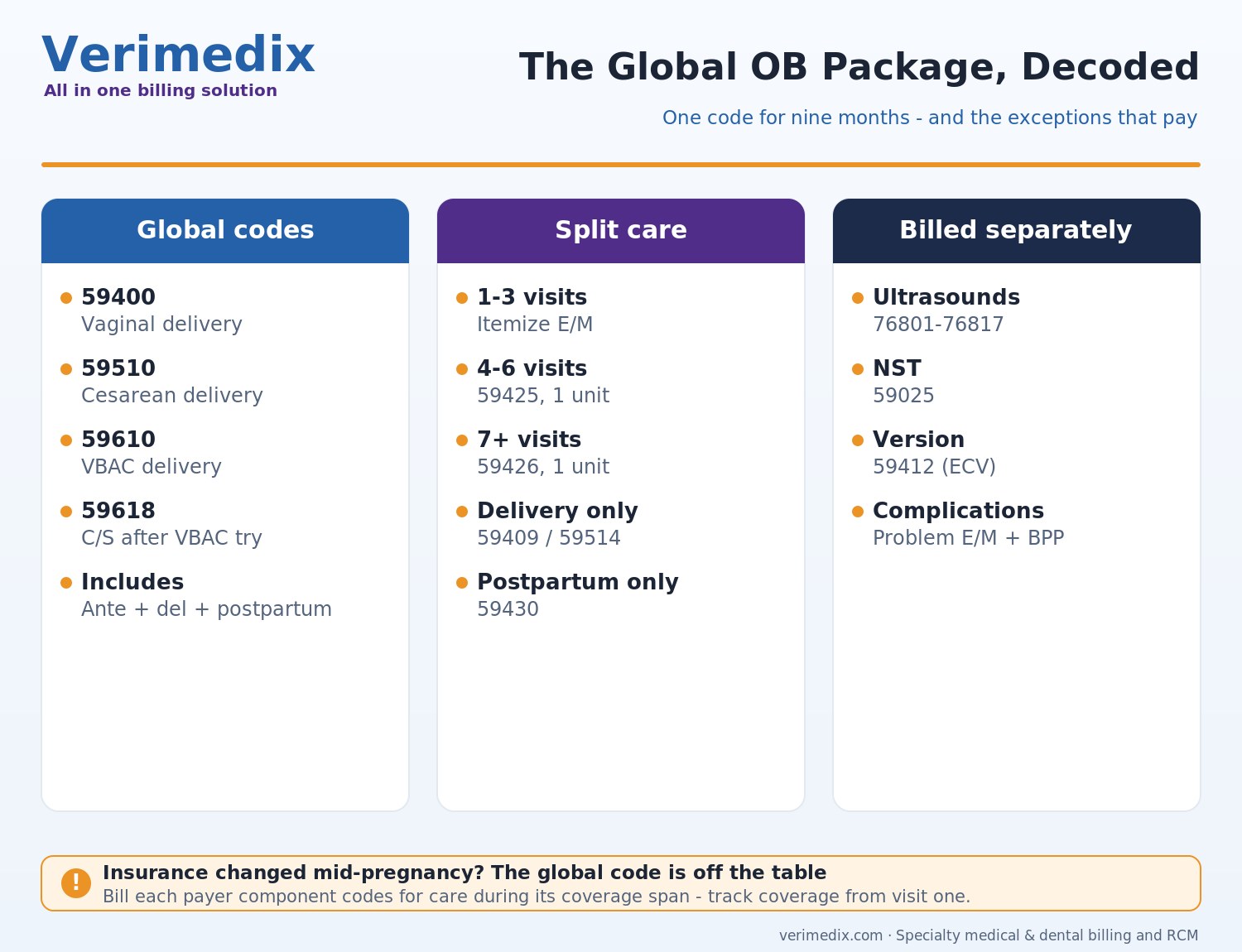
- The global OB package bundles roughly nine months of care into one payment: report 59400 (vaginal), 59510 (cesarean), 59610 (VBAC) or 59618 (cesarean after attempted VBAC) only when one provider or group furnishes antepartum, delivery and postpartum care.
- Ultrasounds (76801-76817 series), non-stress tests (59025), amniocentesis and complication management are outside the global package and separately billable with supporting diagnoses.
- When care splits between providers, code by component: 59425 for 4-6 antepartum visits, 59426 for 7+, delivery-only codes (59409, 59514, 59612, 59620) and 59430 for postpartum-only.
- Mid-pregnancy insurance changes are a top OB revenue leak — the global package cannot be billed to a payer that only covered part of the pregnancy, so split-billing rules decide whether you get paid.
- Payer variation is extreme: visit-count thresholds, twin-delivery rules and Medicaid unbundling requirements differ by plan, which is why OB billing rewards specialty-specific expertise.
- Outsourced maternity billing is typically priced as a percentage of collections in the 4-9% range quoted across practice billing, with scope — not specialty label — driving the fee.
The global OB package: what 59400, 59510 and 59610 include
No other specialty compresses this much work into a single code. An obstetrician can see a patient thirteen or more times, manage a delivery at 2 a.m., and provide six weeks of follow-up — then submit exactly one CPT code for all of it. That structure is efficient when everything goes to plan and punishing when it does not, which is why OB/GYN medical billing services is its own discipline rather than a variant of office E/M billing.
| Code | Package | Included |
|---|---|---|
| 59400 | Routine obstetric care, vaginal delivery | Antepartum care (typically ~13 routine visits), vaginal delivery with or without episiotomy/forceps, and postpartum care (~6 weeks) |
| 59510 | Routine obstetric care, cesarean delivery | Antepartum care, cesarean delivery, postpartum care |
| 59610 | Routine care, vaginal delivery after previous cesarean (VBAC) | Antepartum, VBAC delivery, postpartum |
| 59618 | Cesarean after attempted VBAC | Antepartum, cesarean delivery following attempted vaginal delivery after prior cesarean, postpartum |
Inside the bundle sit the routine prenatal visits (including recording of weight, blood pressure, fetal heart tones and routine urinalysis), admission history and physical, management of uncomplicated labor, and routine postpartum office visits. What is not inside the bundle is where practices leave money behind.
Separately billable: what falls outside the package
Newborn care is outside the package entirely and belongs to a different code family and often a different payer. Delivery attendance (99464) and newborn resuscitation (99465) are reported by the clinician who attends the infant, and everything after that runs on the per-day newborn and neonatal codes (99460–99480) rather than obstetric ones. Practices that bill both sides of the delivery room should read our neonatology billing services page for how the infant claim is built.
| Service | Codes | Billing note |
|---|---|---|
| Obstetric ultrasounds | 76801/76802 (first trimester), 76805/76810, 76811/76812 (detailed anatomy), 76815, 76816 (follow-up), 76817 (transvaginal) | Always outside the global package; many payers cap covered scans per pregnancy and require a documented indication for each |
| Fetal non-stress test | 59025 | Separately billable with medical necessity; bundled into 76818 (BPP) when performed together, per NCCI guidance |
| Amniocentesis, version, cerclage | 59000, 59412 (external cephalic version), 59320/59325 | Procedure codes outside the bundle |
| High-risk / complication care | Problem E/M visits, additional monitoring, BPP 76818 | Care for gestational diabetes, preeclampsia, bleeding and similar conditions exits the routine package when documented as distinct from routine prenatal visits |
| Visits beyond the routine count | E/M codes per payer policy | Several payers allow separate reporting of medically necessary visits beyond the routine antepartum count — policy-specific, so verify in writing |
| Confirmation-of-pregnancy visit | E/M | Often separately payable when it occurs before the OB record is initiated (UnitedHealthcare states this explicitly) |
Unrelated E/M during the antepartum or postpartum period follows the usual global-period logic — an office visit for bronchitis is not maternity care. Payers differ on modifier requirements here; the mechanics mirror what we cover in our modifier 25 guide and modifier 24 global-period guide.
Split care: antepartum-only and delivery-only coding
Patients transfer, relocate, change insurance and switch practices mid-pregnancy constantly. The moment one group no longer provides all three components, the global code is off the table and you bill what you actually did:
| Scenario | Code(s) | Rule |
|---|---|---|
| 1-3 antepartum visits | Itemized E/M visits | Too few visits for the antepartum-care codes |
| 4-6 antepartum visits | 59425 | Report once, 1 unit, per pregnancy per group |
| 7+ antepartum visits | 59426 | Report once, 1 unit — never alongside 59425 by the same group |
| Delivery only | 59409 (vaginal), 59514 (cesarean), 59612 (VBAC), 59620 (cesarean after attempted VBAC) | No antepartum or postpartum care attached |
| Delivery + postpartum | 59410, 59515, 59614, 59622 | Use when your group delivers and provides postpartum but not antepartum care |
| Postpartum only | 59430 | Covers the postpartum visit package (~6 weeks) when another provider delivered |
Watch the calendar-year wrinkle: some Medicaid plans require claims split across calendar years, and several payers want the antepartum codes billed after the last antepartum visit with specific date-span formatting. These are exactly the payer-by-payer rules a specialty billing service should hold in a living matrix.
Common OB/GYN denials and how services prevent them
| Denial | Root cause | Prevention |
|---|---|---|
| Global billed to the wrong payer | Insurance changed mid-pregnancy; payer only covered part of the antepartum period | Track coverage spans from the first visit; bill each payer only for care furnished during its coverage using component codes |
| Unbundling denials | Routine visits or postpartum care billed separately alongside a global code | Charge-hold logic: park routine antepartum charges until delivery, then release the correct package |
| Ultrasound denials | Missing indication, scan-count caps, 76811 billed twice | Diagnosis linkage per scan; use 76816 for follow-ups after a completed anatomy scan |
| Twin delivery underpayment | Payer-specific rules — some want modifier 22 on the global, others a second delivery-only code with modifier 59 or 51 | Payer matrix by plan; appeal with delivery notes when the second twin is written off |
| 59025 bundling | NST billed with BPP (76818) same encounter | Bill 59025 separately only for distinct encounters with distinct rationale |
| Medicaid component rules | Some state programs pay per-visit rather than global | Configure state-specific claim logic instead of forcing the CPT global model |
What outsourced obstetric billing costs
Pricing follows the standard practice-billing structures: percentage of collections (commonly quoted around 4-9% across specialties), flat monthly fees for predictable volume, or per-claim pricing. OB adds two wrinkles worth negotiating. First, cash-flow timing — global reimbursement lands months after work begins, so ask how the vendor reports work-in-progress and whether its fee hits when you collect, not when you bill. Second, scope: confirm whether ultrasound, in-office procedures (colposcopy 57454, hysteroscopy 58558, LARC insertion 58300/11981 with the device HCPCS) and gynecologic surgery billing are inside the same fee. All figures here are illustrative industry ranges; get written quotes. OB practices comparing billing support should ask specifically about global-package handling — partners like Verimedix track antepartum visit counts and transfer-of-care events per patient, so the practice bills 59400 or the split codes correctly the first time.
Worked example: a 28-week transfer (illustrative)
A patient transfers in at 28 weeks after 9 visits elsewhere, and your group provides 6 more antepartum visits, a vaginal delivery and postpartum care. Billing 59400 would misstate the care and invite recoupment; the prior group reports 59426 for its 9 visits (yes — 7+, even though care ended early, subject to payer policy), while your group reports 59425 for 6 visits plus 59410 for delivery with postpartum care. If a payer's fee schedule put 59400 at an illustrative $2,600, the correct component claims might total roughly $2,100 for your group — real money either lost entirely if you wrongly bill the global and get denied, or left unclaimed if staff itemize only the delivery. The point of the example: component coding is not a downgrade, it is how you get paid at all in split-care pregnancies.
Eight questions that expose global-package handling
- How do you track coverage spans so mid-pregnancy insurance changes trigger split billing automatically?
- Show me your payer matrix for twin deliveries and antepartum visit thresholds — is it maintained per plan?
- How are charges held and released around delivery so nothing unbundles the global?
- Do you reconcile every delivery log entry against a billed package or delivery code?
- How do you handle state Medicaid programs that pay per visit rather than globally?
- What is your process for separately billable services — ultrasounds, NSTs, LARC devices — including diagnosis linkage?
- Which KPIs do you report monthly, and can I see a sample with denial reasons broken out?
- What does your fee cover, when is it charged, and what are the exit terms?
Practices comparing vendors more broadly can start with our roundup of the best medical billing companies for small practices.
Quick Answers
What is the global OB package? A single CPT code — 59400, 59510, 59610 or 59618 — covering routine antepartum care, delivery and postpartum care when one provider or group furnishes all three components of a pregnancy.
What is included in CPT 59400? Routine antepartum visits (typically around 13), vaginal delivery with or without episiotomy or forceps, and roughly six weeks of routine postpartum care. Ultrasounds, NSTs and complication care are separately billable.
When do you use 59425 vs 59426? 59425 covers 4-6 antepartum visits and 59426 covers 7 or more, each reported once with one unit when your group provided antepartum care but not the delivery. With only 1-3 visits, itemize E/M codes instead.
How is a delivery-only service billed? With the delivery-only codes: 59409 (vaginal), 59514 (cesarean), 59612 (VBAC) or 59620 — or the delivery-plus-postpartum versions 59410, 59515, 59614 and 59622 when your group also provides postpartum care.
What happens when insurance changes mid-pregnancy? The global code generally cannot go to a payer that covered only part of the pregnancy. Each payer is billed component codes for the care furnished during its coverage span — a rule that makes coverage tracking from visit one essential.
Frequently asked questions
Routine prenatal visits, no — they are inside the package. Visits for problems unrelated to the pregnancy, or for complications distinct from routine antepartum care, are often separately payable with the right diagnosis and modifier use, but payer policies differ, so document the distinct nature of the visit clearly.
There is no single national rule. Some payers want the global code with modifier 22 and documentation for the extra work; others want the global for the first baby plus a delivery-only code with modifier 59 or 51 for the second. A payer-specific matrix — checked before the claim goes out — is the only reliable approach.
The group does. Antepartum, delivery and postpartum care furnished by physicians of the same group practice is combined into one global claim under the group's billing NPI, even if different individual physicians saw the patient at different visits.
Yes — CPT 59430 covers the postpartum-care-only package when your group provides the visits within roughly six weeks after a delivery performed elsewhere. It is reported once, not per visit, and should not be billed alongside a package code that already includes postpartum care.
Most do, but scope varies: office gynecology (colposcopy, hysteroscopy, LARC insertions with device HCPCS codes), gynecologic surgery with global periods, and infertility services each carry their own rules. Confirm in the contract which lines are covered and whether they affect the fee.