
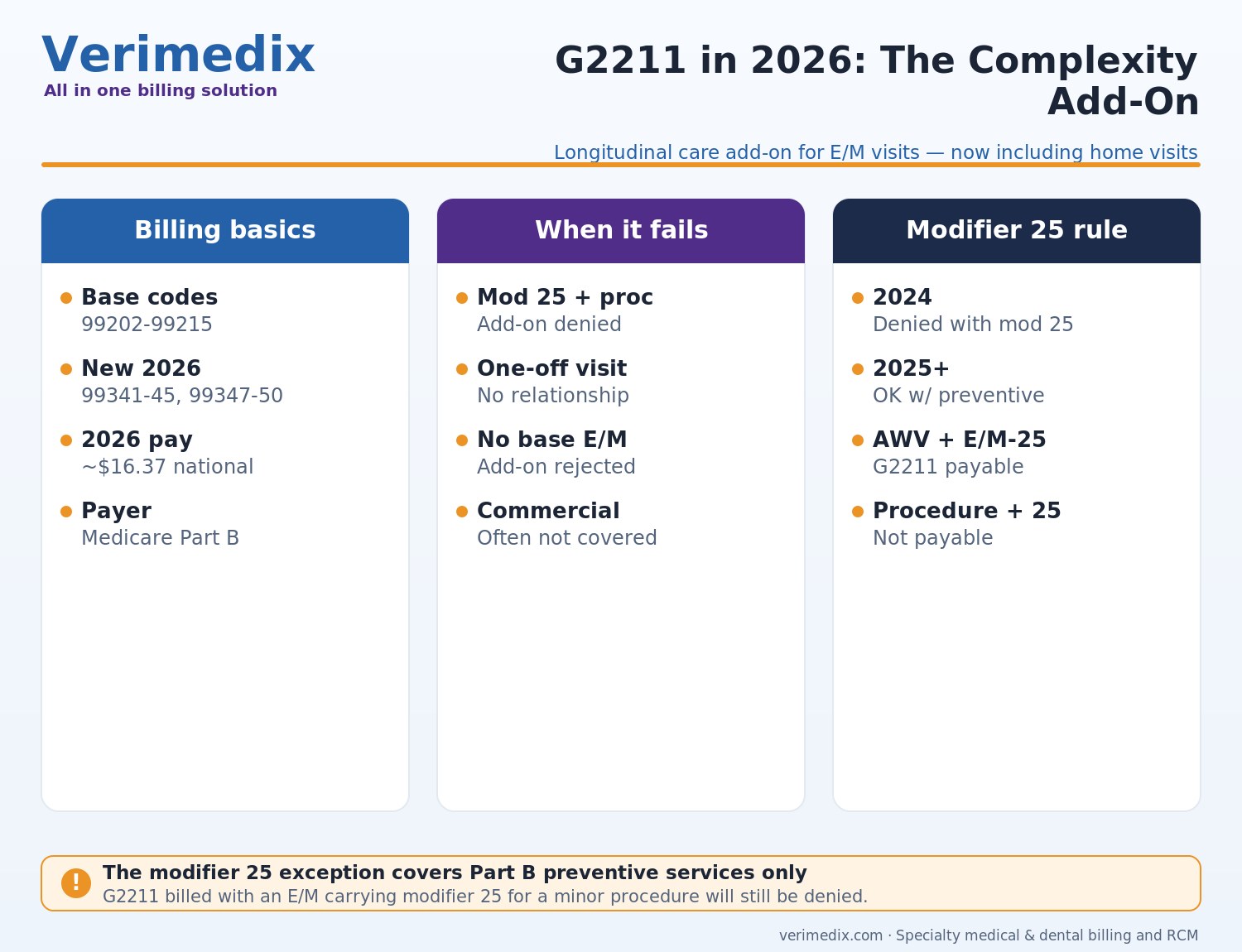
- G2211 is a Medicare add-on code worth roughly $16 nationally in 2026, billed alongside office/outpatient E/M codes 99202-99215 when the visit reflects a longitudinal care relationship.
- New for 2026: CMS finalized expansion of G2211 to home and residence E/M visits (99341-99345 and 99347-99350) in the CY 2026 physician fee schedule final rule.
- The relationship test is what matters — you are the ongoing focal point for the patient's care, or you are managing a single serious or complex condition over time. Discrete, one-off care does not qualify.
- The modifier 25 rule causes most denials: since 2025 G2211 is payable with a modifier 25 E/M only when the same-day service is a Medicare Part B preventive service, not a procedure.
- Never append modifier 25 (or any payment modifier) to G2211 itself, and never bill it without a qualifying base E/M on the same claim.
- Commercial payer and Medicaid recognition of G2211 varies widely — confirm plan policy before appending it outside Medicare.
What G2211 actually pays for
Medicare created this HCPCS add-on in January 2024 to recognize work that E/M codes never captured: the cognitive load of being the clinician a patient keeps coming back to. Reading the same chart for the fifth year, weighing a new symptom against everything already known about the patient, adjusting a plan you built — CMS calls this "visit complexity inherent to evaluation and management" associated with ongoing care. The code carries a work RVU of 0.33 and roughly 0.49 total non-facility RVUs, which at the 2026 conversion factor of $33.4009 works out to about $16.37 nationally before locality adjustment.
There is no separate documentation element to satisfy — no extra paragraph, no attestation. What the record as a whole must support is the relationship: an active care plan, follow-up cadence, medication management over time, or similar evidence that this visit is one chapter in continuing care rather than an isolated transaction.
Who can bill G2211 — and who should not
Any specialty can bill it; CMS deliberately did not restrict the code to primary care. The qualifying question is the nature of the relationship, and CMS frames two qualifying patterns: the clinician (or practice) serves as the continuing focal point for all of the patient's needed care, or the clinician provides ongoing care for a single serious condition or a complex condition. A new-patient visit can qualify when the intent is to establish that ongoing relationship. What does not qualify is care that is discrete, routine, or time-limited in nature.
| Scenario | G2211 appropriate? | Why |
|---|---|---|
| PCP managing a patient's hypertension and diabetes at a routine follow-up | Yes | Continuing focal point for overall care |
| Cardiologist following heart failure over years | Yes | Ongoing care of a single serious condition |
| New-patient visit intended to establish primary care | Often yes | Relationship being established; document the plan for ongoing care |
| Urgent care visit for a laceration | No | Discrete, episodic encounter |
| One-time consult with no planned follow-up | No | Time-limited relationship |
| Telehealth follow-up with an established patient (office E/M) | Generally yes | Medicare permits G2211 with qualifying telehealth E/M visits, subject to current telehealth policy |
One nuance worth flagging: qualification rides on the relationship, not the day's diagnosis. A longitudinal patient seen for a minor acute problem can still generate G2211, because managing even small complaints in the context of full knowledge of the patient is precisely what the code values. Conversely, billing it reflexively on every visit — including walk-ins and covering-provider encounters with no continuity — is the utilization pattern reviewers look for.
The 2026 rules: home visits and payment
In the CY 2026 physician fee schedule final rule, CMS revised the G2211 descriptor and extended the code beyond office/outpatient E/M: effective January 1, 2026, it may also be reported with home or residence visit codes 99341-99345 (new patient) and 99347-99350 (established patient). That is a meaningful change for house-call practices, home-based primary care, and clinicians serving homebound patients, whose relationships are often exactly the longitudinal pattern the code was built for.
Payment in 2026 runs off two conversion factors — $33.4009 for most clinicians and $33.5875 for qualifying APM participants — putting the national add-on at roughly $16-$17, adjusted by locality. Medicare Advantage plans generally follow Medicare payment policy, though claim-editing behavior varies by plan; commercial payers and state Medicaid programs may or may not recognize G2211 at all, so confirm before appending it outside traditional Medicare.
G2211 and modifier 25: the interaction behind most denials
The single most misunderstood part of this code is what happens when the base E/M carries modifier 25. The policy has shifted twice, and old habits are still generating denials:
| Period | Policy | Practical effect |
|---|---|---|
| 2024 | G2211 not payable whenever the base E/M carried modifier 25 | Any same-day procedure or service forcing modifier 25 killed the add-on |
| 2025 onward | Payable with a modifier 25 E/M only when the same-day service is a Medicare Part B preventive service (e.g., annual wellness visit, vaccine administration) | AWV + problem-oriented E/M-25 + G2211 can all be paid together |
| Unchanged | Not payable when modifier 25 reflects a separately billed procedure, test, or minor surgery (0- or 10-day global) | E/M-25 + joint injection, skin biopsy, or 96372 still blocks G2211 |
Two concrete claims make the line obvious. Claim A: 99214-25 + G0439 (subsequent annual wellness visit) + G2211 — payable, because the AWV is a Part B preventive service. Claim B: 99214-25 + 96372 (therapeutic injection) + G2211 — the add-on denies, because an injection is not a preventive service. And in either case, G2211 itself is billed bare: no modifier 25, no modifier 59, nothing appended to the add-on line.
Common G2211 denial scenarios and fixes
| Denial scenario | What went wrong | Fix |
|---|---|---|
| Billed with E/M-25 plus a same-day minor procedure | The preventive-service exception does not cover procedures | Do not append G2211 on procedure-day claims; the E/M and procedure still pay |
| No qualifying base code on the claim | Add-on submitted alone, or with an ineligible base (ED, inpatient, SNF E/M) | Bill only with 99202-99215 or, from 2026, 99341-99345/99347-99350 |
| Commercial or Medicaid payer does not recognize G2211 | Code appended outside Medicare without checking policy | Maintain a payer grid; append only where the plan reimburses it |
| Relationship not supported at audit | Billed on walk-in or one-off visits with no continuity in the record | Reserve for longitudinal patients; ensure the chart shows an ongoing plan |
| Modifier appended to G2211 itself | Payment modifiers on the add-on line trigger edits | Submit G2211 with no modifiers |
| Duplicate G2211 on one date of service | Only one unit per qualifying E/M visit | Bill a single unit per encounter |
What G2211 is worth to a practice
Worked example (illustrative): a two-physician primary care practice logs 3,600 traditional-Medicare office E/M visits a year. Chart review suggests about 70% involve genuinely longitudinal patients — roughly 2,520 eligible visits. At about $16.37 per unit, full capture is worth around $41,000 a year; even a conservative 50% capture rate leaves roughly $20,600 on the table if the code is not being billed. National utilization data since 2024 has consistently shown primary care billing G2211 on only a fraction of eligible visits, so for many practices this is the easiest unclaimed revenue in the fee schedule. Pair it with accurate E/M leveling — see our companion guide to CPT 99214 requirements — and the per-visit difference compounds.
A G2211 billing checklist
Run each Medicare E/M claim through five questions before appending the add-on:
- Is the base code eligible? 99202-99215, or a home/residence code 99341-99345 / 99347-99350 (2026 onward). Nothing else.
- Does the relationship qualify? Ongoing focal point for the patient's care, or continuing management of a serious or complex condition — supported somewhere in the record.
- Is there a same-day procedure forcing modifier 25? If yes, drop G2211 — unless the other service is a Part B preventive service, the one exception since 2025.
- Is the payer traditional Medicare (or a plan that recognizes the code)? If not, check the payer grid first.
- Is the add-on line clean? One unit, no modifiers, same claim as the base E/M.
Quick Answers
What is the G2211 add-on code? A Medicare HCPCS add-on billed with office/outpatient E/M visits (and, from 2026, home/residence visits) that pays for the visit complexity inherent to a longitudinal care relationship. It adds roughly $16 per qualifying visit in 2026.
Who can bill G2211? Any specialty, when the clinician is the ongoing focal point of the patient's care or is managing a single serious or complex condition over time. Episodic, one-off care does not qualify.
Can G2211 be billed with modifier 25? G2211 itself never takes modifier 25. Since 2025, it is payable when the base E/M carries modifier 25 only if the same-day service is a Medicare Part B preventive service; with a same-day procedure, the add-on is denied.
What changed for G2211 in 2026? CMS finalized expansion to home and residence E/M codes 99341-99345 and 99347-99350, effective January 1, 2026, and revised the code descriptor accordingly.
Does G2211 require extra documentation? No separate element is required, but the medical record must support the ongoing relationship — care plans, follow-up cadence, and continuity should be visible on audit.
Do commercial insurers pay G2211? Coverage varies: many commercial plans and some Medicaid programs do not reimburse it. Verify payer policy before appending the code outside traditional Medicare.
Frequently asked questions
Any specialty can bill it. CMS tied eligibility to the care relationship, not the taxonomy code — a cardiologist, oncologist, or rheumatologist providing ongoing management of a serious condition qualifies just as a PCP does. What never qualifies is discrete, time-limited care regardless of specialty.
Yes, when the visit is intended to establish an ongoing relationship — a new-to-practice primary care patient, for example. Document the forward-looking plan of care. A new patient seen once with no expectation of continuity does not qualify.
Generally yes, when the underlying office/outpatient E/M is a covered Medicare telehealth service and the longitudinal relationship test is met. Telehealth coverage rules continue to evolve, so confirm current CMS policy for the date of service.
It should not be, if claims were assembled correctly: since 2025 the preventive-service exception makes G2211 payable alongside an E/M with modifier 25 when the other service is a Part B preventive service like an AWV. Check that modifier 25 sits on the E/M line, not on G2211, and that no separately billed procedure was also on the claim.
There is no annual frequency cap — it can be reported at each qualifying E/M visit, one unit per encounter. Consistency matters more than frequency: the record across visits should reflect the continuing relationship the code pays for.