
- D3310 = root canal, anterior tooth; D3320 = root canal, bicuspid/premolar; D3330 = root canal, molar (3+ canals). Code selection is based on tooth type, not difficulty.
- All three codes include instrumentation, shaping, cleaning, obturation, and temporary restoration. They do not include the final restoration.
- Submit on the completion date (most carriers), not the initiation date. Multi-visit RCTs should be submitted after the final obturation appointment.
- Retreatment of a previously root-canaled tooth requires D3346 (anterior), D3347 (bicuspid), or D3348 (molar) — not D3310/D3320/D3330.
- Pre-operative and post-operative radiographs are required documentation; claims without them are routinely denied.
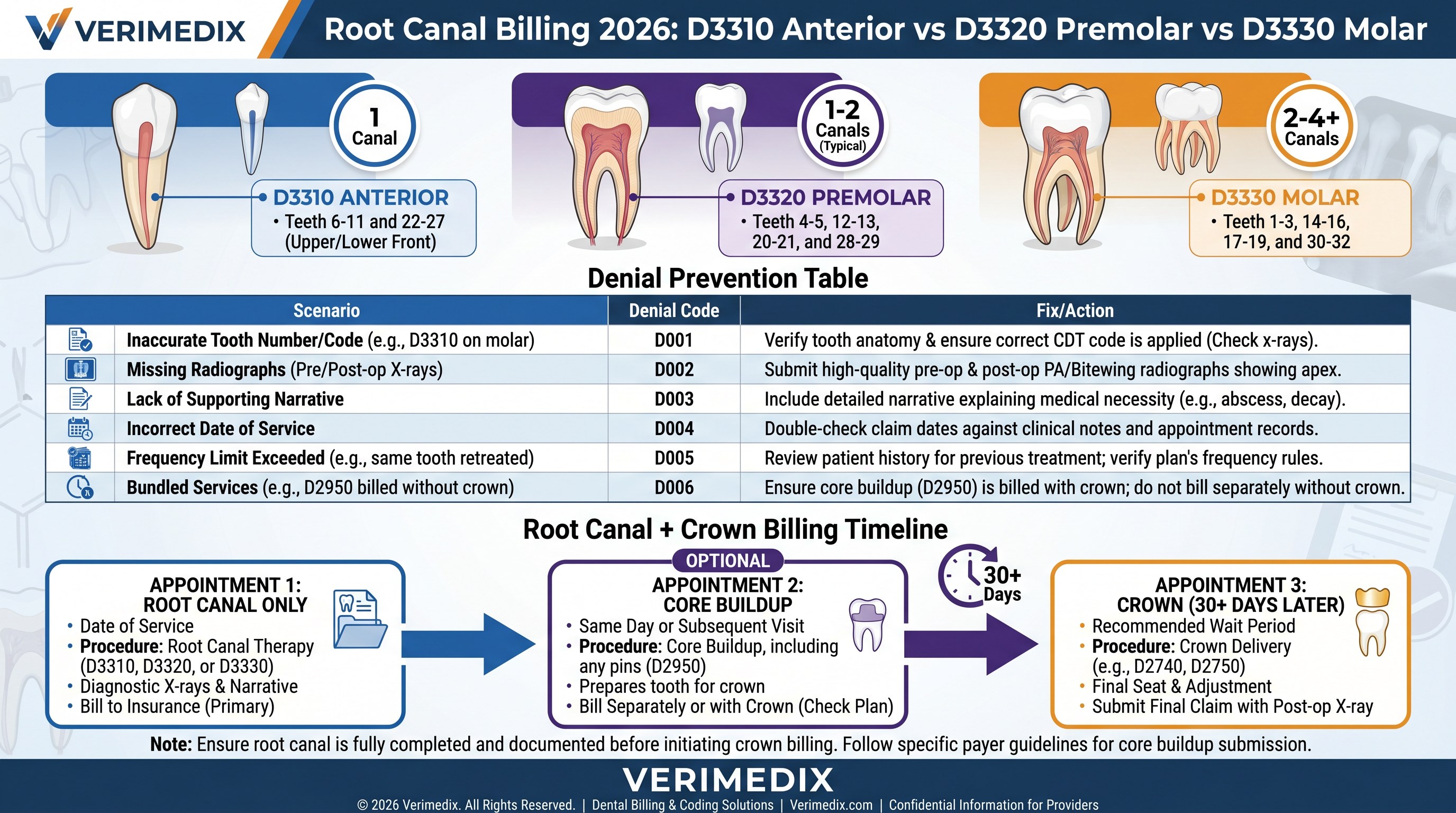
The CDT root canal codes describe complete endodontic therapy: access opening, debridement of the pulp chamber and canals, biomechanical shaping and cleaning, irrigation, and obturation with a permanent root canal filling material (typically gutta-percha and sealer). The temporary restoration placed at the final visit is included. What is not included — and what must be billed separately — is the final restoration, whether a composite buildup, core buildup (D2950), or crown.
Code selection by tooth type
| Code | Tooth type | Canal count expectation | Notes |
|---|---|---|---|
| D3310 | Anterior (incisors and canines) | Typically 1 canal | Tooth numbers 6–11 (maxillary) and 22–27 (mandibular). Code by tooth type, not canal count. |
| D3320 | Premolar/bicuspid | Typically 1–2 canals | Tooth numbers 4–5, 12–13 (maxillary premolars) and 20–21, 28–29 (mandibular premolars). |
| D3330 | Molar | 3 or more canals | Tooth numbers 1–3, 14–16 (maxillary molars) and 17–19, 30–32 (mandibular molars). Most scrutinized and most-billed endodontic code. |
Date of service rules
The ADA recommends using the completion date as the date of service for root canal therapy. Most third-party payers follow this and require the completion date. A multi-visit RCT initiated at one appointment and completed at a later appointment should be submitted after the obturation appointment with the completion date. Submitting on the initiation date risks a denial because the payer sees an open procedure. Some payers accept either date — verify with your specific carrier before billing a multi-visit case.
Radiograph requirements
Virtually all dental carriers require radiographic documentation with endodontic claims. The minimum expected documentation is a pre-operative periapical radiograph showing the canal anatomy, working length, and the pathology requiring treatment; and a post-operative periapical showing the completed obturation with gutta-percha filling the canals to within 0–2mm of the radiographic apex. For D3330 specifically, the post-op film should confirm all canals are obturated. Claims submitted without radiographs are frequently denied on first submission or held pending documentation. Submit radiographs with the initial claim as an attachment (ADA claim form allows electronic attachment) rather than waiting for a documentation request.
Retreatment: D3346, D3347, D3348
When a tooth with a history of prior root canal therapy requires repeat endodontic treatment, the retreatment codes apply: D3346 (retreatment, anterior), D3347 (retreatment, bicuspid), D3348 (retreatment, molar). Submitting D3310/D3320/D3330 for a retreatment case is a coding error that most carriers catch by comparing the claim against prior treatment history. If the carrier's records show a root canal on that tooth number, an initial therapy code will be denied or flagged for audit. The retreatment codes carry their own coverage criteria and often require a clinical narrative explaining the reason for retreatment (e.g., missed canal, persistent periapical pathology, separated instrument).
Buildup and crown timing
The root canal codes do not include the final restoration. Most patients require a core buildup (D2950) and crown after molar or premolar RCT. Many carriers impose a waiting period before covering the crown — commonly 6 months to 1 year after the RCT completion date — to confirm the tooth is retained. Billing the crown on the same date as RCT, or within the carrier's waiting period, will result in a crown denial. The access opening closure at the end of the RCT visit is a small temporary restoration, not a core buildup — D2950 is billed only when a formal composite or amalgam core buildup is placed as foundation for the crown.
Common RCT denials and fixes
| Denial | Cause | Fix |
|---|---|---|
| Missing radiographs | Pre-op or post-op PA not submitted with claim | Attach both periapicals and resubmit; use electronic attachments on the 2024 ADA claim form |
| Wrong code for retreatment | D3310/D3320/D3330 billed for a previously treated tooth | Recode to D3346/D3347/D3348; add clinical narrative explaining reason for retreatment |
| Claim submitted on initiation date | Payer sees an open procedure; denies for incomplete treatment | Hold claim until obturation is complete; submit on completion date |
| Crown denied after RCT | Crown billed within carrier's post-RCT waiting period | Note the waiting period end date and resubmit the crown claim after it expires; appeal with documentation if the crown was clinically urgent |
| D2950 denied as included in RCT | Payer bundles temporary restoration into RCT payment | Confirm a formal core buildup (not just access closure) was placed; document D2950 separately with a narrative distinguishing it from the temporary access filling |
Frequently asked questions
D3310 is root canal therapy on an anterior tooth (incisors and canines). D3320 is root canal therapy on a bicuspid or premolar. D3330 is root canal therapy on a molar with three or more canals. Code selection is based on tooth type and position, not the number of canals actually treated or the difficulty of the case.
Submit on the completion date. The ADA and most payers expect the completion date (date of obturation) as the date of service. Submitting on the initiation date risks a denial for incomplete treatment. Hold the claim until the final canal filling is placed.
At minimum: a pre-operative periapical radiograph showing the canal anatomy and pathology, and a post-operative periapical confirming completed obturation. For D3330, the post-op film should show all canals obturated. Submit both images as electronic attachments with the initial claim.
Use the retreatment codes: D3346 (anterior retreatment), D3347 (bicuspid retreatment), or D3348 (molar retreatment). Using D3310/D3320/D3330 for a previously treated tooth is a coding error and will likely be denied or flagged in an audit.
Yes, if a formal core buildup was placed at that appointment as foundation for a future crown. However, the access opening temporary fill placed at the end of the RCT is not a D2950 — it is already included in the RCT code. D2950 requires a separate, documented core build that is distinct from the temporary access closure.