
- Every ASC case generates two claims — the center’s facility claim and the surgeon’s professional claim (anesthesia bills separately) — and they must stay consistent.
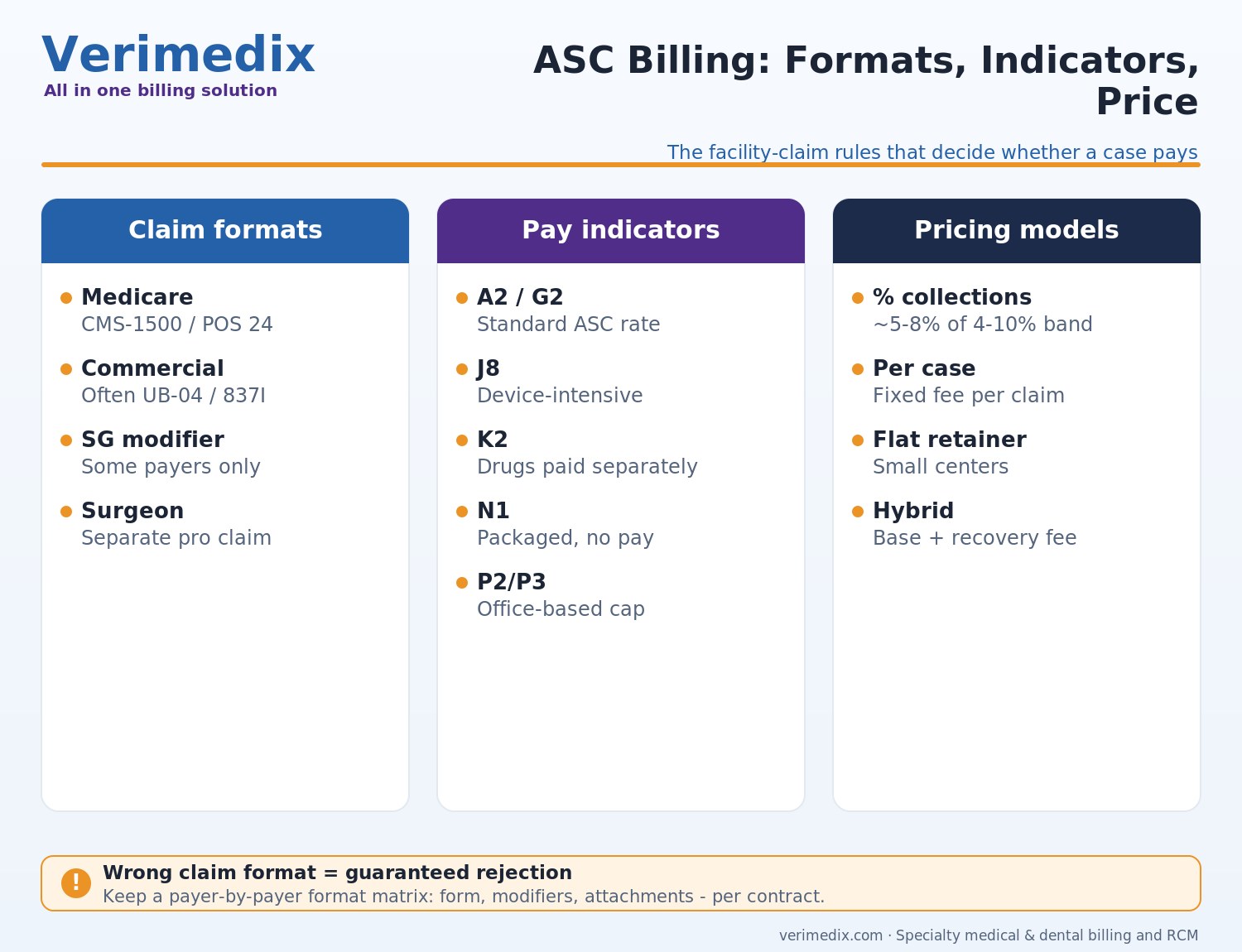
- Medicare wants the ASC facility claim on the CMS-1500/837P with POS 24; many commercial payers require the UB-04/837I instead. Format is contract-specific.
- CMS payment indicators in ASC Addendum AA (A2, G2, J8, K2, N1, P2/P3) determine how — and whether — each CPT code pays in the ASC setting.
- Device-intensive procedures (J8) and commercial implant carve-outs need invoice documentation; missed carve-outs are a major silent underpayment source.
- Published outsourced billing pricing spans roughly 4–10% of collections; ASC work usually prices in the upper half of that band.
- Vet vendors on ASC-specific proof: case-rate and grouper contract handling, underpayment recovery, and specialty-mix experience.
What full-service ASC billing should include
An ambulatory surgery center is neither a physician practice nor a hospital outpatient department, and its claims follow neither rulebook exactly — a competent ASC billing service builds its scope around that fact. The core deliverables: surgical coding from the operative note (CPT and HCPCS Level II, screened against NCCI edits), claim generation in the format each payer’s contract requires, implant and invoice documentation for device cases, payment posting that verifies multiple-procedure discounting was applied correctly, denial appeals, and systematic insurance AR follow-up.
The differentiators are contractual rather than clerical: loading each payer’s fee schedule, grouper methodology, or case rates so every remittance is audited against the expected allowable, flagging underpayments, and pursuing implant carve-outs the contract entitles the center to bill on top of the case rate. ASC payers reimburse through a patchwork of bundled case rates, percentage-of-charge deals, legacy grouper schedules, and Medicare-style fee schedules — and errors hide inside each one, which is why claim submission without contract auditing leaves money behind. For context on how the ASC model differs from hospital billing altogether, see our guide to how hospital billing works.
Facility vs professional claims — and which form goes where
Each case produces a facility claim from the center (OR, nursing, drugs, supplies, equipment) and a professional claim from the surgeon; anesthesia files separately. Payers cross-check the two, so the billing service’s first structural job is keeping codes, diagnoses, and dates identical across both — mismatches trigger denials on both sides.
Claim format is where new administrators get burned. Medicare enrolls ASCs as suppliers and pays facility claims on the CMS-1500 (837P) with place of service code 24. Many commercial payers and some state Medicaid programs take the opposite position and require the ASC facility claim on the UB-04 (837I) institutional format with revenue codes. The SG modifier — historically used to flag ASC facility services — is no longer required by Medicare but is still demanded by some commercial and Medicaid payers. The answer lives in each payer contract and companion guide; a specialist biller maintains a payer-by-payer format matrix so claims go out right the first time — and asking a prospective vendor to describe yours is a fair test.
Payment indicators and the ASC Covered Procedures List
Medicare only pays an ASC facility fee for procedures on the ASC Covered Procedures List, which CMS revises each year in the OPPS/ASC final rule and updates quarterly through the ASC payment addenda. Addendum AA lists each covered procedure with its payment indicator and unadjusted national rate; Addendum BB covers ancillary services. The payment indicator is the single most operationally important field, because it tells you the payment logic — and therefore the financial viability — of every case on your schedule.
| Indicator | What it means | Revenue implication |
|---|---|---|
| A2 | Surgical procedure on the ASC list since CY 2007; payment based on OPPS relative weight | Standard ASC facility rate |
| G2 | Non office-based procedure added CY 2008 or later; OPPS-based payment | Standard ASC facility rate |
| J8 | Device-intensive procedure; paid at an adjusted rate reflecting device cost | Higher rate — but invoice documentation expectations apply |
| K2 | Separately payable drugs and biologicals furnished integral to the procedure | Bill separately; don’t bury in the facility fee |
| N1 | Packaged service or item | No separate payment — writing this off as a “denial” wastes appeal effort |
| P2 / P3 | Office-based procedures; ASC payment effectively capped at the lesser of the ASC rate or the MPFS non-facility practice-expense amount | Often pays less in the ASC than expected — check before booking |
| Z2 / Z3 | Radiology or diagnostic services paid separately (OPPS-based or MPFS-based) | Separate line-item payment |
A billing partner fluent in indicators verifies the current-quarter Addendum AA status of new procedure lines before the center invests in them, and screens scheduled Medicare cases so off-list or office-based-capped procedures never become surprise write-offs.
Pricing models for ASC billing
Industry pricing guides put outsourced medical billing at roughly 4–10% of net collections, with per-claim arrangements around $3–$12; ASC engagements tend to land in the upper half of the band because certified ASC coders are scarce and a single coding error can cost thousands on one case. Treat every figure below as market orientation, not a quote.
| Model | Typical structure | Best fit | Watch out for |
|---|---|---|---|
| Percentage of collections | Commonly ~5–8% for full-service ASC RCM | Centers that want vendor incentives aligned with collections | Define the base: net collections only, and whether implant/carve-out revenue is included |
| Per-case / per-claim | Fixed fee per case; common for coding-only work | High-volume, stable-acuity centers; coding-only outsourcing | No incentive to work denials unless AR follow-up is separately scoped |
| Flat monthly retainer | Fixed fee sized to case volume and payer mix | Single-specialty centers with predictable volume | Re-price triggers when volume grows; scope-creep disputes |
| Hybrid | Base retainer or reduced % plus contingency on recovered underpayments | Centers prioritizing underpayment recovery | Complexity — model total cost at your real volume before signing |
Worked example (illustrative only). A multi-specialty ASC runs 350 cases a month at an average facility reimbursement of $1,800 — about $630,000 in monthly collections. A full-service vendor at 6% costs $37,800 a month. An in-house team — ASC coder plus two billers and software — might run $20,000–$25,000 fully loaded. But the real comparison isn’t fee versus payroll: if the vendor’s carve-out capture and underpayment recovery lift net collections just 2%, that is $12,600 a month the in-house team wasn’t finding. Run the math with your own volume and payer mix.
The ASC denial patterns a specialist prevents
ASC denials cluster predictably; a specialist’s value is making these categories structurally impossible, not appealing heroically.
| Problem | Root cause | Prevention / fix |
|---|---|---|
| Wrong claim format rejection | UB-04 sent where the contract requires CMS-1500, or vice versa | Payer format matrix maintained per contract; clearinghouse edits by payer ID |
| Device/implant payment missing | Invoice documentation not submitted for device-intensive (J8) or carved-out implants | Implant log tied to the case record; invoice attached or held per payer protocol |
| Multiple-procedure underpayment | Discounting on second and subsequent procedures applied incorrectly | Post payments against expected allowables line by line, not claim totals |
| Site-of-service or non-covered denial | Procedure not on Medicare’s CPL or the payer’s ASC-approved list | Pre-schedule eligibility screen against current Addendum AA and payer policy |
| Documentation requests stalling payment | Operative note or pathology report not available at claim time | Coding-from-final-op-note workflow with a case-to-claim lag KPI |
| Timely filing write-offs | Slow coding backlog meets short commercial filing windows | Track lag daily; know each payer’s deadline — see our timely filing limits by payer guide |
How to choose an ASC billing partner: an 8-point scorecard
Score candidates 0–2 per point (0 = no credible answer, 2 = documented process); under 12 of 16 is a pass.
- ASC references in your specialty mix. GI, ophthalmology, orthopedics, and pain centers have very different coding and implant profiles.
- Coder credentials. Who codes your cases, and what ASC-specific certification and audit history do they hold?
- Payer format matrix. Can they show you, payer by payer, which claim form, modifiers, and attachments your contracts require?
- Underpayment audit. Are your fee schedules, groupers, and case rates loaded so every remittance is checked against expected allowables?
- Implant and carve-out workflow. Who maintains the implant log, and how is carve-out revenue tracked and reported separately?
- Denial workflow with named owners. Categorized reporting, appeal timelines, and a monthly prevention review.
- KPI reporting. Net collection rate, days in AR, case-to-claim lag, and clean claim rate delivered monthly, with a live sample report up front.
- Exit terms. Notice period, data return, and AR wind-down ownership — settled before signing.
If you want the deeper version of this scope conversation for your center, the Verimedix ambulatory surgery center billing page outlines how facility-side coding, contract auditing, and AR follow-up fit together in one engagement.
Quick Answers
What are ASC billing services? Outsourced revenue cycle management for ambulatory surgery centers: surgical coding from operative notes, facility claim submission in each payer’s required format, implant documentation, payment posting audited against contracts, denial appeals, and AR follow-up.
Do ASCs bill on the UB-04 or the CMS-1500? Both, depending on payer. Medicare requires the ASC facility claim on the CMS-1500/837P with place of service 24, while many commercial payers and some Medicaid programs require the UB-04/837I. Each contract dictates the format.
What is an ASC payment indicator? A code in CMS’s ASC Addendum AA that defines how a procedure pays in the ASC setting — for example A2/G2 (standard OPPS-based rate), J8 (device-intensive, adjusted rate), K2 (separately payable drugs), and N1 (packaged, no separate payment).
How much do ASC billing services cost? Published outsourced billing pricing runs roughly 4–10% of net collections, and ASC work usually prices in the upper half of that band; per-case and flat-retainer models also exist. Always confirm what counts as “collections” in the fee base.
Does the surgeon’s claim come from the ASC? No — the surgeon and anesthesia provider file separate professional claims; the ASC files only the facility claim.
Frequently asked questions
Medicare no longer requires the SG modifier on ASC facility claims, but some commercial payers and state Medicaid programs still do. Treat it as a contract-by-contract question and keep the requirement documented in your payer matrix rather than applying it globally.
The anesthesia provider or group bills separately on its own professional claim; anesthesia is not part of the ASC facility fee. If the center employs its anesthesia providers, billing can be coordinated, but the claims remain distinct from the facility claim.
Under Medicare, device-intensive procedures (payment indicator J8) pay an adjusted facility rate that reflects device cost. Commercial contracts often handle implants through negotiated carve-outs billed with invoice documentation on top of the case rate — missed carve-outs are a common and preventable revenue leak.
Yes, and there are real advantages: procedure codes, diagnoses, and dates stay consistent across both claims, which reduces cross-check denials. Just make sure the fee structure and reporting keep the two revenue streams clearly separated.
At minimum: net collection rate against contracted allowables, days in AR, clean claim rate, case-to-claim lag, denial rate by category, and separately tracked implant/carve-out revenue. Ask for a live sample report during vetting — the format tells you how the vendor actually manages accounts.