
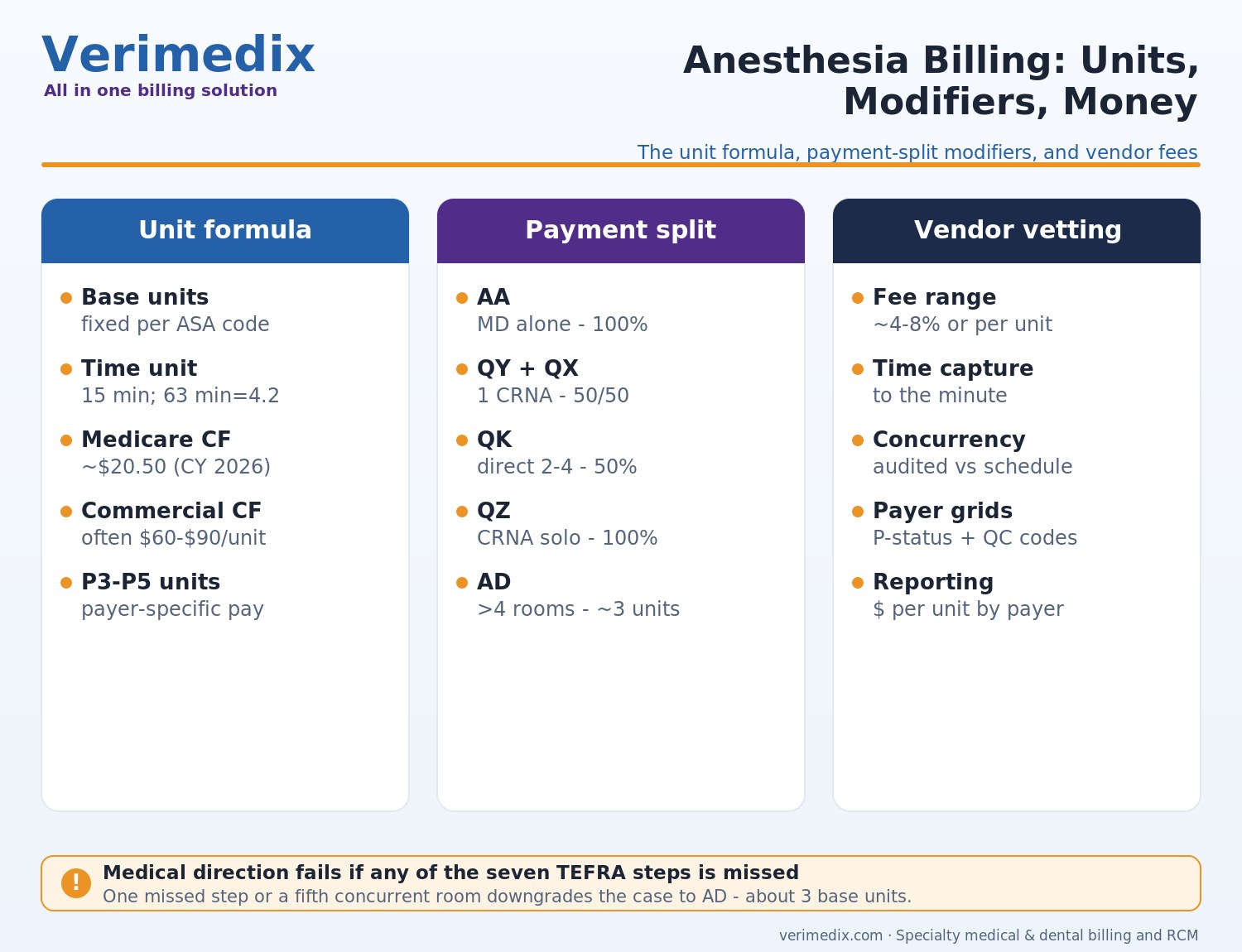
- Anesthesia payment follows a unit formula: (base units + time units + modifying units) x conversion factor. Base units come from the anesthesia code (00100-01999); one time unit is typically 15 minutes.
- The CY 2026 Medicare anesthesia conversion factor is about $20.50 nationally before locality adjustment -- $20.4976 for most clinicians and $20.5998 for qualifying APM participants; commercial conversion factors are negotiated and often quoted several times higher, commonly in the $60-$90 range.
- Provider modifiers set the payment split: AA (personally performed, 100%), QY/QX (one medically directed CRNA, 50/50), QK (medical direction of 2-4 concurrent cases, 50%), QZ (non-directed CRNA, 100% of the allowable), AD (supervision beyond 4 concurrent cases, limited units).
- Medical direction requires all seven TEFRA steps documented per case -- miss one and the case legally downgrades to supervision, with a large payment cut.
- Physical status modifiers P1-P6 describe patient condition; ASA convention adds units for P3-P5, but Medicare does not pay physical status or qualifying-circumstance units -- payment is payer-specific.
- Billing service fees commonly run about 4-8% of collections or a per-unit/per-case rate; all figures here are illustrative -- verify quotes and current CMS/payer policy.
Why anesthesia billing is its own discipline
No other specialty bills the way anesthesia does. There is no flat fee per CPT code: every case's value is assembled from the procedure's base units, the documented minutes of anesthesia time, modifier-driven payment splits across physicians and CRNAs, and a conversion factor that differs between Medicare and every commercial contract. That structure creates failure modes generalist billers rarely see -- unanchored start/stop times, concurrency miscounts, wrong provider modifiers, discontinuous time handled badly -- and each one silently shaves units off every case. A group running thousands of cases a year cannot afford per-case leakage measured in whole units.
An anesthesia-competent billing service should own, at minimum: anesthesia record abstraction and time capture, ASA/CPT crosswalk coding, concurrency tracking for medical direction, modifier assignment, payer-specific rules for physical status and qualifying circumstances, claim submission and clean-claim scrubbing, denial appeals, and unit-level reporting that lets you audit collected dollars per unit by payer.
The payment formula: base + time + modifying units
The standard anesthesia payment calculation is:
(Base units + Time units + Modifying units) x Conversion factor = Payment
- Base units are fixed per anesthesia code (00100-01999) and reflect procedure complexity -- published in the CMS anesthesia base unit file and the ASA Relative Value Guide. They do not change with time spent.
- Time units: anesthesia time runs from when the provider begins continuous care in preparation for the procedure until the patient is safely placed in post-anesthesia care. One unit is typically 15 minutes; Medicare calculates fractional units to one decimal (so 63 minutes = 4.2 units, not 5). Commercial payers vary -- some round by different rules, which is itself an audit point.
- Modifying units: under ASA convention, physical status P3 adds 1 unit, P4 adds 2, P5 adds 3, and qualifying circumstances codes add more (99100 extreme age +1, 99116 hypothermia +5, 99135 controlled hypotension +5, 99140 emergency +2). Medicare pays none of these; many commercial payers pay some -- policy is contract-specific.
- Conversion factor: Medicare publishes locality-adjusted anesthesia conversion factors -- about $20.50 nationally for CY 2026 ($20.4976 for most clinicians, $20.5998 for qualifying APM participants) per the CMS fee schedule. Commercial conversion factors are negotiated and frequently quoted in the $60-$90 per unit range in industry discussions, which is why payer mix dominates anesthesia group economics.
Provider and status modifiers: who did what, and who gets paid
| Modifier | Meaning | Medicare payment effect |
|---|---|---|
| AA | Anesthesiologist personally performed | 100% of the allowable to the physician |
| QY + QX | Physician medically directs one CRNA (QY); CRNA service with medical direction (QX) | Each paid 50% of the allowable -- 100% total for the case |
| QK | Medical direction of 2-4 concurrent procedures | Physician paid 50% of the allowable per case (paired with QX on the CRNA claim) |
| QZ | CRNA without medical direction | 100% of the allowable to the CRNA (state supervision/opt-out rules apply) |
| AD | Medical supervision: physician involved in more than 4 concurrent procedures (or direction requirements not met) | Sharply limited -- generally 3 base units per case, plus one additional unit if the physician documents presence at induction |
| P1-P6 | Physical status (P1 healthy through P6 organ donor) | Not paid by Medicare; some commercial payers pay added units for P3-P5 |
| QS / G8 / G9 | Monitored anesthesia care indicators | Informational/payer-specific; MAC still bills full anesthesia time |
Medical direction vs supervision is a compliance cliff, not a labeling choice. To bill QY/QK medical direction, the physician must personally satisfy all seven TEFRA-derived steps on each case: perform the pre-anesthetic exam and evaluation; prescribe the anesthesia plan; personally participate in the most demanding portions including induction and emergence (as applicable); ensure qualified personnel perform what they do not; monitor at frequent intervals; remain physically present and available; and provide indicated post-anesthesia care. If any step fails -- or concurrency exceeds four -- the case drops to AD supervision and the physician side of the payment collapses to roughly three units. A billing service that does not audit concurrency logs against the schedule is guessing about your compliance.
Worked example: one case, three payment paths (illustrative)
Laparoscopic procedure crosswalked to an anesthesia code with 7 base units; anesthesia time 63 minutes = 4.2 time units; patient is P3 (severe systemic disease).
| Scenario | Unit math | Illustrative payment |
|---|---|---|
| Medicare, AA (personally performed) | (7 + 4.2) x ~$20.50 (P3 not paid) | ~$229.60 |
| Commercial at $70/unit, AA, P3 paid (+1) | (7 + 4.2 + 1) x $70 | ~$854.00 |
| Medicare care team, QY/QX | (7 + 4.2) x ~$20.50, split 50/50 | ~$114.80 each side |
Now scale the failure modes. If time is recorded in whole 15-minute blocks and rounded down, that 63-minute case may go out as 4.0 units instead of 4.2 -- at a $70 commercial rate, $14 lost. If sloppy documentation forces AD instead of QK on 100 directed Medicare cases a month, the physician side drops from 50% of full units to about 3 units per case. For a group running 800 cases monthly at a blended ~$45/unit and ~11 units per case, a mere 0.3-unit average capture improvement is worth roughly $10,800 per month -- about $130,000 a year. Every figure here is illustrative, but the sensitivity is real: anesthesia revenue moves in tenths of units.
Pricing models: percentage, per-unit, and flat fee
| Model | Typical range (industry-published) | Notes |
|---|---|---|
| Percentage of collections | Roughly 4-8% for full-service RCM | Market-standard; specialty expertise justifies the mid-range, not automatically the top |
| Per-unit or per-case fee | Negotiated; seen in anesthesia because unit volume is measurable | Aligns cost to workload; demands accurate unit reporting you can audit |
| Flat monthly / hybrid | Sized to case volume and provider count | Common for hospital-contracted groups with stable schedules |
Whichever model you choose, tie it to unit-level reporting: collected dollars per unit by payer, average units per case, and denial rate. Those three metrics expose a weak biller within one quarter.
How to choose: an anesthesia-specific vetting list
- What share of your clients are anesthesia groups or CRNA practices, and can we speak to two?
- How do you capture anesthesia time -- abstraction from the anesthesia record, or trust in whatever the EHR passes through?
- Show me a concurrency audit: how do you verify QK cases never exceeded four concurrent rooms?
- How do you decide QZ vs QX/QY in states with supervision opt-outs, and who maintains that state/payer matrix?
- Which of our commercial contracts pay P3-P5 and qualifying circumstances, and how is that tracked per payer?
- What is your average collected-per-unit by payer for comparable clients (redacted is fine)?
- How are OB epidural cases (time-based across hours) and discontinuous time handled?
- What are your denial and appeal workflows for medical-direction documentation challenges, and how do you keep claims inside timely filing limits?
If your group also staffs facility cases, our ASC billing services page covers the facility-side claim logic that pairs with professional anesthesia billing. And when you want a specialty benchmark for the shortlist, Verimedix's anesthesiology billing services are built around exactly this unit-and-modifier discipline.
Quick Answers
How is anesthesia billing calculated? Payment = (base units + time units + modifying units) x the conversion factor. Base units are fixed per anesthesia code; one time unit is typically 15 minutes; modifying units depend on payer policy.
What is the 2026 Medicare anesthesia conversion factor? About $20.50 per unit nationally for CY 2026 -- $20.4976 for most clinicians, $20.5998 for qualifying APM participants, then adjusted by locality -- confirm your MAC's published locality rate. Commercial conversion factors are negotiated and often several times higher.
What do the AA, QK, QX, and QZ modifiers mean? AA is a personally performing anesthesiologist (100%); QK is medical direction of 2-4 concurrent cases (50% to the physician); QX is a medically directed CRNA (50%); QZ is a CRNA working without medical direction (100% of the allowable).
What is the difference between medical direction and medical supervision? Medical direction (QY/QK) requires the physician to complete all seven TEFRA steps per case with no more than four concurrent rooms; anything beyond that is supervision (AD), generally paid at about 3 base units per case.
Do physical status modifiers P1-P6 increase payment? Under ASA convention P3 adds 1 unit, P4 adds 2, and P5 adds 3, but Medicare does not pay them; commercial payment is contract-specific. They must still reflect the documented ASA classification.
How much does anesthesia billing cost? Commonly about 4-8% of collections, or negotiated per-unit/per-case rates; scope, case volume, and payer mix drive the quote. Get unit-level reporting written into any agreement.
Frequently asked questions
Time begins when the anesthesia provider starts continuous care in preparation for the procedure and ends when the patient is safely placed under post-anesthesia supervision. It must be documented with actual clock times, and Medicare converts minutes to fractional 15-minute units to one decimal place. Discontinuous time must be handled per payer rules.
Because medical direction is all-or-nothing: the physician must personally complete every one of the seven required steps on each concurrent case, and concurrency can never exceed four rooms. A missing pre-anesthetic evaluation signature or an overlapping fifth case converts the claim to supervision, which generally pays only about three base units.
No -- Medicare pays neither P-modifier units nor qualifying circumstances codes such as 99100 or 99140. Many commercial contracts do pay some of them, which is why anesthesia billing services maintain payer-specific grids rather than one coding rule.
QZ reports a CRNA working without medical direction, paid at 100% of the allowable under Medicare. A group's QZ share reflects its staffing model and state supervision rules; billing it when direction was actually provided (or vice versa) creates compliance exposure, so the modifier must match the record.
Published full-service RCM ranges run roughly 4-8% of collections, and anesthesia's measurable unit volume also makes per-unit or per-case fees workable. Judge cost against collected dollars per unit by payer -- a cheaper vendor that captures fewer units per case is more expensive in practice.