- For a documented therapeutic pulpotomy, D3220 is the ADA CDT entry to investigate; the current descriptor excludes the final restoration.
- Do not select a pulpotomy code from a procedure nickname, diagnosis alone, or the expected fee. Match the line to the procedure note and current CDT entry.
- Document the tooth, pulp findings, service performed, materials or medicament when relevant, and the date of service clearly enough for a plan review.
- A correct CDT code does not guarantee payment. Benefit limits, exclusions, frequency rules, attachments, and plan-specific policies still control adjudication.
- Keep the code decision separate from the coverage decision: verify the documented service first, then check the member’s current dental policy.
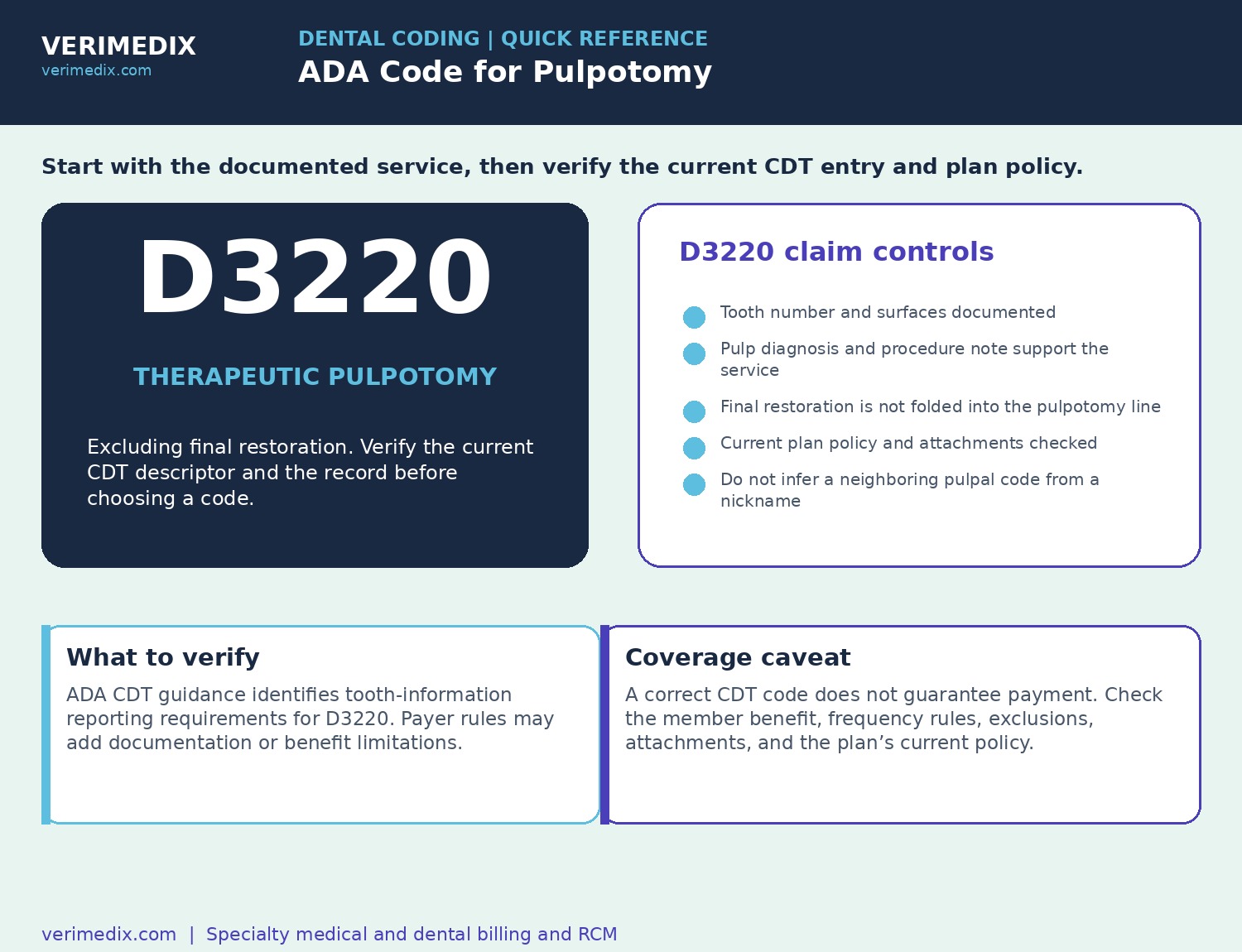
What is the ADA code for a pulpotomy?
D3220 is the ADA CDT code to investigate for a therapeutic pulpotomy, excluding the final restoration. The ADA’s published CDT reference material identifies the service as removal of pulp coronal to the dentinocemental junction and application of medicament. Use the current CDT entry and the clinical record together; this article does not reproduce the full code set.
The phrase “pulpotomy” is not enough by itself. Before assigning D3220, confirm what was actually performed, which tooth was treated, whether the record supports a therapeutic pulpotomy, and whether any restoration is separately documented. Verimedix supports practices through dental billing services and dental billing workflow and pricing guidance.
What does D3220 include and exclude?
| Review point | Billing control |
|---|---|
| Service | Confirm the procedure note supports a therapeutic pulpotomy. |
| CDT entry | Verify the current D3220 descriptor for the date of service. |
| Final restoration | D3220 excludes the final restoration; review any separate restorative line under its own documentation and plan rules. |
| Tooth information | Record the tooth and relevant anatomy required by the claim form or payer. |
| Neighboring pulpal codes | Do not choose another pulpal code solely because its wording sounds similar; confirm the exact service and current CDT entry. |
The ADA’s dental claim-data guidance indicates that tooth information is relevant to D3220 reporting. That reporting guidance does not decide coverage or payment. The payer’s plan document and claim policy still control what is payable.
What documentation supports a D3220 claim?
A defensible claim packet should make the code decision visible to another biller. Keep:
- the tooth number and surface or anatomy details required by the claim;
- the presenting pulp findings and diagnosis documented by the treating dentist;
- the procedure note describing the pulpotomy and the material or medicament used when relevant;
- the date of service, treating provider, and location;
- the final-restoration status, including whether it was performed on the same date or later; and
- any radiograph, narrative, periodontal/endodontic record, or attachment required by the plan.
Do not add a narrative that says more than the clinical record. If the documentation is ambiguous, query the provider before changing the code. A short, traceable query is safer than a payer-facing explanation unsupported by the record.
How do dental plans review pulpotomy coverage?
Dental plans can apply different benefit categories, age or tooth limitations, frequency rules, exclusions, alternate benefits, and attachment requirements. A state program’s covered-code list or one commercial plan’s policy is not a universal rule for every member. Check the current plan document, payer portal, and date-of-service guidance.
When a plan requests more information, send the record that answers the question asked: tooth, diagnosis, procedure, restoration status, and any required imaging or narrative. Do not promise coverage to the patient before eligibility and benefit verification is complete.
Authoritative reference points: Confirm the current code entry through the ADA CDT resource and review the ADA’s 2026 guide to dental procedures and tooth reporting. These references help validate code and tooth-detail questions; the member’s plan document still controls coverage and payment.
What are common D3220 claim denials?
| Denial pattern | Control gap | Correction path |
|---|---|---|
| Code or service mismatch | Procedure note does not support the line | Reconcile the note with the current CDT descriptor. |
| Missing tooth detail | Claim lacks required anatomy information | Validate the tooth field and claim-data requirement. |
| Restoration confusion | Final restoration treated as part of D3220 | Separate services and review the plan’s bundling rules. |
| Coverage exclusion | Benefit or frequency rule not checked | Read the member’s current plan policy before appeal. |
| Attachment request | Narrative or image not sent | Submit the specific record the payer requests. |
Worked example: separating coding from coverage
Illustrative only: a claim includes a documented therapeutic pulpotomy for a named tooth, but the plan asks for a narrative and radiograph. The biller should preserve the D3220 code decision if the procedure note supports it, then submit the requested evidence and check the plan’s benefit rules. The missing attachment is not proof that a different CDT code is correct.
If the note instead describes a different pulpal service or does not establish what was performed, pause for a provider query. Never use a neighboring code as a guess.
How can a dental practice reduce pulpotomy billing rework?
Build a pre-submission checklist that connects the clinical note, tooth field, current CDT reference, benefit verification, and attachment rules. Track denials by code and reason, then feed recurring issues back to front-desk verification and provider documentation. A dental billing partner should be able to show the source record behind a code correction.
For related operational support, review dental claim denial prevention, dental insurance verification, and dental billing services.
Quick Answers
What is D3220? D3220 is the ADA CDT entry to investigate for a therapeutic pulpotomy, excluding the final restoration. Verify the current descriptor and procedure note.
Does D3220 include the final restoration? No. The published descriptor excludes the final restoration. Review any restorative service separately under its own documentation and plan rules.
Does D3220 guarantee payment? No. Dental benefit limits, frequency rules, exclusions, attachments, and plan policies can change the outcome.
What should a biller do when the note is unclear? Query the treating provider for the missing service, tooth, or restoration detail rather than selecting a neighboring pulpal code by guesswork.
Frequently asked questions
D3220 is the ADA CDT entry to investigate for a therapeutic pulpotomy, excluding the final restoration. Verify the current descriptor and procedure note.
No. The published descriptor excludes the final restoration. Review any restorative service separately under its own documentation and plan rules.
No. Dental benefit limits, frequency rules, exclusions, attachments, and plan policies can change the outcome.
Query the treating provider for the missing service, tooth, or restoration detail rather than selecting a neighboring pulpal code by guesswork.
Check the tooth information, procedure note, diagnosis, restoration status, member benefit, and any required narrative, image, or attachment.