
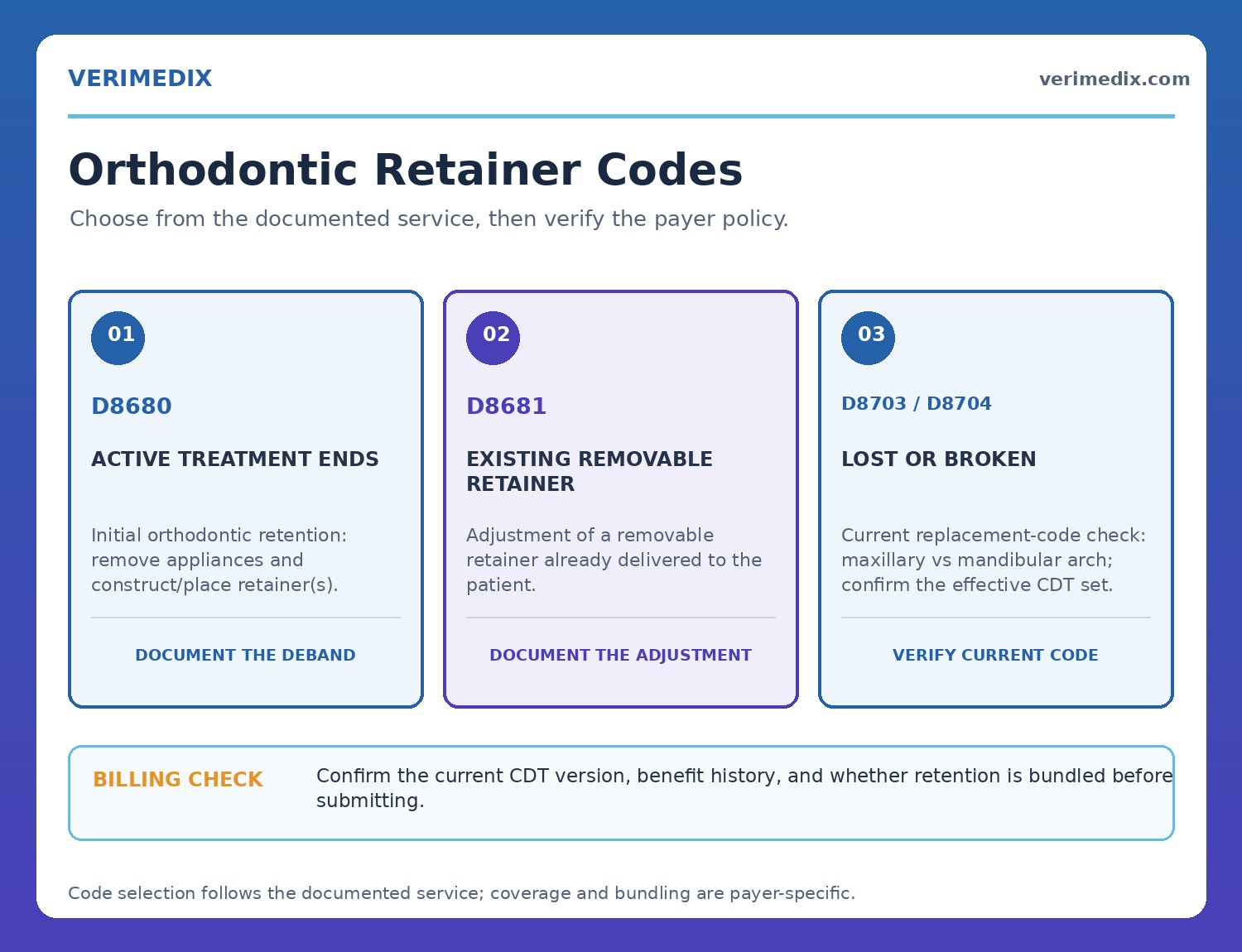
- For the retention visit at the end of active orthodontic treatment, D8680 describes removal of appliances plus construction and placement of retainer(s).
- D8681 is the boundary case: adjustment of an existing removable orthodontic retainer, not initial delivery or replacement.
- For a lost or broken replacement, current code-set checks may point to D8703 (maxillary) or D8704 (mandibular); verify the effective CDT version and payer policy before filing.
- D8680 is not automatically a separately payable line. Some plans and state programs bundle retention into the comprehensive orthodontic fee.
- Build the claim from the documented service, date of service, arch, retainer type, case-completion record, and the payer's benefit rules.
What is the ADA code for an orthodontic retainer?
The answer depends on what happened at the visit. D8680 is the CDT code for orthodontic retention when active appliances are removed and retainer(s) are constructed and placed. D8681 is for adjusting an existing removable orthodontic retainer. A lost or broken retainer is a replacement scenario, so the biller must check the current CDT code set and the payer's instructions rather than reusing D8680. The phrase “dental code for retainer” is therefore not one universal line item; the documented event controls the starting code question.
“ADA code” is common office shorthand; the reportable procedure code is a CDT code. The American Dental Association's CDT code FAQ explains that the code set supports consistent documentation. The ADA also says the full current CDT entry should be considered and that the code version effective on the date of service controls the claim. Coverage is determined by the contract between the plan purchaser and payer, not by the existence of a CDT code.
When should a practice use D8680?
Use D8680 only when the documented service matches the retention event: active orthodontic treatment has ended, appliances are removed, and retainer(s) are constructed and placed. The code's descriptor is “orthodontic retention (removal of appliances, construction and placement of retainer(s)).” It is a completion-of-treatment event, not a catch-all code for anything involving a retainer.
| Documented event | Starting code question | Claim-control check |
|---|---|---|
| Deband and initial retainer delivery | Does the record support D8680? | Record the completion date, retainer type, and arch or arches. |
| Adjustment of a removable retainer already delivered | Is this D8681 territory? | Describe the fit, comfort, or function issue and the adjustment performed. |
| Lost or broken retainer | Is a current replacement code applicable? | Check the effective CDT year, arch, benefit history, and payer replacement rules. |
When is D8681 the better fit?
D8681 is the code to investigate when the patient already has a removable orthodontic retainer and the visit changes that appliance to improve fit, comfort, or function. The clinical note should make the sequence clear: the appliance existed before the appointment, the patient presented with a specific issue, the office performed an adjustment, and fit or function was checked afterward.
Do not use the initial-retention logic simply because the patient says a retainer feels tight. If the same retainer was delivered previously and is adjusted at a later visit, the record describes a different service from the deband-and-delivery event. If the appliance is lost, broken, replaced, fixed, or otherwise handled outside this adjustment scenario, pause and confirm the applicable current CDT entry before submission.
What code check applies to a lost or broken retainer?
Replacement coding changed over time, which is why a 2026 workflow should not rely on an old office cheat sheet. A Washington Health Care Authority orthodontic billing guide documents D8703 for a lost or broken retainer in the maxillary arch and D8704 for the mandibular arch, and explains that earlier D8692 treatment was superseded in that program. That is a payer-program example, not a universal promise of coverage.
Before filing a replacement claim, verify four items:
- Which CDT version was effective on the date of service.
- Whether the replacement is maxillary, mandibular, or otherwise described by the current code entry.
- Whether the plan has a replacement frequency, waiting period, prior-authorization, or patient-responsibility rule.
- Whether the note states that the original retainer was lost or broken and supports the replacement delivered.
The DentistryIQ retainer-billing overview also separates initial retention from replacement work. Use it as a workflow reference, then validate the current code descriptor and payer policy.
Is D8680 separately billable?
Not automatically. Retention can be included in a comprehensive orthodontic case fee or handled as an installment or separate benefit, depending on the plan and contract. A state program may specify that its fee includes debanding and retainers; another payer may process the completion event differently. Never turn a payer-specific rule into a universal billing rule.
At case start, document whether the patient agreement and payer arrangement treat retention as part of the comprehensive fee. At completion, compare the planned billing arrangement with the claim history. If D8680 is submitted separately, include the completion evidence the payer requests rather than assuming the procedure code alone proves payment entitlement.
What should the orthodontic retainer claim record contain?
A defensible record connects the code to the work performed. Use this checklist as an operational starting point, then apply the carrier's exact requirements:
- Date active appliances were removed and retention began.
- Date and details of retainer construction and placement, when the service is initial retention.
- Retainer type and arch or arches involved.
- For an adjustment, evidence that a removable retainer already existed, the patient's complaint or finding, the adjustment made, and the post-adjustment fit check.
- For a replacement, the lost or broken status, current replacement code check, and payer benefit or authorization result.
- Reference to the orthodontic case or treatment-completion record when the payer requires it.
How can a practice prevent retainer-code denials?
Put the decision boundary into the work queue. First classify the event as initial retention, later adjustment, replacement, or another appliance service. Then check the date-of-service code set, the plan's benefit history, and whether the service is bundled. Finally, compare the claim line with the clinical note before transmission.
The most common preventable error is treating every retainer encounter as D8680. A second is carrying a deleted or superseded replacement code forward without checking the current CDT year. A third is filing a technically correct code without checking whether the payer includes retention in a global orthodontic fee. A short pre-submit checklist catches all three.
If your team needs a repeatable workflow for eligibility checks, claim submission, and orthodontic exceptions, see Verimedix dental billing services and the full-cycle dental RCM guide. Both resources are service-level starting points; the code decision still belongs to the documented service and payer rules.
Frequently asked questions
For initial orthodontic retention at the end of active treatment, D8680 describes removal of appliances plus construction and placement of retainer(s). The exact current CDT entry and payer handling must be checked for the date of service.
D8681 is the CDT code to investigate for adjustment of an existing removable orthodontic retainer. The record should show that the retainer was already delivered, why it needed adjustment, what was done, and the fit or function check.
A current code-set check may point to D8703 for a maxillary replacement or D8704 for a mandibular replacement. Verify the effective CDT version, benefit history, and payer rules before filing because replacement coverage is not universal.
Not necessarily. Some comprehensive orthodontic plans and state programs include retention in the global case fee, while other arrangements may process it as a completion or separate benefit. Follow the specific plan and contract.
Only when the documented service matches initial retention at the end of active treatment. A later adjustment, lost or broken replacement, or other appliance service requires a separate current-code and payer-policy review.
Document the event type, tooth or arch information when applicable, date of service, retainer status, work performed, treatment-completion context, and the payer benefit or bundling check. Attach only the records the plan requests or requires.