
- Comprehensive orthodontic cases are billed once with a case-fee CDT code — D8070 (transitional), D8080 (adolescent) or D8090 (adult dentition) — chosen by dentition stage, not patient age or appliance brand.
- Payers typically pay an initial portion at banding (often around 25–50% of their obligation, plan-dependent) and release the remainder as automatic or claim-triggered periodic payments over the treatment months.
- Orthodontic benefits carry a separate lifetime maximum — commonly in the $1,000–$3,000 range on employer PPO plans — and prior ortho treatment on any plan may have already consumed part of it.
- D8670 (periodic orthodontic treatment visit) is part of the contract structure, not an add-on fee; submit it only when and how the specific plan requires.
- Patients who change insurance mid-treatment trigger continuation-of-care (work-in-progress) rules: the new plan may prorate remaining benefits, require a new claim with banding date and months remaining, or exclude treatment in progress entirely.
- Verification for ortho must capture six data points: ortho rider present, lifetime max remaining, age limits, payment schedule, work-in-progress policy and whether the plan auto-pays.
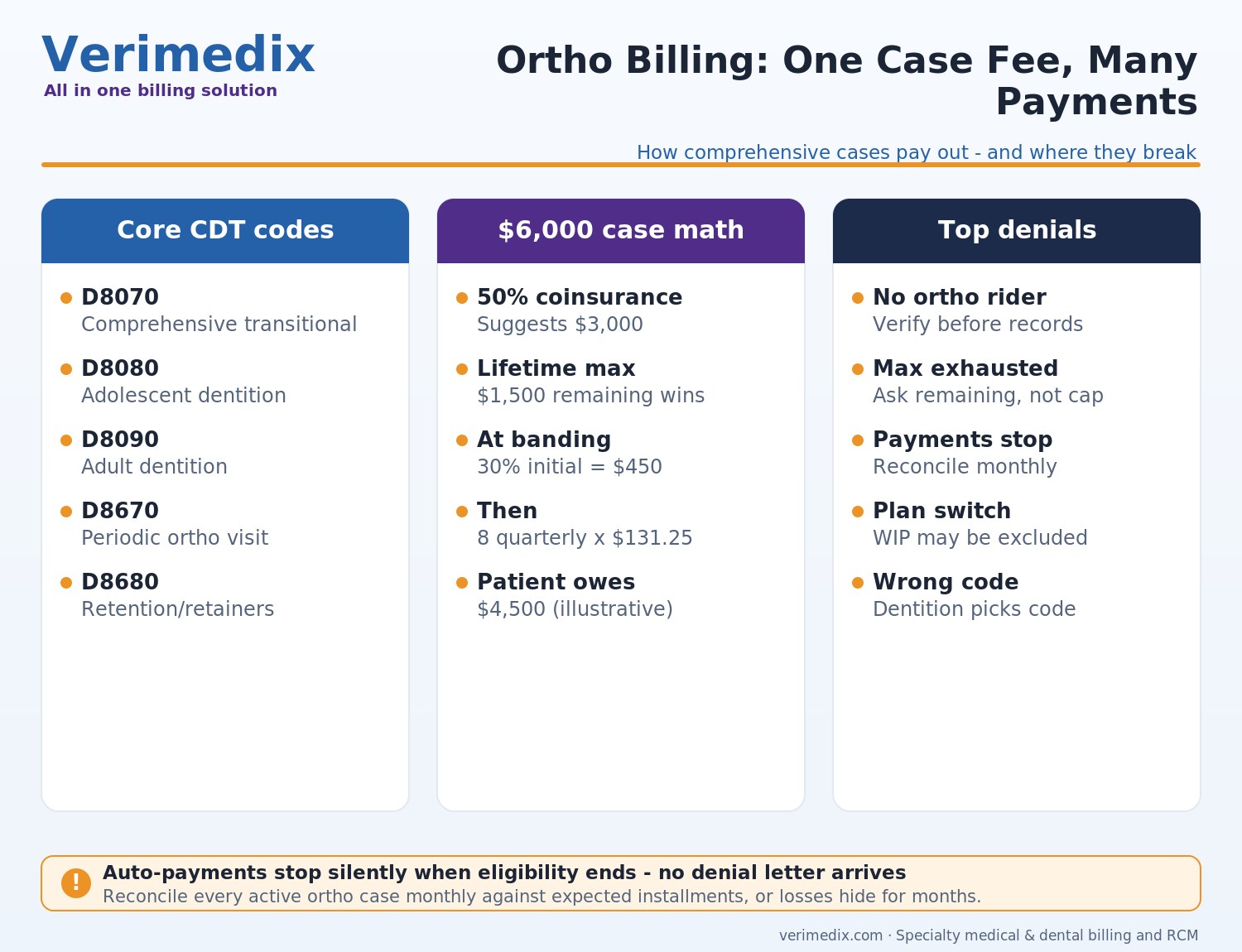
How orthodontic billing differs from general dental billing
A crown is billed once, paid once, closed. An orthodontic case opens a payment relationship that can run 12 to 36 months, survive plan renewals, and involve a payer that pays in installments against a single claim filed at banding. That means ortho AR is not really claim follow-up — it is contract tracking: knowing, for every active case, what the plan owes in total, what it has paid so far, when the next auto-payment should land, and what happens if the patient’s coverage changes before debond.
Practices that treat ortho like general dentistry hit the same wall: payments stop mid-treatment and nobody notices for months, because no new claims were “due.” The fix is a case ledger — per patient, per plan — reconciled monthly against expected periodic payments.
The orthodontic CDT codes (verified against ADA CDT descriptors)
These are the codes that carry nearly all orthodontic billing, with the distinctions payers actually enforce:
| CDT code | Descriptor (abbreviated) | Billing notes |
|---|---|---|
| D8010–D8040 | Limited orthodontic treatment (primary, transitional, adolescent, adult dentition) | Partial-objective treatment; some plans cover limited cases differently than comprehensive ones |
| D8070 | Comprehensive orthodontic treatment of the transitional dentition | Mixed dentition cases; dentition stage — not age — selects the code |
| D8080 | Comprehensive orthodontic treatment of the adolescent dentition | The workhorse code for teen cases; case fee includes appliance placement |
| D8090 | Comprehensive orthodontic treatment of the adult dentition | Adult dentition (which can include a 16-year-old); many plans restrict or exclude adult ortho — verify first |
| D8660 | Pre-orthodontic treatment examination to monitor growth and development | Observation visits before active treatment; coverage varies widely |
| D8670 | Periodic orthodontic treatment visit | Reports ongoing treatment under the contract; only some plans (notably Medicaid programs) want it claimed per visit |
| D8680 | Orthodontic retention (removal of appliances, construction and placement of retainer(s)) | Some plans bundle retention into the case fee; others allow it separately — check before charging the patient |
| D8090/D8999 alt. | D8999 unspecified orthodontic procedure | Narrative required; use only when no listed code fits |
Code selection is the easy part. The verified rule worth repeating: the adolescent/adult split follows the dentition, per the ADA’s CDT descriptors — an adult dentition in a 15-year-old is still D8090 territory, and payers audit this.
Contract billing: banding fee, periodic payments and auto-pay
When a comprehensive case starts, you submit one claim with the total case fee, the banding (appliance placement) date, and the estimated treatment length in months. From there, plans pay in one of three patterns — and you must know which one each plan uses:
- Automatic installments. The plan pays an initial amount at banding — frequently in the neighborhood of 25–50% of its total obligation, though schedules vary by plan — then releases the remainder automatically on a monthly or quarterly cycle for as long as the patient stays eligible. No further claims needed; your job is reconciliation.
- Claim-triggered installments. The plan requires periodic claims (often D8670) on its schedule before releasing each payment. Miss the claim, miss the payment.
- Lump sum. A minority of plans pay their full obligation at banding. Simple — but remember eligibility issues later cannot claw your attention back if the case fee was underquoted.
Two traps live inside this structure. First, auto-payments silently stop when the patient loses eligibility, the group changes carriers, or the plan year resets incorrectly — which is why the monthly case-ledger reconciliation exists. Second, the initial claim’s banding date and months-of-treatment fields drive the payer’s entire payment schedule; errors there misalign every subsequent installment.
Lifetime maximums and verification
Orthodontic benefits almost always sit under a separate lifetime maximum — commonly $1,000–$3,000 on commercial PPO plans, per person, per lifetime — distinct from the annual dental maximum. Verification must therefore ask for the remaining lifetime max, because treatment years ago under a prior employer’s plan can have consumed part of it (many plans count prior ortho payments from any carrier). A complete ortho verification captures: rider present, remaining lifetime max, coinsurance percentage, age limits (many plans cap coverage at age 19 for dependents; adult ortho is often excluded), payment schedule type, work-in-progress policy, and waiting periods. Our dental insurance verification how-to guide covers the workflow, and outsourced dental verification services can carry this load for high-volume ortho practices.
Worked example: how a $6,000 case actually pays (illustrative)
Illustrative case: comprehensive adolescent treatment, $6,000 case fee, 24-month treatment plan. Plan: 50% ortho coinsurance, $1,500 remaining lifetime maximum, quarterly auto-payments, 30% initial payment.
- Plan obligation = the lesser of 50% × $6,000 = $3,000 and the $1,500 remaining lifetime max → $1,500 total.
- Initial payment at banding: 30% × $1,500 = $450.
- Remaining $1,050 paid quarterly over 24 months → 8 payments of $131.25, contingent on continued eligibility each quarter.
- Patient responsibility = $6,000 − $1,500 = $4,500, which the practice should schedule on its own financial agreement — never assume insurance covers half the fee just because coinsurance says 50%.
The most common estimation error in ortho: quoting the patient from the coinsurance percentage while ignoring the lifetime max, then discovering mid-treatment that the plan stopped paying at $1,500 while the patient was promised $3,000 of coverage.
Common ortho denials — and the continuation-of-care problem
| Denial scenario | Why it happens | Fix / prevention |
|---|---|---|
| No ortho rider / adult ortho excluded | Ortho is an optional benefit; many plans exclude D8090 for adults | Verify rider and age limits before records appointment; get exclusions in writing |
| Lifetime maximum exhausted | Prior treatment (any carrier) consumed the max | Ask for remaining max, not the headline number; document the quote |
| Payments stopped mid-treatment | Eligibility loss, group carrier change, or missed claim-triggered installment | Monthly case-ledger reconciliation; act the first month a payment is missing |
| Work-in-progress exclusion | New plan refuses cases banded before its effective date | Submit continuation claim with banding date, total fee, months remaining and payments received; appeal with treatment plan if denied |
| D8670 frequency denial | Plan limits periodic visits (e.g., some Medicaid programs allow one per calendar month) | Bill periodic visits only on the plan’s schedule with required continuation-of-care forms |
| Dentition/code mismatch | D8080 billed for an adult dentition or vice versa | Select by dentition stage per CDT descriptors; keep records supporting staging |
Continuation of care deserves its own paragraph because it is the highest-dollar failure. When a patient changes carriers mid-treatment, the original plan generally stops paying at the eligibility end date, and the new plan — if it covers work in progress at all — typically prorates: it calculates remaining months of treatment against its own payment schedule and maximum. Your continuation claim to the new carrier should include the original banding date, total case fee, treatment length, months completed, and the amount prior carriers paid. Plans that exclude work in progress will deny; that denial is sometimes appealable under state continuity-of-care rules, but the reliable protection is a financial agreement that makes the patient responsible for coverage gaps. For the denial-workflow side, see the most common dental claim denials and fixes.
Because contract billing rewards continuity, orthodontic practices often assign it to a dedicated billing resource — full-service partners like Verimedix manage continuation-of-care claims, auto-payment reconciliation, and transfer cases as part of routine dental RCM.
Quick Answers
What is the difference between D8080 and D8090? D8080 is comprehensive orthodontic treatment of the adolescent dentition and D8090 of the adult dentition. The ADA CDT descriptors key the choice to dentition stage, not the patient’s age — an adult dentition in a teenager is still reported with D8090.
How do insurance companies pay for braces? Most plans pay an initial portion of their obligation at banding — often somewhere around 25–50%, plan-dependent — then release the rest as monthly or quarterly payments across treatment, capped by the lifetime orthodontic maximum and contingent on continued eligibility.
What is a lifetime orthodontic maximum? A per-person cap on everything a plan will ever pay toward orthodontics, commonly $1,000–$3,000 on commercial plans and separate from the annual dental maximum. Prior orthodontic treatment may already have reduced it, so always verify the remaining amount.
What is D8670 used for? D8670 reports a periodic orthodontic treatment visit under an existing case. It is part of the contract structure rather than an extra fee, and should be claimed only when a plan requires per-visit claims to release installments — some Medicaid programs limit it to one per calendar month.
What happens to ortho billing when a patient changes insurance mid-treatment? The old plan stops at its eligibility end date; the new plan may prorate remaining benefits from a continuation claim (banding date, total fee, months remaining, prior payments) or exclude work in progress entirely. A signed financial agreement should make the patient responsible for any resulting gap.
Frequently asked questions
For comprehensive cases, appliance placement is generally included in the comprehensive case-fee code (D8070/D8080/D8090) rather than billed as a separate banding charge. What varies is how the payer splits its payment — initial amount at banding plus installments — not whether banding is a separate billable procedure. Follow the plan's claim-format instructions.
The usual causes are loss of eligibility (job change, dependent aging out), the employer group switching carriers, a plan-year administrative reset, or — on claim-triggered plans — a missed periodic claim. Because no new claims are 'due,' these stoppages go unnoticed without a monthly reconciliation of expected versus received installments per case.
It depends on the plan. Some payers consider retainer construction and placement part of the comprehensive case fee; others allow D8680 as a separate benefit. Verify before charging the patient, and remember replacement retainers after retention are typically not covered at all.
Sometimes. Many employer plans limit ortho to dependent children under a cutoff age (often 19), and adult ortho riders are less common — though clear-aligner-era plans increasingly include them. Never start an adult case on an assumption; verify the rider, age limits and remaining lifetime maximum in writing.
Bill the payer for the remaining treatment, not the full case: most plans want a claim reflecting the transfer with your fee for completing treatment, months remaining, and the original banding date. Coverage follows the plan's work-in-progress rules, so verify before quoting, and set the patient's financial agreement on your completion fee.