
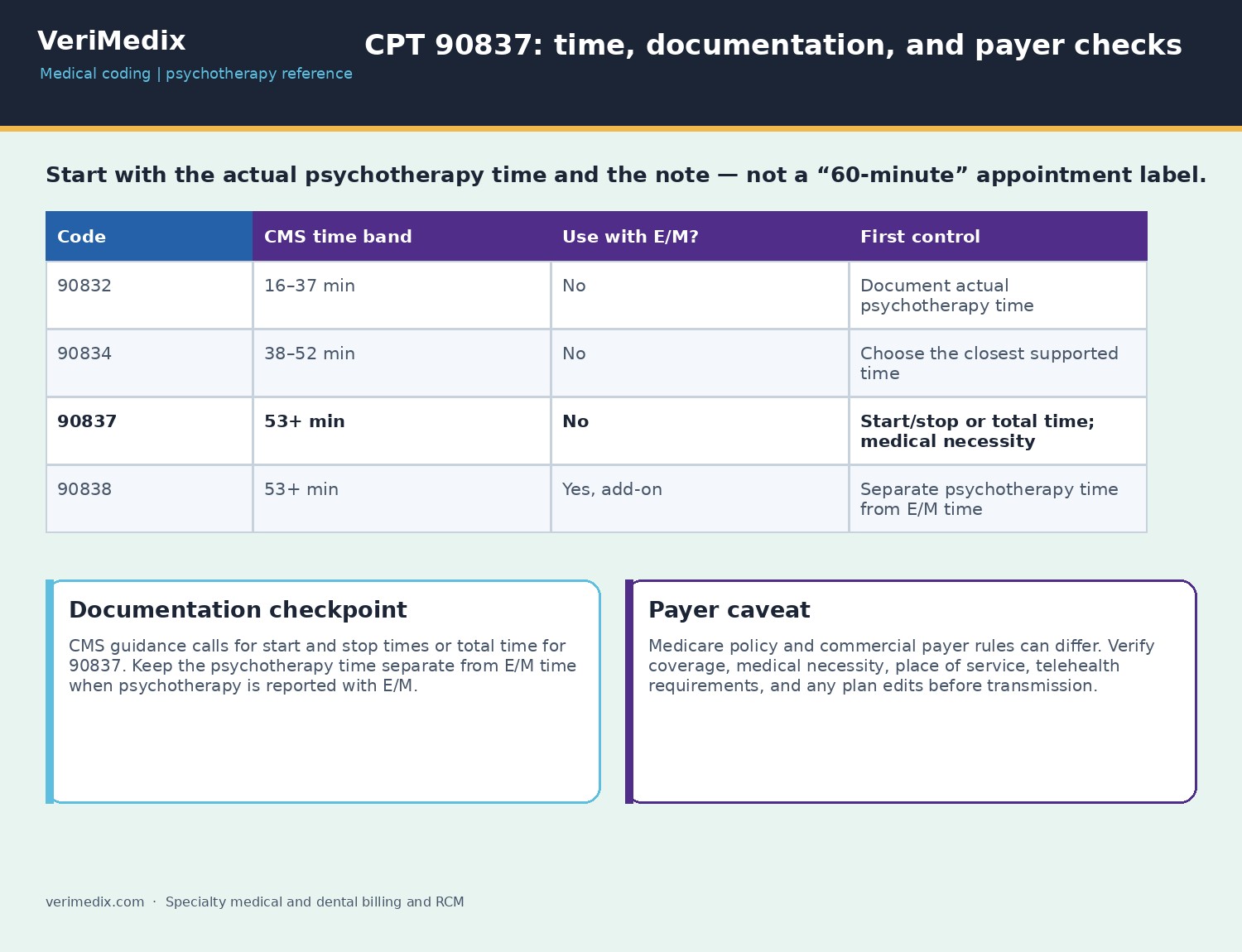
- CPT 90837 is the psychotherapy code to investigate when the documented face-to-face psychotherapy time is 53 minutes or more; CMS directs billers to choose the code closest to actual time.
- The AMA describes 90837 as psychotherapy, 60 minutes with the patient, while CMS time bands use 53 or more minutes for 90837 and 90838.
- Document start and stop times or total psychotherapy time, the clinical service, the patient’s presence, and medical necessity; do not count scheduling, waiting, or unrelated administrative work as psychotherapy time.
- 90837 without E/M is different from 90838, the psychotherapy add-on used with E/M. Keep psychotherapy time separate from E/M time and verify the payer’s current rules.
- A code choice does not guarantee payment. Coverage, authorization, diagnosis support, place of service, telehealth rules, and audit controls remain payer-specific.
What is CPT 90837?
CPT 90837 is the psychotherapy code for a 60-minute service with the patient, and CMS guidance places it in the 53-minutes-or-more time band. The AMA’s CPT 90837 reference describes the clinical service and reminds readers that the CPT manual and payer policy remain controlling authorities. For billing review, use the signed note and actual psychotherapy time rather than the scheduled appointment length.
For behavioral-health practices, the revenue risk is not only a denial. A session can be undercoded when a documented 53-minute service is reduced to a shorter code, or overcoded when a 50-minute note is pushed into 90837. Verimedix supports practices through behavioral health billing services, medical coding services, and denial management services.
How much time supports 90837?
| Code family | CMS time band | Control before claim submission |
|---|---|---|
| 90832 / 90833 | 16–37 minutes | Confirm documented psychotherapy time and whether an E/M service is involved. |
| 90834 / 90836 | 38–52 minutes | Use the closest supported time band; do not round up. |
| 90837 | 53 minutes or more | Retain start/stop times or total psychotherapy time and the clinical note. |
| 90838 | 53 minutes or more | It is an add-on with E/M; keep psychotherapy time separate from E/M time. |
The CMS Billing and Coding: Psychiatry and Psychology Services article states that psychotherapy codes are time-based, directs the biller to choose the code closest to actual time, and identifies 53 or more minutes for 90837 and 90838. Confirm the applicable MAC article and payer policy for the date of service; a Medicare rule should not be presented as a universal commercial-plan rule.
What documentation supports a 90837 claim?
A defensible 90837 claim lets another reviewer connect the service to the signed record. Keep:
- the patient’s identity, date of service, treating clinician, and place of service;
- start and stop times or the total psychotherapy time, as required by the applicable payer;
- the modality and clinical focus of the psychotherapy service;
- the patient’s participation and the interventions or treatment approach documented by the clinician;
- assessment, response, progress, risk or safety findings when clinically relevant, and the plan; and
- medical-necessity and diagnosis support that matches the record and payer policy.
Do not let a template create facts that did not occur. A note that says “60-minute session” without actual psychotherapy time may not establish a 90837 line, and a time entry copied forward from another date is an audit risk. Query or correct the record before changing the code.
How is 90837 different from 90838?
90837 is the standalone psychotherapy code in the 53-minutes-or-more band. CMS identifies 90838 as the psychotherapy add-on used with an E/M service. If psychotherapy and E/M are provided by the same clinician, the documentation should show separately identifiable services and the psychotherapy time should not include the E/M time. The exact E/M code, place of service, and payer edits must be verified separately.
Do not choose 90838 merely because a session was long. First establish whether a separately identifiable E/M service was performed and documented, then apply the current CPT and payer guidance. If no E/M service is supported, review 90837 rather than adding an unsupported line.
How do telehealth and payer rules affect 90837?
Telehealth claims add another policy layer. Verify whether the payer requires a particular place of service, telehealth modifier, audio-video modality, patient location, provider location, or consent documentation. Do not apply a universal modifier rule: commercial plans, Medicare, Medicaid programs, and dates of service can differ.
Before transmission, reconcile eligibility, authorization, network status, diagnosis support, the signed psychotherapy note, and any plan-specific frequency or medical-necessity edit. The CMS article is a useful Medicare reference, but the member’s plan and the applicable payer bulletin control the claim outcome.
For broader psychotherapy coding context, the APA Services psychotherapy-code reference lists the psychotherapy code family. Use the current AMA CPT manual and payer guidance for final code selection.
What causes 90837 denials or downcoding?
| Denial pattern | Likely gap | First correction step |
|---|---|---|
| Time does not support 90837 | Note shows less than 53 minutes or no time evidence | Reconcile the actual psychotherapy time and review the closest supported code. |
| Missing medical necessity | Diagnosis or treatment rationale is not connected to the service | Review the signed note and applicable payer policy; query the clinician if needed. |
| 90838 used without E/M | Add-on line lacks a separately identifiable E/M service | Remove unsupported reporting and verify the service actually performed. |
| Telehealth edit | Place of service, modality, or modifier does not match the plan | Check the payer’s current telehealth instructions for the date of service. |
| Authorization or benefit issue | Eligibility, authorization, or behavioral-health benefit not checked | Verify the member’s plan and retain the reference used for the claim review. |
Worked example: correcting a time mismatch
Illustrative only: a note documents 50 minutes of psychotherapy and a scheduled 60-minute appointment. The biller should not use the appointment label to force 90837. Reconcile the actual documented service with the current time bands, confirm the payer policy, and query the clinician if the record is incomplete.
In a different claim, the note documents 55 minutes of psychotherapy plus a separately identifiable E/M service. The biller should preserve the audit trail, review whether the record supports the psychotherapy-with-E/M pathway, and verify the payer’s reporting rules before considering an add-on code. Never infer the E/M service from the session length alone.
How can a practice reduce psychotherapy billing rework?
Build a pre-submission checklist that links the appointment record, psychotherapy start/stop or total time, signed note, diagnosis support, place of service, authorization, and payer edits. Track denials by code and reason, then feed recurring issues back to scheduling and clinician documentation. A billing partner should show the source record behind a code correction instead of promising that every 60-minute appointment belongs in 90837.
Quick Answers
How many minutes are needed for 90837? CMS guidance places 90837 in the 53-minutes-or-more band. Verify the payer’s current policy and the note’s actual psychotherapy time.
Is 90837 exactly a 60-minute session? The AMA descriptor refers to psychotherapy, 60 minutes with the patient, while CMS coding bands use 53 or more minutes. Use the current authority and documented time together.
Can 90837 be billed with E/M? Review the separate psychotherapy-with-E/M pathway and current payer rules. 90838 is the add-on identified by CMS; do not add it without a separately identifiable E/M service.
Does 90837 guarantee payment? No. Coverage, medical necessity, authorization, place of service, telehealth requirements, and payer edits can still affect adjudication.
Frequently asked questions
CMS guidance places 90837 in the 53-minutes-or-more band. Verify the payer’s current policy and the note’s actual psychotherapy time.
The AMA descriptor refers to psychotherapy, 60 minutes with the patient, while CMS coding bands use 53 or more minutes. Use the current authority and documented time together.
Review the separate psychotherapy-with-E/M pathway and current payer rules. 90838 is the add-on identified by CMS; do not add it without a separately identifiable E/M service.
Keep the signed psychotherapy note, actual start/stop or total psychotherapy time, service details, patient participation, diagnosis and medical-necessity support, and payer-required claim information.
No. Coverage, medical necessity, authorization, place of service, telehealth requirements, and payer edits can still affect adjudication.