
- Incident-to billing pays qualifying NP/PA services at 100% under the physician’s NPI — office setting only, established patient, physician-initiated plan of care, direct supervision, and group employment.
- Split/shared applies only in facility settings (inpatient, outpatient, observation, ED); the practitioner who performs the substantive portion bills, with modifier FS.
- Under CMS policy in effect through 2026, the substantive portion is more than half of the total time or a substantive part of the medical decision making; critical care remains time-only.
- From January 1, 2026, CMS made virtual direct supervision (real-time audio-video) permanent for most incident-to services; audio-only does not qualify.
- Billing incident-to in a hospital department, for a new patient, or for a new problem is a compliance risk and a recurring OIG audit theme.
- When incident-to criteria fail, the service is still billable under the APP’s own NPI at 85% of the physician fee schedule.
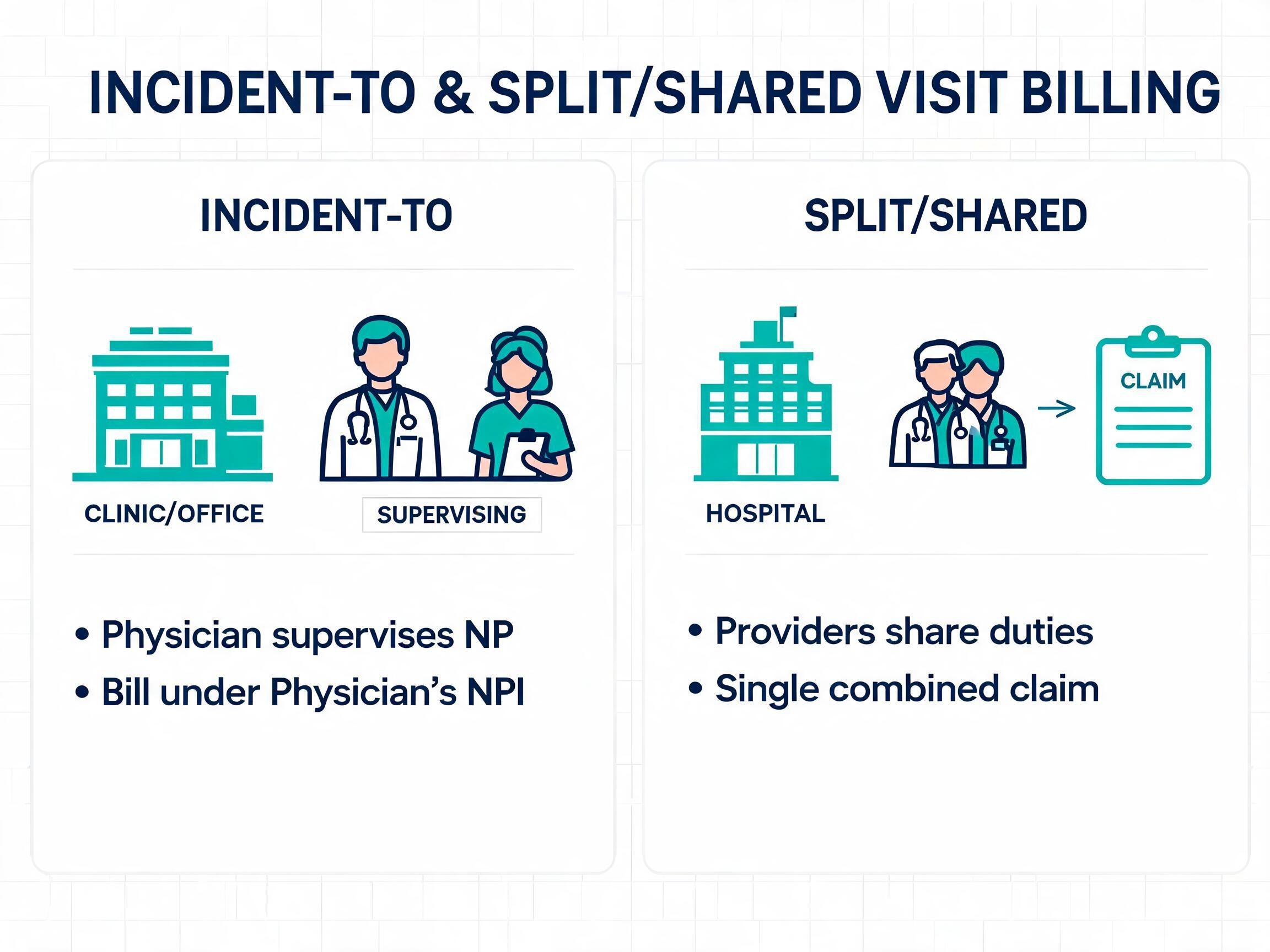
Practices that employ nurse practitioners and physician assistants live with a 15% question: bill the visit under the APP’s NPI and accept 85% of the fee schedule, or qualify it for full payment under incident to billing or the split/shared rules. The two models are often confused, yet they never overlap — one exists only in the office, the other only in the facility — each with its own criteria, modifiers, and audit exposure. Below: both rule sets as they stand for 2026, the dollar difference, and the checks that keep each model defensible.
What Incident-to Billing Requires in 2026
Under the Medicare Benefit Policy Manual (Chapter 15, Section 60), services billed incident-to a physician’s service must meet all of the following — miss one, and the claim belongs under the APP’s own NPI:
- Non-facility setting only. The office or clinic (typically POS 11). Incident-to does not exist in hospital inpatient, outpatient departments, or the ED.
- Established patient, established problem. The physician must have personally performed the initial service and initiated the plan of care. A new patient — or an established patient presenting with a new problem — cannot be billed incident-to; the physician must see and evaluate the new problem first.
- Ongoing physician involvement. The physician must stay actively involved in the course of treatment at a frequency that reflects continued management.
- Direct supervision. A supervising physician (any qualified physician in the group, not necessarily the one who wrote the plan) must be immediately available. Historically that meant present in the office suite; per the CY2026 Physician Fee Schedule final rule, real-time two-way audio-video availability now permanently satisfies direct supervision for most incident-to services. Audio-only never qualifies, and procedures with 010/090 global indicators still require physical presence.
- Employment relationship. The APP must be a W-2, leased, or contracted employee of the physician or the physician’s group. A hospital-employed NP cannot bill incident-to for a private physician group.
When every element holds, the claim pays at 100% under the supervising physician’s NPI — and that should be the physician present (physically or virtually) on the date of service, a detail that trips up multi-physician offices.
Split/Shared Visits: The Facility-Side Rules
A split (or shared) visit is an E/M encounter in a facility setting — hospital inpatient, outpatient, observation, or ED — where a physician and an APP from the same group each perform part of the visit. The combined work is billed once, under whichever practitioner performed the substantive portion.
CMS finalized the current definition in the CY2024 Physician Fee Schedule and has retained it through 2026: the substantive portion is more than half of the total time spent by both practitioners, or a substantive part of the medical decision making — meaning the billing practitioner performed or approved the MDM and takes responsibility for it. Critical care remains the exception: substantive portion is defined by time only. Time spent jointly at the bedside counts once, not twice. Documentation must identify both practitioners, and the billing practitioner must sign and date the note, per CMS claims-processing guidance.
Two claim-level flags matter here:
| Modifier | What it flags | When it applies |
|---|---|---|
| FS | Split/shared E/M visit | Required on every split/shared claim, whether the physician or the APP bills |
| FR | Supervising practitioner present via real-time two-way audio-video | When virtual presence satisfied a supervision requirement |
| FQ | Service furnished using audio-only communication | Certain permitted audio-only services (mainly behavioral health) — not a supervision substitute |
Incident-to vs Split/Shared vs Independent Billing
| Element | Incident-to | Split/shared | APP independent |
|---|---|---|---|
| Setting | Office/non-facility only | Facility only (inpatient, outpatient, observation, ED) | Any |
| Patient | Established patient, established problem, physician-initiated plan | Any qualifying facility E/M | Any |
| Supervision/participation | Direct supervision (physical or real-time audio-video from 2026) | Billing practitioner performs the substantive portion | Per state scope-of-practice law |
| Billing NPI | Supervising physician | Practitioner who performed the substantive portion | APP’s own NPI |
| Medicare payment | 100% of fee schedule | 100% if physician bills; 85% if APP bills | 85% of fee schedule |
| Required modifier | None specific | FS | None |
The 85% vs 100% Difference in Dollars (Illustrative)
Take a 99214 with an illustrative Medicare allowed amount of $130. Billed incident-to under the physician’s NPI, the practice collects $130 (before patient cost-sharing splits). Billed under the NP’s own NPI, payment is 85% — $110.50 — a difference of $19.50 per visit.
Scale that: an NP producing roughly 2,944 visits a year (16 a day, 4 days a week, 46 weeks), with 60% legitimately qualifying, makes the model worth about $34,400 per year per NP versus billing everything at 85%. That is exactly why auditors look closely — and why forcing non-qualifying visits into incident-to never pays: one extrapolated overpayment demand can erase years of the differential. Figures are illustrative; allowed amounts vary by locality and year.
Where Practices Get Burned: Compliance Risks
Incident-to billing has appeared repeatedly in OIG work plans and False Claims Act settlements because the claim itself hides who rendered the service. The recurring failure modes:
- New problem billed incident-to. The patient came in for hypertension follow-up but the NP also worked up new knee pain. That visit no longer qualifies.
- No supervising physician available. The physician was at the hospital or on vacation while visits went out under their NPI. Virtual availability must be genuine and documented, not assumed.
- Wrong setting. Incident-to claims from a hospital outpatient department (POS 19/22), where the model does not apply.
- Hospital-employed APPs. Neither model works when the hospital, not the physician group, employs the APP.
- Missing FS modifier or unsupported substantive portion. The note must show who did what; if the physician bills, the record must support the time or MDM standard.
Because the differential is only 15%, the risk-adjusted answer for borderline visits is almost always the APP’s NPI — the discipline a professional billing partner builds into charge review.
Decision Framework: Which Model Applies?
- Where did the visit happen?
- Office (POS 11): split/shared is off the table.
- Established patient, established problem, physician-initiated plan, direct supervision available, APP employed by the group? → Incident-to, physician NPI, 100%.
- Any element missing (new patient, new problem, no supervising physician)? → APP’s own NPI, 85%.
- Facility (inpatient, outpatient, observation, ED): incident-to is off the table.
- Did both a physician and an APP from the group perform part of the E/M? → Split/shared: bill under whoever performed the substantive portion (more than half the time, or the MDM), append FS.
- APP performed the visit alone? → APP’s own NPI, 85%.
- Office (POS 11): split/shared is off the table.
- Who employs the APP? Hospital-employed and outside the group → neither model; the facility/employer billing rules govern.
- Is the payer Medicare? Commercial payers may not recognize incident-to, may credential APPs directly, or may pay APPs at 100% — check each contract. Getting APPs credentialed with every payer keeps the fallback path clean.
Quick Answers
What is incident-to billing? Incident-to billing allows services performed by an NP or PA in the office setting to be billed under the supervising physician’s NPI at 100% of the Medicare fee schedule, provided the patient is established, the physician initiated the plan of care, direct supervision is available, and the APP is employed by the physician or group.
What is a split/shared visit? A split/shared visit is a facility-setting E/M encounter performed jointly by a physician and an APP from the same group, billed by whichever practitioner performed the substantive portion — more than half of the total time or the medical decision making — with modifier FS appended.
Can incident-to billing be used in a hospital? No. Incident-to applies only in the non-facility office setting. Hospital inpatient, outpatient department, observation, and ED visits fall under split/shared rules or independent APP billing instead.
Who can bill a split/shared visit? The physician or the APP — whichever one performed the substantive portion. If the physician did, the claim pays at 100%; if the APP did, it pays at 85%.
Can supervision be virtual in 2026? Yes, for most incident-to services: CMS made real-time audio-video direct supervision permanent effective January 1, 2026. Audio-only does not qualify, and certain higher-risk procedures still require on-site presence.
APP Billing Audit Checklist
- Employment relationship documented for every APP (physician group vs hospital)
- POS codes on APP claims match the model used (POS 11 for incident-to; facility POS for split/shared)
- Physician-initiated plan of care on file for every incident-to patient, with periodic physician visits
- Supervision coverage log — who was available (on site or via real-time audio-video) each clinic day
- No incident-to claims for new patients or new problems (sample and verify quarterly)
- FS modifier present on all split/shared claims; notes identify both practitioners and support the billing practitioner’s substantive portion
- Commercial payer policies for APP billing confirmed in writing, and APPs enrolled where payers credential them directly — see our credentialing guide
Related Rules and Reading
Place-of-service coding drives which model is possible, and clean enrollment determines whether the 85% fallback pays at all. See our guides to POS 11 vs 22 and the provider credentialing checklist for the adjacent pieces.
Frequently asked questions
No. Both incident-to and split/shared billing require the APP to be employed by (or leased/contracted to) the physician or physician group. A hospital-employed NP working alongside a private group falls under the hospital's billing arrangements instead.
The physician must personally perform a substantive portion of the visit — more than half of the combined time or a substantive part of the medical decision making under CMS policy in effect through 2026. Simply reviewing the APP's note afterward does not qualify the physician to bill.
No. Incident-to requires an established patient with an established problem under a plan of care the physician initiated. New patients and new complaints must be seen by the physician first, or billed under the APP's own NPI at 85%.
Effective January 1, 2026, CMS permanently allows direct supervision for most incident-to services via real-time, two-way audio-video technology, ending years of temporary extensions. Audio-only availability does not qualify, and procedures with 010- or 090-day global indicators still require physical presence.
Not uniformly. Some commercial payers do not recognize incident-to at all, some credential and pay APPs directly at negotiated rates, and modifier requirements differ. Confirm each payer's written policy before applying Medicare logic to non-Medicare claims.