
- D0210 = intraoral comprehensive series (FMX) — updated by ADA in 2023 to mean a radiographic survey of the whole mouth displaying crowns, roots, periapical areas, interproximal areas, and alveolar bone. No longer requires a specific image count.
- D0220 = first periapical image; D0230 = each additional periapical image. D0220 may only appear once per claim; subsequent periapicals are D0230.
- D0274 = four-bitewing series. Quantity billed is 1 (not 4); the code itself represents the complete four-film set.
- Do not bill D0274 and D0210 on the same date — the FMX already captures interproximal coverage.
- Most plans cover FMX once every 3–5 years and bitewings once per benefit year; frequency limits vary widely by carrier.
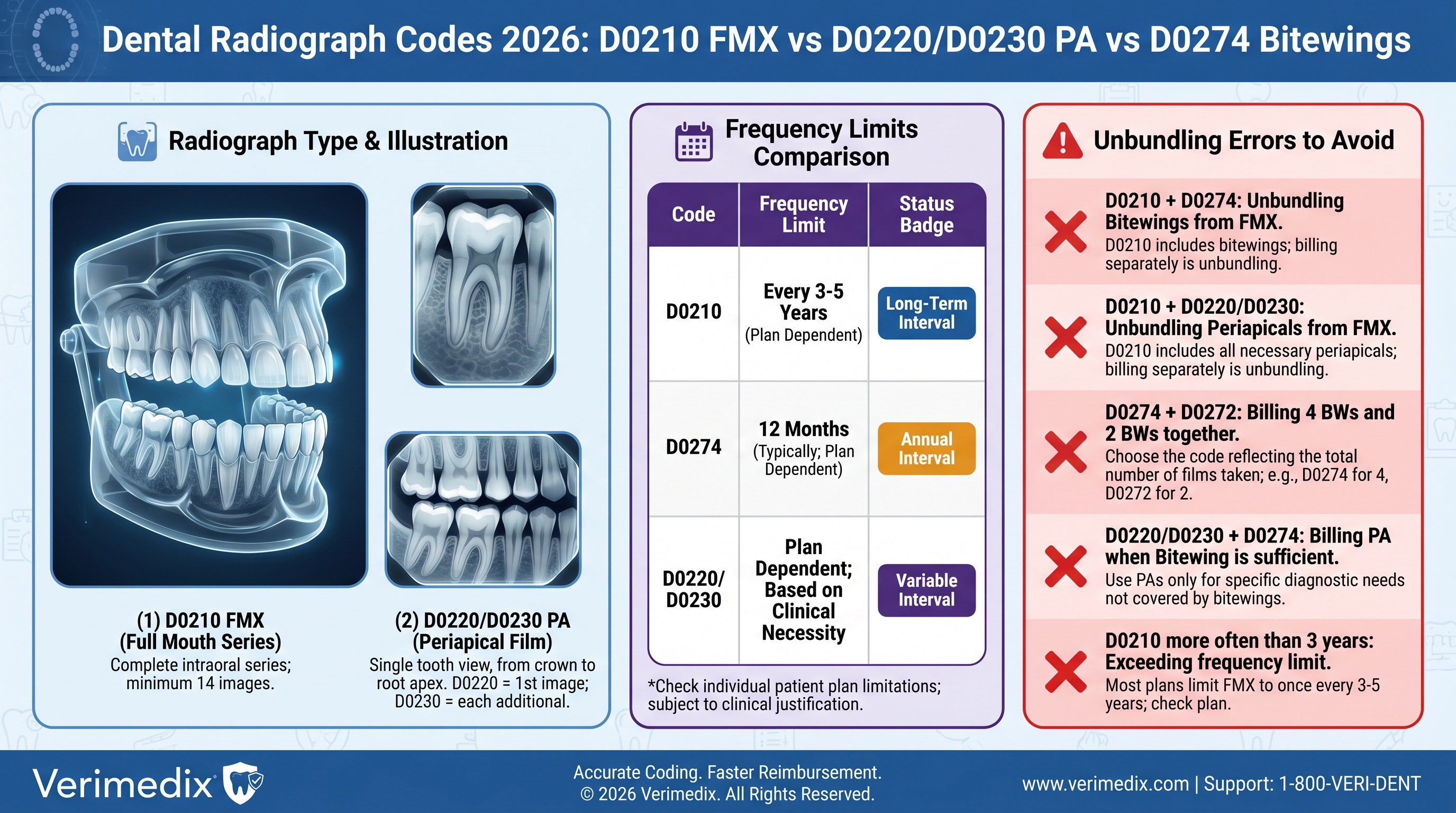
The ADA's 2023 revision to D0210 removed the requirement for a fixed number of images (previously 14–22 films) and replaced it with a description-based definition: a radiographic survey intended to display the crowns and roots of all teeth, periapical areas, interproximal areas, and alveolar bone. This change gave practices more clinical flexibility but also made documentation of what was taken more important, since the survey must substantiate full-mouth coverage without a mandatory film count.
Code definitions and clinical use
| Code | ADA description (CDT 2026) | Notes |
|---|---|---|
| D0210 | Intraoral – comprehensive series of radiographic images | FMX; must display all teeth, roots, periapical areas, interproximal areas, and alveolar bone. Panoramic (D0330) is extraoral and cannot substitute for D0210. |
| D0220 | Intraoral-periapical first radiographic image | Use once per claim; shows full tooth length from crown to root tip. Bill D0230 for every additional PA taken the same day. |
| D0230 | Intraoral-periapical each additional radiographic image | Billed per image after the first D0220; enter the quantity and tooth number range in Box 27 and Box 29b of the 2024 ADA claim form. |
| D0270 | Bitewing – single radiographic image | Rarely billed; for one follow-up film on a specific area. |
| D0272 | Bitewings – two radiographic images | Standard pediatric series; two films. |
| D0273 | Bitewings – three radiographic images | Transitional dentition or specific clinical need. |
| D0274 | Bitewings – four radiographic images | Standard adult series; bill quantity 1 (not 4) — the code represents the complete four-film set. |
| D0330 | Panoramic radiographic image | Extraoral; cannot substitute for D0210 on a claim. |
Frequency limits by carrier type
Almost all dental plans impose frequency limits on radiographs. FMX (D0210) is typically covered once every 3–5 years, depending on the carrier and group contract. Bitewings (D0272–D0274) are generally covered once per benefit year — but billing a single bitewing (D0270), two bitewings (D0272), or four bitewings (D0274) on any one date of service typically triggers the plan's annual bitewing limitation for that entire year. Frequency windows may reset by calendar year or by rolling date-of-service, and the reset method varies by carrier. Always verify the specific plan's frequency language during insurance verification — not just the general coverage category.
The FMX-bitewing bundling rule
D0210 and D0274 (or any bitewing code) may not be billed on the same date. The FMX's full-mouth intraoral coverage already encompasses the interproximal surfaces captured by bitewings. Submitting D0210 and D0274 together on the same claim will result in automatic bundling of the bitewing code, with D0274 denied. Similarly, D0210 and D0220/D0230 may not be billed on the same date for the same coverage area — the FMX is already comprehensive. Periapicals at a separate emergency appointment for specific teeth are billed as D0220 + D0230 and do not conflict with an FMX taken at a different date.
Claim form accuracy for radiograph codes
- D0220: Billed once on the claim; enter the tooth number in Box 27.
- D0230: Bill per additional PA; enter quantity in Box 29b and the range of tooth numbers in Box 27 (e.g., "Teeth #2, 3, 4, 5").
- D0274: Quantity is always 1. Do not enter 4 in the quantity field — each unit of D0274 represents the entire four-film series.
- D0210: No quantity entry needed beyond 1. The supporting chart note should document which teeth were imaged and confirm the survey covers all required areas.
Common radiograph denials and fixes
| Denial | Cause | Fix |
|---|---|---|
| Frequency limit denial | FMX or bitewings within plan's restricted window | Verify dates of prior radiographs before submission; if medically necessary (e.g., post-trauma, new pathology), submit with narrative of clinical necessity |
| D0274 bundled with D0210 | Both codes on same date | Remove D0274; the FMX covers the interproximal scope. Re-educate scheduling team. |
| D0220 billed more than once | Multiple D0220 codes on same claim instead of D0220 + D0230 | Correct to D0220 (first PA) + D0230 (each additional PA) and resubmit |
| D0330 submitted as D0210 | Panoramic coded as FMX | Correct to D0330; D0210 requires intraoral films |
| No radiographic interpretation in chart | Payer audits and requests documentation; no written evaluation present | Document the dentist's written interpretation of all radiographs in the patient record at time of service |
Frequently asked questions
No. D0210 (FMX) already captures the full-mouth intraoral coverage that includes the interproximal areas shown in a bitewing series. Billing D0274 or any bitewing code on the same date as D0210 will result in the bitewing code being bundled and denied.
Only once. D0220 is the code for the first periapical image. Every additional periapical taken the same day is billed as D0230. For example, four periapicals = D0220 x1 + D0230 x3. Document each tooth number.
Enter quantity 1, not 4. D0274 represents the complete four-bitewing series as a single unit. Entering quantity 4 will cause the payer to interpret the claim as billing for four series of four films each.
No. The ADA revised D0210 in 2023. The current definition no longer requires a specific number of images. The survey must display the crowns and roots of all teeth, periapical areas, interproximal areas, and alveolar bone. The clinical standard determines how many films achieve that coverage.
Yes, if there is a documented clinical necessity for the radiographs before the frequency window expires. Submit the appeal with the dentist's clinical notes documenting new pathology, significant change in condition, or another medical necessity reason that justified early imaging. Payer frequency limits are plan provisions, not absolute clinical rules.