
- CPT 99490 pays for the first 20 minutes per calendar month of clinical-staff chronic care management (CCM) for patients with two or more chronic conditions; 99439 adds each extra 20 minutes.
- For RPM, 99453 covers one-time setup, 99454 covers device supply when readings are transmitted on 16+ days in 30, and 99457/99458 cover monthly management time.
- For 2026, CMS raised rates roughly 7–10% (about $66 for 99490, $51 for 99439) and added new RPM codes 99445 (2–15 reading days) and 99470 (10–19 minutes).
- CCM and RPM can be billed for the same patient in the same month, but no minute of staff time may count toward both.
- 99453 and 99454 pay once per patient per period regardless of device count.
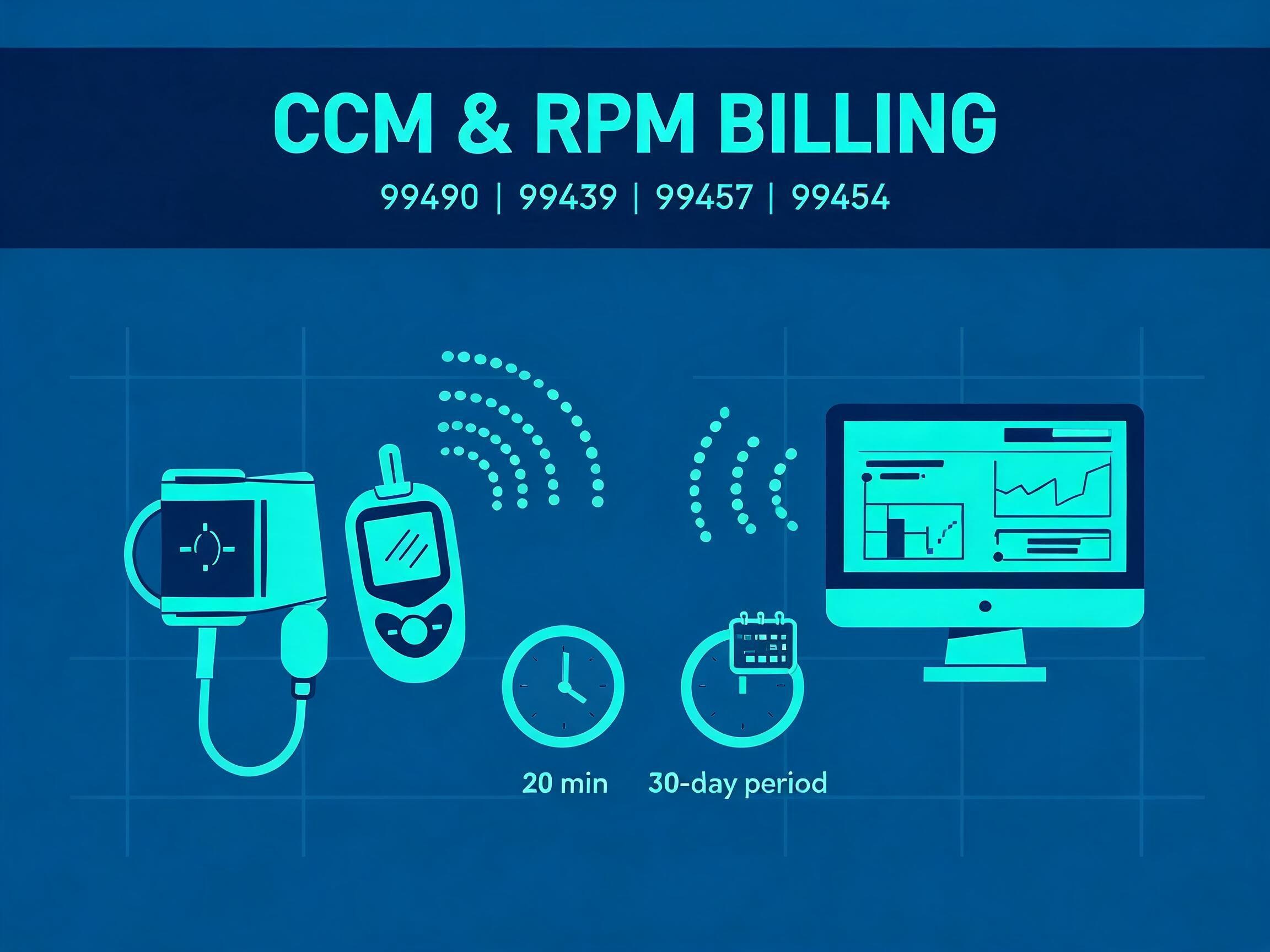
Care management is one of the few areas where the 2026 Medicare Physician Fee Schedule moved payment decisively upward: the 99490 CPT code rose from $60.49 to roughly $66.30 nationally, and RPM gained two long-requested codes, 99445 and 99470, that make low-adherence months billable. This guide covers both code families, the 16-day rule, concurrent billing, a worked revenue example, and the denials that stall new programs. A structured medical coding and revenue cycle workflow matters as much as enrollment.
What CPT 99490 covers — and who qualifies
CPT 99490 reports the first 20 cumulative minutes per calendar month of non-face-to-face chronic care management furnished by clinical staff under general supervision. The patient needs two or more chronic conditions expected to last 12+ months (or until death) that pose significant risk of death, acute exacerbation, or functional decline — a single chronic diagnosis on the claim is a common denial trigger.
Three prerequisites precede the first billed month. First, an initiating visit (E/M, AWV, or IPPE) for patients not seen within 12 months. Second, documented patient consent — verbal is acceptable to CMS, but the chart must record it, including the cost-sharing discussion. Third, a comprehensive, electronically shared care plan. In CCM audits, a missing consent note or care plan is the fastest route to recoupment even when the minutes were genuinely worked.
Beyond 99490: 99439 adds each extra 20 staff minutes (commonly capped at two units), 99491/99437 report practitioner-personal time, and 99487/99489 cover complex CCM at 60+ minutes.
The RPM code family: 99453, 99454, 99457, 99458 — plus new 99445 and 99470
Remote physiologic monitoring splits into device codes and time codes. CPT 99453 pays once (about $22 nationally) for device setup and patient education. CPT 99454 pays roughly $52 per 30-day period for device supply — but only when readings are transmitted on at least 16 days in that period. CPT 99457 covers the first 20 minutes per month of treatment management and requires at least one real-time interactive communication (phone or video); 99458 adds each additional 20 minutes.
The CY 2026 final rule, published November 2025, added two gap-closing codes. CPT 99445 covers device supply with only 2–15 days of readings in a 30-day period — previously worth $0. CPT 99470 covers 10–19 minutes of management, below the old 20-minute floor, at roughly $26. Guardrails: 99445 cannot be billed with 99454 for the same period, and 99470 cannot be billed with 99457 for the same month. CMS also reaffirmed that every RPM management code still requires at least one real-time interaction.
Device rules are strict: equipment must meet the FDA definition of a medical device and transmit physiologic data automatically — patient-keyed readings do not qualify. Only one practitioner may bill RPM per patient per period, and device codes pay once per period regardless of device count.
CCM vs RPM side by side
| Feature | CCM (99490 family) | RPM (99453/99454/99457 family) |
|---|---|---|
| Pays for | Care coordination time | Device monitoring plus management time |
| Patient eligibility | 2+ chronic conditions lasting 12+ months | Any condition where monitoring is reasonable and necessary |
| Device requirement | None | FDA-defined medical device with automatic data transmission |
| Core threshold | 20 staff minutes per calendar month | 16+ reading days per 30 (99454); 20 minutes with live contact (99457) |
| Below-threshold option (2026) | None | 99445 for 2–15 reading days; 99470 for 10–19 minutes |
| Who performs the work | Clinical staff under general supervision, or practitioner (99491) | Clinical staff under general supervision, or practitioner |
2026 code reference and payment ballparks
Approximate 2026 national non-facility amounts from published CY 2026 PFS final rule summaries; actual payment varies by locality and MAC.
| CPT code | Description | Approx. 2026 national rate |
|---|---|---|
| 99490 | CCM, first 20 min of clinical staff time per month | ~$66 |
| 99439 | CCM, each additional 20 min (usually max 2 units) | ~$51 |
| 99453 | RPM device setup and patient education (one-time) | ~$22 |
| 99454 | RPM device supply, 16+ days of readings per 30 days | ~$52 |
| 99445 | RPM device supply, 2–15 days of readings (new 2026) | ~$47–$52 |
| 99457 | RPM treatment management, first 20 min per month | ~$52 |
| 99458 | RPM treatment management, each additional 20 min | ~$41 |
| 99470 | RPM treatment management, 10–19 min (new 2026) | ~$26 |
The 16-day rule, decoded
The 99454 threshold counts days with at least one transmitted reading, not total readings — 40 readings across 10 days is still 10 days. The 30-day supply period also runs on its own clock, independent of the calendar month used for the time codes. Since 2026, 99445 captures 2–15 day months, so the only unbillable supply scenario is zero or one day of data. Document the exact day count: vague adherence notes are a leading audit finding, since 99445 explicitly requires the day range and 99470 the documented 10–19 minute range.
Billing CCM and RPM in the same month
CMS allows the same practitioner to bill CCM and RPM for the same patient in the same month because they compensate different work. The non-negotiable condition: no minute counts twice. Supporting 99490 plus 99457 requires at least 40 total minutes in two separately logged buckets — a shared 25-minute log cannot back both codes. The same separation applies against TCM, behavioral health integration, and principal care management; overlapping time is what auditors look for first. Practical fix: configure EHR timers with distinct CCM and RPM activity categories.
Worked example: what one enrolled patient is worth (illustrative)
Illustrative only, using approximate 2026 national rates. A practice enrolls 50 Medicare patients in a hypertension-and-diabetes program. Each RPM patient hitting 16+ reading days and 20 management minutes generates 99454 (~$52) + 99457 (~$52) ≈ $104 per month. If 30 of the 50 also meet CCM requirements with separately logged time, each adds 99490 (~$66): roughly (50 × $104) + (30 × $66) ≈ $7,180 per month, about $86,000 a year — before device, platform, and staffing costs. The 2026 codes change the floor math too: a patient with 12 reading days and 15 management minutes, previously worth $0, can now generate 99445 + 99470 (~$73–$78). Real economics depend on adherence, staffing cost per minute, and locality.
Program setup checklist
- Define the eligible panel — query the EHR for 2+ qualifying chronic conditions (CCM) and conditions warranting monitoring (RPM).
- Select devices and platform — confirm FDA device status, automatic transmission, and day-count reporting.
- Script and capture consent — cover cost-sharing and the right to withdraw; document before the first billed month.
- Run the initiating visit for CCM patients not seen in 12 months; build the care plan there.
- Set up dual time tracking — separate CCM and RPM logs with staff, date, minutes, activity.
- Build the billing calendar — calendar-month close for time codes; rolling 30-day close for 99454/99445.
- Assemble a monthly audit file — time logs, transmission reports, consent, care plan, live-contact note.
Common CCM/RPM denials and how to fix them
| Denial scenario | Likely cause | Fix |
|---|---|---|
| 99454 denied | Fewer than 16 days of transmitted readings in the 30-day period | Pull the platform transmission report; if 2–15 days, bill 99445 instead (2026 forward) |
| 99457 denied or downcoded | No documented real-time interactive communication | Note date, modality, and participant of the live contact; use 99470 for 10–19 minute months |
| 99490 denied | Only one chronic diagnosis on the claim | Report at least two qualifying chronic conditions consistent with the care plan |
| Duplicate denial | Another practitioner billed RPM/CCM for the same period | Confirm single-biller status at enrollment; coordinate with specialists |
| Post-payment recoupment | Missing consent or care plan; overlapping CCM/RPM minutes | Keep a monthly audit file; enforce separate time buckets |
Recurring denials here are usually workflow problems, not coding problems — where a denial management process pays for itself.
Quick Answers
What is CPT 99490 used for? It bills the first 20 minutes per calendar month of non-face-to-face chronic care management for Medicare patients with two or more chronic conditions expected to last 12+ months.
Can CCM and RPM be billed together in the same month? Yes — provided each service independently meets its threshold: 20 minutes for 99490 and a separate 20 minutes for 99457, with no minute counted twice.
How many days of readings does 99454 require? At least 16 days with a transmitted reading in a 30-day period; from 2026, 2–15 day months bill 99445 instead.
How often can 99457 be billed? Once per calendar month per patient, with 20 documented minutes including one real-time interaction; 99458 adds each further 20 minutes.
What changed for RPM billing in 2026? CMS raised CCM and RPM payment and added CPT 99445 (2–15 days of device data) and CPT 99470 (10–19 minutes of management), making partial months billable.
What to check before billing
- Consent documented before the first billed month, including cost-sharing.
- Two or more qualifying chronic diagnoses on every 99490 claim.
- Day-count report retrievable for every 99454/99445 claim.
- Real-time interaction noted for every 99457/99458/99470 month.
- CCM and RPM minutes in separate buckets — run a monthly overlap check.
- One practitioner billing care management per patient per period.
Related codes and further reading
Adjacent families: transitional care management (99495–99496), principal care management (99424–99427), and remote therapeutic monitoring (98975–98981). Because 99457 interactions happen by phone or video, telehealth rules intersect here — see telehealth CPT codes in 2026 and the new 98000–98016 telehealth E/M codes. Care-management claims age like any others — keep deadlines in view with our timely filing limits by payer reference.
Frequently asked questions
Yes. CMS allows the same practitioner to bill CCM (99490) and RPM (99457) for the same patient in the same month because they pay for different work. The requirement is that each service independently meets its time threshold, so the record needs at least 40 total minutes in two separately documented logs with no minute counted toward both.
CPT 99454 requires transmitted readings on at least 16 days within a 30-day period, counting days rather than total readings. Starting in 2026, months with only 2 to 15 reading days can be billed with the new code 99445 instead, though the two codes can never be billed for the same period.
Published summaries of the CY 2026 Physician Fee Schedule final rule put 99490 at roughly $66 nationally in the non-facility setting, up from about $60 in 2025. Actual payment varies by geographic locality, so confirm your MAC's fee schedule before building revenue projections.
The device must meet the FDA's definition of a medical device and must transmit physiologic data automatically. Readings that a patient manually types into an app or portal do not satisfy the requirement, which is one of the most common compliance gaps in new RPM programs.
Qualified clinical staff, such as nurses and medical assistants acting within state scope-of-practice, can furnish CCM and RPM time under the billing practitioner's general supervision, meaning the practitioner directs the service but need not be physically present. Time personally performed by the physician or QHP can alternatively be reported with codes like 99491.