
- Cardiology spans office E/M, diagnostics (93000 ECG, 93306 echo, stress tests, 78452 nuclear), cath lab (93458), and EP procedures (93653/93656) — each with its own bundling and documentation rules.
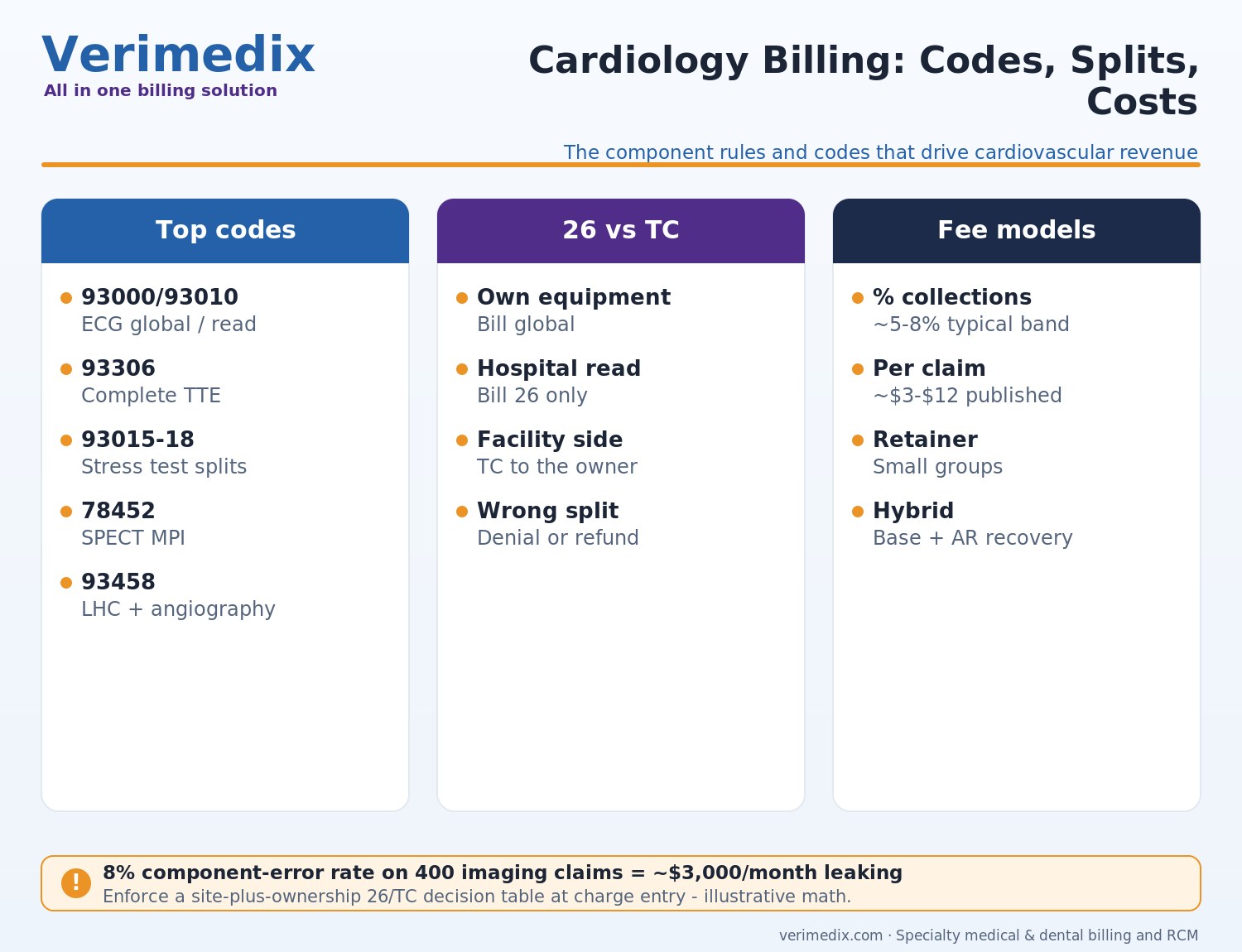
- The 26/TC split is the specialty’s signature trap: global billing is only correct when the practice owns the equipment and performs the interpretation; hospital reads take modifier 26.
- Payer medical-necessity policies and frequency limits on imaging make diagnosis linkage and prior authorization tracking central to clean claims.
- Cath and EP codes bundle heavily — components like access, injections, and supervision are built into the primary code, and unbundling triggers denials or audits.
- Published billing fees run roughly 4–10% of collections; cardiology usually prices mid-to-upper band due to code breadth and prior-auth workload.
- Vet vendors on cardiology proof: a documented 26/TC decision rule, imaging prior-auth workflow, LCD/frequency screening, and denial recovery on high-dollar procedures.
What a full-service cardiology engagement covers
A cardiology group’s revenue cycle covers more distinct service types than nearly any other outpatient specialty, and the billing scope has to match: eligibility and benefits checks with prior authorization for advanced imaging, charge capture across office, hospital, and ASC settings, coding review for diagnostics and procedures, correct professional/technical component assignment, claim scrubbing against NCCI edits, payment posting, denial appeals, and AR follow-up. Groups with device clinics add another stream — remote monitoring services billed on calendar-driven cycles that punish sloppy date tracking.
The differentiator among vendors is not whether they list those functions — everyone does — but whether they run cardiology-specific controls: a written 26/TC assignment rule per site of service, payer policy grids for echo and nuclear frequency limits, and a prior-auth log that follows the order, not the claim. Cardiology denials are concentrated and predictable, which means a specialist can prevent most of them structurally.
The top cardiology CPT codes and their billing rules
The table below covers the workhorse codes that drive most cardiology revenue, with the rule that most often breaks each one.
| Code | Service | Rule that breaks it |
|---|---|---|
| 93000 / 93005 / 93010 | ECG: global / tracing only / interpretation only | Billing global when the practice only performed the read |
| 93306 | Complete TTE with spectral and color Doppler | 26/TC assignment; payer frequency and medical-necessity limits |
| 93350 / 93351 | Stress echocardiography (93351 includes the stress test) | Component overlap with 93015-series stress codes |
| 93015–93018 | Cardiovascular stress test: global or split components | Site of service determines which component codes apply |
| 78452 | SPECT myocardial perfusion imaging, multiple studies | Prior authorization; radiopharmaceutical billed separately |
| 93224–93227 | Holter / extended ECG monitoring | Component billing and minimum recording-time documentation |
| 93458 | Left heart catheterization with coronary angiography | Access, injections, and supervision are bundled — don’t unbundle |
| 93451 | Right heart catheterization | Combined RHC/LHC encounters have their own combination codes |
| 93653 / 93656 | EP ablation: SVT / atrial fibrillation (pulmonary vein isolation) | Extensive bundling of EP study components; documentation depth |
| 93294–93296 | Remote device interrogation (pacemaker/ICD) | Calendar-period billing — overlapping dates deny |
For the specialty’s highest-volume imaging code, our dedicated CPT 93306 echocardiography billing guide walks through documentation elements, Doppler requirements, and the denial patterns specific to TTE.
Modifier 26 vs TC: the split that decides who gets paid
Nearly every cardiology diagnostic has three billing identities: global (equipment + interpretation), technical component (TC — the equipment, staff, and tracing), and professional component (26 — the interpretation and report). The assignment follows ownership and site of service. A cardiologist reading an echo performed in the practice’s own office on practice-owned equipment bills global 93306. The same cardiologist interpreting a hospital-performed echo bills 93306-26 while the hospital bills the technical side. Reverse or duplicate the components and the claim denies — or pays the practice for work the hospital performed, which surfaces later as a refund demand.
This is mechanical once systematized: site of service plus equipment ownership yields the modifier, every time. A billing service should show you that decision table on request; the full logic, including common edge cases, is in our modifier 26 vs TC guide. Groups that split reads across offices, hospitals, and an ASC should expect their vendor to maintain the assignment rule per location and audit it quarterly — 26/TC errors are among the most frequently cited causes of cardiology imaging denials.
Pricing models and the fee-band math
Industry pricing guides place outsourced billing at roughly 4–10% of net collections, per-claim fees around $3–$12, and flat retainers for small groups. Cardiology typically quotes mid-to-upper band: the code range is wide, prior-auth volume is high, and hospital-based charge capture adds reconciliation work that a family-practice engagement never sees.
| Model | Structure | Cardiology-specific caution |
|---|---|---|
| Percentage of collections | Commonly ~5–8% within the published 4–10% range | Confirm whether hospital professional-fee collections are in the base and how TC revenue is treated |
| Per-claim | Roughly $3–$12 per claim per industry guides | Cheap for high-dollar cath claims, expensive for ECG volume — model your actual mix |
| Flat retainer | Fixed monthly fee by provider count | Watch for exclusions on appeals and prior-auth support |
| Hybrid | Retainer plus reduced percentage, or contingency on recovered AR | Common for groups bringing legacy AR cleanup with them |
Worked example (illustrative only). A three-cardiologist group collects $250,000 a month; a 6% vendor costs $15,000. Suppose 400 imaging claims a month go out and 8% carry component errors — reversed 26/TC, global billed on hospital reads. If those errors average $95 of delayed or lost reimbursement each, that is roughly $3,000 a month leaking plus rework labor, and component errors are only one denial category of several. A vendor whose edits eliminate that category structurally funds a meaningful share of its own fee — which is why the vetting questions below focus on prevention proof, not price.
Common cardiology denials and how a specialist prevents them
| Denial pattern | Root cause | Prevention / fix |
|---|---|---|
| 26/TC component errors | Modifier omitted, reversed, or global billed at the wrong site | Site-plus-ownership decision table enforced at charge entry |
| Medical necessity / frequency | Diagnosis doesn’t meet payer policy, or imaging repeated inside frequency windows | LCD and payer-policy screening before scheduling; diagnosis linkage review |
| Prior authorization missing | Advanced imaging or procedures performed before auth confirmed | Auth log tied to orders with hard stops for high-cost studies |
| Unbundling in cath/EP claims | Components billed separately that the primary code includes | NCCI-aware scrubbing plus coder review of procedure notes |
| Device-clinic date overlaps | Remote monitoring billed inside a prior service period | Calendar-driven billing engine for 93294–93296 cycles |
| Documentation gaps on stress/echo | Missing interpretation elements or supervision attestation | Report templates aligned to code requirements; periodic chart audits |
Vetting a cardiology billing partner: a 7-point checklist
- Cardiology references at your acuity. Office-based diagnostics, interventional, and EP-heavy groups have different billing profiles — match the reference.
- The 26/TC decision table. Ask to see it. A vendor without a written component-assignment rule will produce component denials.
- Prior-auth workflow. Order-triggered, with status visible before the patient is scheduled — not discovered at claim denial.
- Policy and frequency screening. How do they track payer medical-necessity policies and frequency limits for echo, nuclear, and stress testing?
- Cath/EP coding depth. Who codes procedure notes, and what certification and audit history stands behind them?
- Charge reconciliation across sites. Hospital rounds and reads must reconcile against a schedule so unbilled encounters surface weekly.
- Reporting. Net collection rate, days in AR, denial categories, auth turnaround, and component-error rate — monthly, with a live sample up front.
The cardiology billing services page shows how these controls — component assignment, auth tracking, and multi-site charge reconciliation — operate inside a full engagement.
Quick Answers
What is a typical cardiology billing rate? Most cardiology engagements are quoted at roughly 5-8% of net collections, inside the 4-10% range published across outsourced billing pricing guides. Per-claim pricing of about $3-$12 and flat monthly retainers are the common alternatives for smaller groups.
What are the highest-volume cardiology CPT codes? ECGs (93000/93010), complete transthoracic echocardiography (93306), stress testing (93015-series and stress echo 93350/93351), SPECT myocardial perfusion imaging (78452), and diagnostic catheterization (93458) drive most claim volume in a typical group.
When does a cardiologist use modifier 26? When interpreting a study performed on equipment the practice does not own — most commonly hospital-performed echoes and ECGs. The facility bills the technical component; the physician bills the professional component with modifier 26.
Does a percentage or per-claim model cost less for cardiology? It depends on claim mix: per-claim pricing favours groups whose volume is dominated by high-dollar cath and EP claims, while percentage pricing usually costs less where ECG and device-check volume is high. Model both against last quarter’s actual claim counts before signing.
What do published benchmarks say cardiology billing costs? Published outsourced billing pricing runs roughly 4–10% of net collections, and cardiology typically lands mid-to-upper band given code breadth and prior-auth workload; per-claim and retainer models exist for smaller groups.
Why do cardiology claims get denied most often? The leading patterns are 26/TC component errors, medical-necessity and frequency-policy failures on imaging, missing prior authorization, and unbundling of components already included in cath and EP codes.
Frequently asked questions
Yes — global billing is correct when the practice owns the equipment, employs the sonographer, and its physician performs the interpretation. If any of those pieces belongs to another entity, the claim must be split into technical and professional components.
The good ones do. Cardiologists generate significant professional-fee revenue from hospital rounds, consults, and reads, and those encounters are the easiest to lose because they originate outside the practice's PMS. Ask how the vendor reconciles hospital encounters against schedules and call logs.
Electrophysiology codes such as 93653 and 93656 bundle extensive components — diagnostic study elements, mapping, and additional ablation targets follow intricate add-on rules — so they demand coders who work from the full procedure note. Unbundling errors on EP claims are both common and audit-prone.
Scope varies: some vendors include auth tracking, others treat it as a practice-side task. In cardiology the auth burden on advanced imaging is heavy enough that you should settle this in the contract explicitly — an auth missed at scheduling becomes an unappealable write-off later.
Net collection rate, days in AR, first-pass clean claim rate, denial rate by category (with 26/TC errors broken out), prior-auth turnaround, and unbilled-encounter counts by site. A vendor reluctant to commit to that reporting list is telling you something.