
- Payers now run claims through machine-learning review at scale; practices that still work denials manually are bringing a spreadsheet to an algorithm fight.
- AI in revenue cycle management is delivering first on narrow jobs — eligibility checks, claim scrubbing, denial-appeal drafting — not on end-to-end autonomous billing.
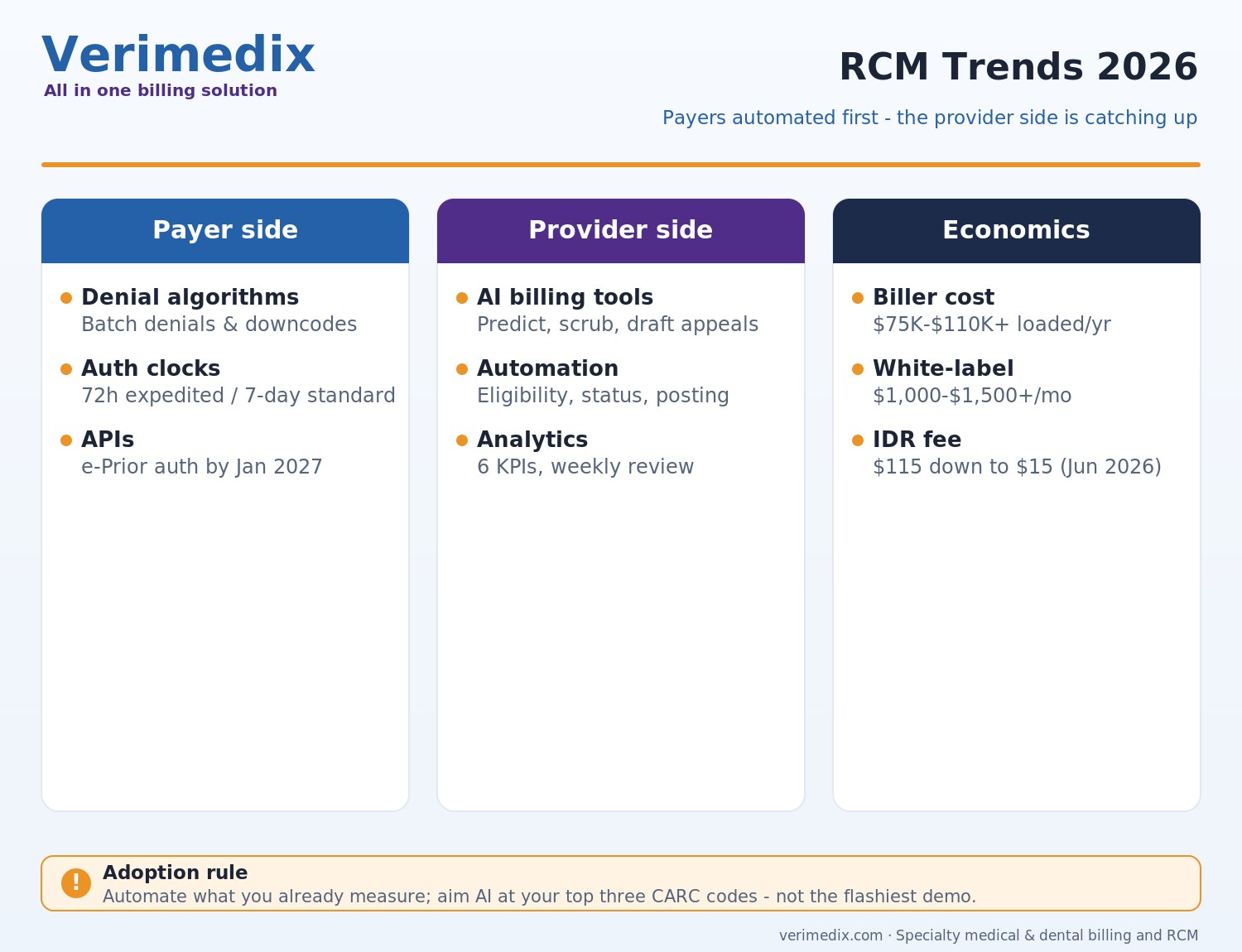
- CMS interoperability rules now hold major payers to 72-hour expedited / 7-day standard prior-auth decisions, with full electronic prior-auth APIs required by January 2027.
- The June 2026 IDR overhaul cut the No Surprises Act administrative fee from $115 to $15 per party, reopening arbitration economics for smaller out-of-network claims.
- Rising deductibles make patient collections a top-three payer for most practices — point-of-service estimates and card-on-file are now core RCM, not extras.
- Adoption rule for 2026: automate what you already measure, and buy tools that attack your top three CARC codes — not the flashiest demo.
1. Payer AI is denying claims at scale
The defining fact of 2026 revenue cycles is asymmetry: national payers screen claims with machine-learning models that flag utilization patterns, downcode E/M levels, and batch-deny in seconds, while the average practice still hand-works each denial. The result shows up as higher initial denial rates with lower per-denial dollar values — algorithms deny broadly and cheaply.
What to do: stop treating denials as individual events. Group 90 days of denials by CARC code and payer, appeal in batches with templated, criteria-mapped arguments, and escalate patterns to your payer rep or state regulator when downcoding is systematic. Our denial management guide covers the workflow.
2. AI medical billing moves to the provider side
The counter-wave: AI medical billing tools that draft appeal letters from the payer policy, predict which claims will deny before submission, autonomously check claim status, and suggest codes from the note. The tools that work share a trait — they attack one narrow, measurable job. The ones that disappoint promise "autonomous RCM."
What to do: pick your top three CARC codes and buy (or pilot) only tools that address them. Measure before/after on denial rate and touch time per claim. Deeper dive: AI in healthcare billing and RCM.
3. RCM automation graduates from RPA to agents
First-generation RCM automation was screen-scraping RPA: brittle bots clicking through portals. The 2026 generation is API-first and increasingly agentic — software that runs eligibility (270/271), checks claim status (276/277), posts ERAs, and only escalates exceptions to humans. The economic point of rcm automation is not headcount reduction; it is moving scarce billers from status-checking to appeal-writing, where judgment actually pays.
What to do: automate the three highest-volume, lowest-judgment tasks first: eligibility, claim status, and payment posting. Keep denial strategy human.
4. Electronic prior authorization gets real
The CMS Interoperability and Prior Authorization rule (CMS-0057-F) now requires affected payers — Medicare Advantage, Medicaid, and exchange plans — to decide standard prior-auth requests within 7 calendar days and expedited requests within 72 hours, publish denial reasons, and stand up electronic prior-auth APIs on a January 2027 compliance clock. Auth is becoming a data workflow instead of a fax workflow.
What to do: centralize auth tracking now (requirement → clinicals → approval number on file), so you can plug into payer APIs the moment your PM/EHR supports them. If auth volume is drowning staff, the prior-auth staffing options comparison covers costs.
5. The patient is now a top-three payer
High-deductible enrollment keeps climbing, which means the patient balance is no longer the rounding error at the bottom of the remit — for many practices it rivals the second-largest insurance payer. Collection succeeds at the point of service and decays fast afterward.
What to do: estimates before service, copays and known balances at check-in, card-on-file with consent, and payment plans offered proactively. Statement-chasing is the most expensive collection channel you own.
6. The billing staffing shortage is structural
Experienced billers and certified coders remain scarce and expensive — a fully loaded U.S. biller runs $75K–$110K+ a year, turnover is chronic, and every resignation walks payer-specific knowledge out the door. That scarcity, not ideology, is what drives the outsourcing and white-label staffing boom: dedicated offshore-based specialists working inside the practice's systems under its brand at $1,000–$1,500+ per month per resource.
What to do: price your true cost per role before your next hire — the cost-to-hire math and RCM staffing guide lay out build-vs-buy by function.
7. Denial rates keep climbing — prevention beats appeal
Industry surveys keep finding the same pair of facts: initial denial rates have drifted upward across payer types, and a large share of denials are never worked at all. Since most denials trace to front-end causes, the highest-ROI response is upstream: verify twice, authorize before service, code from documentation.
What to do: instrument the funnel — denial rate, top CARCs, appeal overturn rate — and set one owner per metric. Prevention is a management system, not a software purchase.
8. Telehealth billing is permanent infrastructure
Telehealth flexibilities that were year-to-year cliffhangers have hardened into standing policy through 2026 — including permanent virtual direct supervision — and the code set has matured around 98000–98016, POS 10 vs 02, and modifiers 95/93. The trend is no longer "will telehealth persist" but "who bills it correctly."
What to do: audit a sample of telehealth claims for POS/modifier alignment by payer; commercial adoption of the 98000 series still varies and drives quiet denials.
9. Price transparency and the No Surprises Act tighten
The NSA is now fully operational machinery: good-faith estimates for self-pay patients, balance-billing prohibitions for out-of-network emergency and facility-based care, and a federal IDR process that a June 2026 final rule just overhauled — cutting the administrative fee from $115 to $15 per party and batching rules, which makes arbitration economical for far smaller claims. Compliance details in our NSA guide for practices.
What to do: if you write off out-of-network underpayments because IDR "wasn't worth it," rerun that math under the new fee.
10. Analytics replace reports
Month-end PDF reports describe the past; the 2026 standard is a live KPI panel — clean-claim rate, denial rate by CARC, days in A/R, net collection, A/R over 90 — reviewed weekly with one owner per number. The practices pulling ahead are not the ones with the most tools; they are the ones where every stage of the cycle answers to a metric. Benchmarks and formulas: the complete RCM guide.
What to do: pick six KPIs, put them on one page, review them every Monday. That single habit outperforms most software purchases.
The 10 trends on one page
| # | Trend | The signal you'll see | First move |
|---|---|---|---|
| 1 | Payer denial algorithms | Batch denials, uniform downcodes | Appeal by CARC pattern, not claim-by-claim |
| 2 | Provider-side AI billing | Tools promising "autonomous RCM" | Pilot against your top 3 CARCs only |
| 3 | API-first automation | RPA bots breaking on portal changes | Automate eligibility, status, posting |
| 4 | Electronic prior auth | 72h/7-day payer decision clocks | Centralize auth tracking now |
| 5 | Patient as payer | Growing patient A/R share | Estimates + point-of-service collection |
| 6 | Structural staffing shortage | $75K–$110K loaded biller cost, turnover | Cost out white-label/hybrid per role |
| 7 | Rising denial rates | More initial denials, many unworked | Front-end prevention with owned KPIs |
| 8 | Telehealth permanence | 98000-series & POS 10/02 variance | Payer-by-payer telehealth claim audit |
| 9 | NSA/IDR tightening | $15 IDR admin fee since June 2026 | Re-run out-of-network arbitration math |
| 10 | Live analytics | Month-end PDFs nobody reads | Six KPIs, one page, weekly review |
How to sequence adoption without burning budget
Every vendor deck says "start now"; the cycle says start in order. First quarter: instrument the six core KPIs and split denials by CARC — you cannot automate what you have not measured, and this costs nothing but discipline. Second: automate the measured, repetitive stages (eligibility, claim status, posting) through your existing clearinghouse or PM before buying anything new. Third: point AI at your single most expensive denial pattern and demand a measured before/after. Last: revisit staffing — once the repetitive layer is automated, the roles you actually need are denial analysts and appeal writers, and that is where a team-structure rethink or dedicated white-label specialists earn their keep. Practices that run this sequence spend less than the ones that started with the software demo — and end up with a cycle where every tool answers to a number.
Quick Answers
What are the biggest RCM trends in 2026? Payer denial algorithms, provider-side AI billing tools, API-driven automation, electronic prior authorization under CMS-0057-F, patient-as-payer growth, structural staffing shortages, rising denial rates, permanent telehealth, NSA/IDR changes, and live KPI analytics.
How is AI used in revenue cycle management? Today's working uses are narrow: predicting denials before submission, drafting appeals from payer policy, automating eligibility and claim-status checks, and flagging coding gaps — not fully autonomous billing.
What is RCM automation? Software that executes repetitive cycle tasks — eligibility (270/271), claim status (276/277), ERA posting — and escalates exceptions to staff, shifting human time toward denials and appeals.
What changed with prior authorization in 2026? Affected payers must decide expedited requests in 72 hours and standard requests in 7 days and publish denial reasons, with electronic prior-auth APIs required on a January 2027 compliance timeline.
Did the No Surprises Act change in 2026? Yes — a June 2026 final rule overhauled the IDR process, cutting the administrative fee from $115 to $15 per party and revising batching, making arbitration viable for smaller claims.
Frequently asked questions
Not in any near horizon. AI is absorbing the repetitive layer — status checks, posting, first-draft appeals — while the judgment layer (denial strategy, payer negotiation, complex coding) becomes more valuable. The realistic 2026 outcome is fewer people doing higher-value work per claim.
Eligibility verification, claim-status checking, and ERA payment posting. They are high-volume, low-judgment, and cheap to automate through your clearinghouse or PM system — and they free the hours needed to actually work denials.
Payer review has become heavily automated, and several national payers face litigation and regulatory scrutiny over algorithmic denial and downcoding programs. Practically, the pattern shows up as batch denials and E/M downcodes that arrive too fast and too uniformly to be manual review.
It is the CMS interoperability and prior-authorization rule: affected payers must answer standard auth requests within 7 days (72 hours expedited), give specific denial reasons, report metrics, and expose electronic prior-auth APIs on a January 2027 compliance timeline.
Demand a before/after on one number you already track — denial rate, touch time per claim, or days in A/R — over a defined pilot. If the vendor cannot name the metric their tool moves, it is a demo, not a solution.