
ENT billing services cover one of medicine's widest procedure ranges — nasal endoscopy (31231), tympanostomy tubes (69436), balloon sinuplasty (31295-31298), allergy testing and immunotherapy (95004, 95165), sleep apnea surgery, and head-and-neck oncology with 90-day global periods. Paired structures make bilateral modifier 50 rules a daily decision, and endoscopy families carry dense NCCI bundling edits. Verimedix bills for otolaryngology groups with coders who know the scope families, the global-period calendar, and the payer medical policies that decide sinuplasty and turbinate claims.
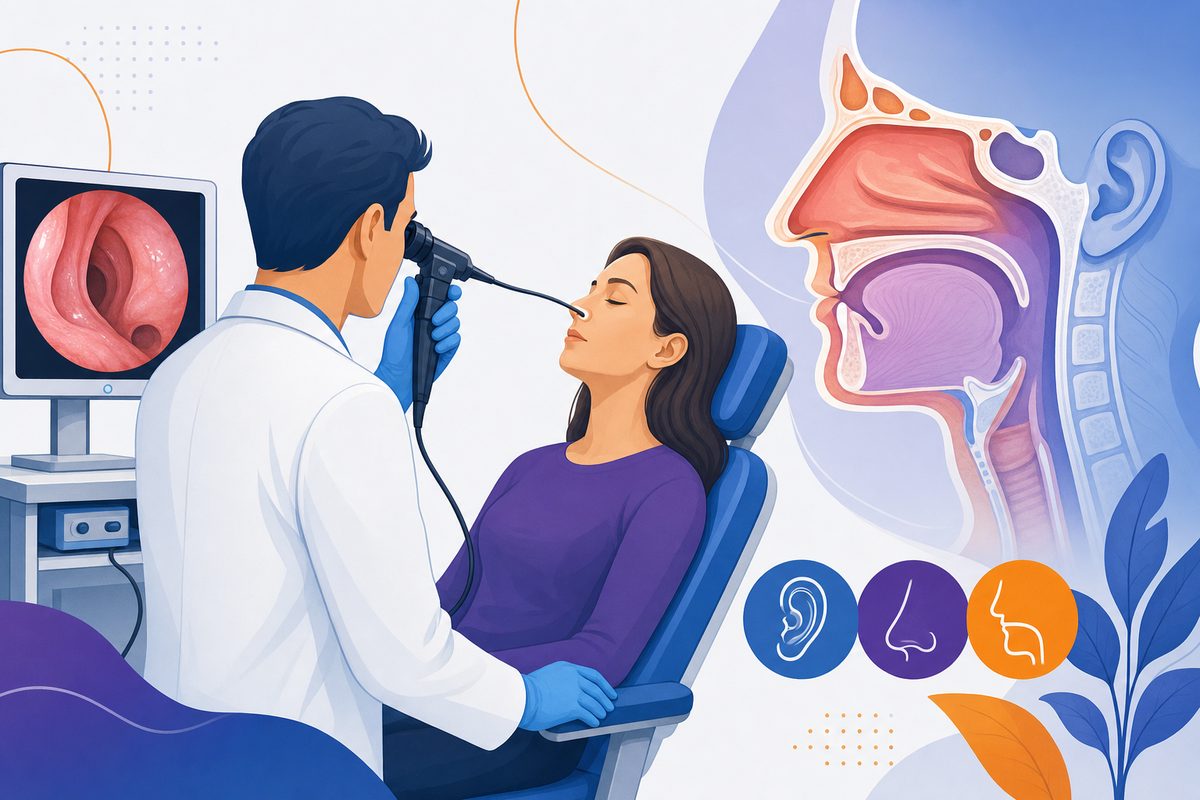
Otolaryngology (ENT) is one of the most procedure-intensive specialties in outpatient medicine, generating revenue from a broad mix of office procedures, endoscopic surgeries, allergy services, audiological diagnostics, and major head/neck surgery. Office-based procedures include flexible laryngoscopy (31575 for diagnostic, 31576/31577/31578 for therapeutic), nasal endoscopy (31231 for diagnostic, 31237–31294 for surgical), cerumen removal (69210 for manual; note that 69209 for irrigation/lavage replaced the older code), and tympanostomy tube removal. Charge capture in ENT requires meticulous distinction between diagnostic and surgical endoscopy: the surgical endoscopy always includes the diagnostic endoscopy (no separate billing of 31231 when 31237 or higher is performed at the same site), and the highest level of service performed determines the billable code. NCCI endoscopy bundling rules are extensive in ENT and require careful navigation—particularly for sinonasal procedures where multiple separate sinus cavities may be addressed in a single session.
Sinusitis procedures—particularly functional endoscopic sinus surgery (FESS)—generate significant revenue but also significant billing complexity. Each sinus cavity is separately coded: 31256 (uncinectomy), 31267 (middle meatal antrostomy), 31276 (frontal sinus exploration), 31288 (sphenoidotomy), and 31253/31254 (ethmoidectomy, partial/total). In a bilateral procedure, each side is billed separately with -50 (bilateral) or as two separate line items with -RT and -LT. The use of image guidance (61795 or the add-on 61782) is separately billable when used and documented. Post-sinus surgery visits within the global period (10 or 90 days depending on procedure complexity) are included in the global payment; billing separate E/M codes for routine post-op visits without modifier -58 or -79 is a major ENT compliance issue. Balloon sinuplasty (31295–31297 for catheter-based dilation) uses a distinct code set and has variable payer coverage—verify coverage and obtain PA before scheduling.
ENT practices frequently provide allergy services (testing and immunotherapy) using the same code families as allergists (95004, 95165, 95115, 95117), sleep medicine services for obstructive sleep apnea (uvulopalatopharyngoplasty 42145, tongue base reduction 41512, palate implants 0184T), and voice/laryngology services including laryngoscopy with stroboscopy (31579 for laryngoscopy with stroboscopy), laryngeal EMG (95867), and Botox injection to larynx (64617). Head and neck oncology procedures (parotidectomy 42410–42426, thyroidectomy 60210–60271, neck dissection 38700–38724) are high-value surgical services with 90-day global periods. Balloon dilation of the eustachian tube (69705 for dilation with catheter or 69706 for eustachian tube dilation) has been gaining payer coverage but requires documentation of chronic eustachian tube dysfunction diagnosis.
The 2026 pressure points in otolaryngology billing are payer medical policies and site-of-service review: balloon sinuplasty and turbinate reduction claims face criteria-driven medical-necessity screens (documented failed medical management, CT findings), image-guided sinus surgery bundles per NCCI, and in-office procedures are increasingly paid at different rates than facility settings. Clean ENT claims pair the operative note's laterality and extent with the right modifier set — 50 for true bilateral paired procedures, RT/LT where payers require them, 59/XS only where structures are genuinely distinct — and track every 10- and 90-day global window for post-op visit billing.
Below are commonly billed codes our certified coders manage for ent (otolaryngology) practices. Always confirm payer-specific coverage and current code values.
| Code | Description | Billing note |
|---|---|---|
31231 | Nasal endoscopy, diagnostic, unilateral or bilateral (separate procedure) | Diagnostic nasal scope; if surgical endoscopy is also performed, do not separately bill 31231—it is bundled into the surgical code |
31237 | Nasal/sinus endoscopy, surgical; with biopsy, polypectomy, or debridement (separate procedure) | Surgical endoscopy for polyp removal, debridement; -50 for bilateral or separate RT/LT line items |
31254 | Nasal/sinus endoscopy, surgical; with ethmoidectomy, partial (anterior) | Partial anterior ethmoidectomy; 31255 for total ethmoidectomy; bill per side for bilateral |
31267 | Nasal/sinus endoscopy, surgical; with middle meatal antrostomy, including any nasal/sinus endoscopy, polypectomy, and/or anterior ethmoidectomy | Maxillary antrostomy; includes ethmoidectomy when done at same side; do not separately bill 31254 with 31267 same side |
31575 | Laryngoscopy, flexible; diagnostic | Flexible fiberoptic laryngoscopy; in-office procedure; 31576/31577/31578 for therapeutic laryngoscopy with biopsy, FB removal, or polyp excision |
69436 | Tympanostomy (requiring insertion of ventilating tube), general anesthesia | Tube insertion under GA (typically pediatric); 69433 for local/topical anesthesia; 10-day global period |
42820 | Tonsillectomy and adenoidectomy; younger than age 12 | T&A combined; 42821 for 12+ years; 90-day global; 42830/42831 for adenoidectomy only; 42825/42826 for tonsillectomy only |
95004 | Percutaneous tests with allergenic extracts, immediate type reaction; specify number of tests | ENT practices offering allergy services use same A/I testing codes; see allergy section for rules |
69210 | Removal of impacted cerumen requiring instrumentation, unilateral | Manual cerumen removal with curette or pick; 69210 per ear; not for irrigation (69209); document impaction, instruments used |
Our standard operating procedures for ent (otolaryngology) revenue cycle management — the step-by-step workflow we follow on every claim:
These are the issues we see most often in ent (otolaryngology) billing — and exactly how we resolve them:
CPT 31231 (diagnostic nasal endoscopy) is bundled into any surgical nasal/sinus endoscopy (31237+) performed at the same site on the same date. Billing both codes results in NCCI bundling denial. Fix: Configure the billing system to suppress 31231 whenever a surgical endoscopy code is present on the same claim; train coders on the surgical-includes-diagnostic endoscopy principle.
Billing post-operative E/M visits that are included in the 90-day global period for major sinus surgery without modifier -58 or -79 causes denial. Fix: Implement a global period tracking system; assign every surgical patient a global period end date; require coders to review global status before processing any E/M claim within 90 days of a sinus or head/neck surgery.
Bilateral sinus surgery billed as a single unit without -50 or without separate -RT/-LT lines results in payment for only one side. Fix: Audit all FESS cases to confirm bilateral modifier usage; configure operative note templates to prompt laterality documentation; train surgical schedulers and coders on bilateral billing rules.
ENT practices offering allergy services frequently miscount 95165 units (billing per allergen instead of per dose), identical to the problem in standalone allergy practices. Fix: Adopt the same corrective actions as allergy practices: train staff that 95165 = one unit per dose prepared; audit existing 95165 billing; correct and re-educate.
Billing 69210 for simple cerumen removal that was not impacted (does not require instrumentation) or billing irrigation under 69210 (instead of 69209) creates coding inaccuracies. Fix: Train providers to document impaction status and instrument used; use 69210 only for impacted cerumen requiring a curette, pick, or suction under direct visualization.
Verimedix works inside the systems ent (otolaryngology) practices already use, including:
Otolaryngology billing typically prices at a percentage of collections that reflects its procedure mix and appeal workload — surgical specialties commonly run 4-8% for full scope. Verimedix quotes per group after reviewing volume, payer mix, and surgical share; the billing review is free.
No. NCCI guidelines bundle the diagnostic nasal endoscopy into any surgical sinus endoscopy performed on the same side on the same date. The surgical endoscopy (31237 and above) includes the diagnostic component. Only bill the highest-level surgical procedure performed per anatomic site.
Bill CPT 31237 (polypectomy) with modifier -50 for bilateral when the same procedure is performed in both nasal cavities in one session. Some payers prefer two separate line items with -RT and -LT. Check each payer's bilateral billing preference. Documentation must confirm bilateral polypectomy was performed.
CPT 69436 (tympanostomy, general anesthesia) has a 10-day global period. Routine post-op tube check visits within 10 days are included in the global. If a complication arises requiring a separate procedure (tube removal, 69424), use modifier -58 (staged) or document that it is beyond the original procedure scope. Tube removal is not included in the insertion global when done as a separate planned procedure.
Medicare covers balloon sinuplasty codes 31295 (maxillary), 31296 (frontal), and 31297 (sphenoid) for chronic sinusitis when medical necessity criteria are met. However, coverage requires documentation of failed medical management (antibiotics, steroids, nasal irrigation) and confirmed sinusitis on CT imaging. Commercial payers have varying policies; some require step therapy with FESS having higher coverage than standalone balloon dilation. Verify coverage and obtain PA before scheduling.
Yes, with modifier -25 on the E/M when a significant, separately identifiable evaluation and management service was performed. Document the E/M note addressing a separate clinical issue or a more comprehensive assessment beyond the pre/post-service work of the laryngoscopy. Some payers require the E/M to address a diagnosis different from the laryngoscopy indication.
Septoplasty (30520) and inferior turbinate reduction (30140 for submucous resection; 30130 for excision) are separately billable when performed in the same session. Bill each procedure with the appropriate code; NCCI edits may apply and modifier -59 may be required. Document each procedure separately in the operative note, including technique for each. If the turbinate reduction is bilateral, append -50 or bill with -RT and -LT.
Verimedix handles the entire ent (otolaryngology) revenue cycle — coding, submission, denials, and A/R — so your team can focus on patients.