
- RCM in medical billing is the full financial pipeline — eligibility, coding, claims, denials, and payment — not a synonym for "submitting claims."
- Most lost revenue is decided before the claim goes out: registration, eligibility, and prior-authorization errors drive a large share of first-pass denials.
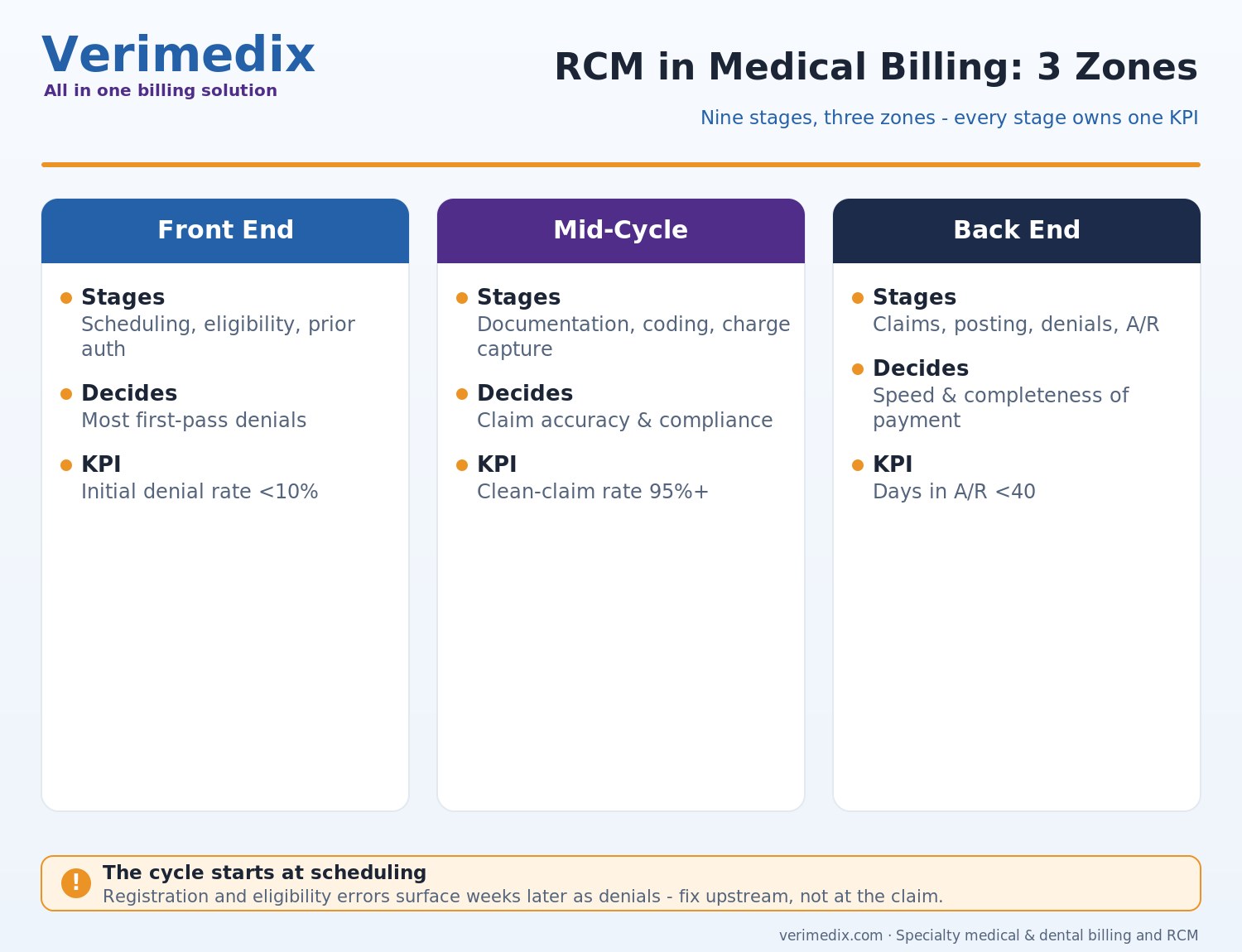
- 2026 benchmarks for a healthy cycle: clean-claim rate 95%+, initial denial rate under 10% (best performers 5–8%), days in A/R under 40, net collection rate 96%+.
- Each stage has one owner and one number: tie eligibility to denial rate, coding to clean-claim rate, A/R follow-up to days in A/R — unowned metrics drift.
- Cost to collect typically runs 3–4% of collections in-house once salaries, software, and turnover are counted; outsourced revenue cycle management services commonly price at 4–9% of collections.
- AI and automation are reshaping the cycle fastest at the two ends — eligibility checks and denial appeals — see our 2026 RCM trends briefing for what to adopt first.
What RCM means in medical billing
Ask three billers what RCM covers and you will get three different answers, which is exactly why revenue leaks. In practice, revenue cycle management in healthcare is every administrative and clinical function that touches the money: capturing patient information, verifying coverage, documenting and coding the encounter, submitting a compliant claim, posting the payment, working the denial, and collecting the patient balance. The cycle starts when an appointment is booked — not when a claim is created — and it ends only when the account reaches a zero balance.
The clean mental model is three zones. The front end happens before and at the visit: scheduling, registration, insurance eligibility, prior authorization, and patient cost estimates. The mid-cycle converts care into billable data: clinical documentation, medical coding, and charge capture. The back end turns data into cash: claim scrubbing and submission, payment posting, denial management, A/R follow-up, and patient collections. Our companion piece on the 10 steps of the medical billing process walks the same pipeline step by step; this guide focuses on how the zones fit together, what each one is accountable for, and where the dollars fall through.
Front-end: the stages that decide most denials
Scheduling and registration. A transposed policy number or an outdated address is enough to generate a CO-16 denial weeks later. Registration accuracy is boring and decisive — front-end data errors remain among the most common root causes of first-pass denials.
Eligibility and benefits verification. Run eligibility at booking and again 48–72 hours before the visit, because coverage changes mid-month. Real verification goes beyond "active/inactive": plan type, copay, deductible remaining, carve-outs, and whether the service needs referral or authorization. The full workflow is covered in our verification of benefits guide.
Prior authorization. Payer auth lists keep widening, and a missing authorization is functionally unappealable in most contracts. High-performing groups track auth status like a pre-flight checklist: requirement identified at scheduling, clinicals submitted, approval number on file before the patient arrives. CMS interoperability rules now require major payers to answer standard prior-auth requests within seven days (72 hours expedited), which helps — but only practices that submit complete documentation benefit.
Patient cost estimates. With deductibles rising, the patient is often the second-largest payer on the account. Good-faith estimates for self-pay patients are a No Surprises Act obligation, and point-of-service collection of copays and known balances is the cheapest collection activity you will ever run — every dollar collected at check-in costs a fraction of a dollar chased by statement.
Mid-cycle: documentation, coding and charge capture
The mid-cycle answers one question: does the claim tell the same story as the chart? Clinical documentation must support the codes billed — an E/M level without matching medical decision making, or a procedure note that never mentions laterality, sets up a denial or a downcode. Medical coding translates the encounter into CPT, ICD-10-CM, and HCPCS with the modifiers that payer edits expect; a single missed modifier produces a CO-4, and an unspecified diagnosis on a policy-driven service produces a CO-50.
Charge capture is the silent leak. Services performed but never charged — the injection given during a visit, the second procedure in the operative note, supplies in a facility setting — cost practices a meaningful share of earned revenue, and the worst part is that missed charges generate no denial, no report, no signal. Reconciling schedules against charges (every kept appointment should map to a claim) is the simplest audit most practices never run. A periodic billing audit makes it systematic.
Back-end: claims, denials and A/R follow-up
Claim scrubbing and submission. Claims pass through edits — NCCI pairs, payer-specific rules, demographic checks — before reaching the payer. The metric here is clean-claim rate: the share of claims accepted and paid on first pass with no manual touch. Every rejected or reworked claim costs staff time and, per industry estimates, tens of dollars in rework before a single appeal is written.
Payment posting. ERAs post remittances against accounts, and this is where underpayments hide. Posting is not clerical — it is surveillance: contractual adjustments that exceed the fee schedule, CO-45 write-offs that are actually payer errors, and zero-pay lines that never make it into the denial queue.
Denial management. Denials are the cycle's feedback loop. Each CARC code names a broken upstream step — eligibility, coding, filing deadline — so the real work is two workflows, not one: appeal the current denial, then fix the root cause so it stops recurring. Our denial management guide and the CARC-by-CARC library cover the mechanics; the discipline is measuring both the initial denial rate and the overturn rate.
A/R follow-up and patient collections. Claims age silently, and value decays with age — the industry rule of thumb is that recovery odds fall sharply once a claim crosses 90 days, well before timely-filing limits extinguish them entirely. Work A/R by payer and dollar value, not chronologically, and measure the queue with days in A/R.
The 2026 KPI benchmarks that define a healthy cycle
| KPI | Formula | 2026 benchmark | Owned by |
|---|---|---|---|
| Clean-claim rate | Claims paid first pass ÷ claims submitted | 95%+ | Coding & scrubbing |
| Initial denial rate | Claims denied ÷ claims submitted | <10% (best: 5–8%) | Front end |
| Days in A/R | Total A/R ÷ average daily charges | <40 days | A/R follow-up |
| Net collection rate | Payments ÷ (charges − contractual adjustments) | 96%+ | Whole cycle |
| A/R over 90 days | A/R aged 90+ ÷ total A/R | <20% | A/R follow-up |
| Cost to collect | RCM cost ÷ collections | ~3–4% in-house | Practice leadership |
Two cautions. First, benchmarks are directional — a surgical group and a behavioral-health practice will not share identical numbers. Second, a single metric can be gamed: net collection rate looks great if you write balances off aggressively, which is why the KPIs are read as a panel, not in isolation.
Where revenue actually leaks — and the fix for each
| Leak | Typical signal | Fix |
|---|---|---|
| Registration/eligibility errors | CO-16, CO-22, CO-27 denials | Re-verify 48–72h pre-visit; front-desk accuracy scorecard |
| Missing prior auth | Auth-related denials, unappealable write-offs | Auth checklist at scheduling; track approval numbers |
| Missed charges | No signal — revenue simply absent | Schedule-to-charge reconciliation, every day |
| Coding downcodes & edits | CO-4, CO-50, CO-97 patterns | Modifier matrix, NCCI review, documentation feedback loop |
| Underpayments | Paid ≠ contracted rate | Load fee schedules; variance report at posting |
| Aged A/R | A/R >90 days above 20% | Payer/dollar-ranked queues; escalation SLAs |
| Patient balances | Statements ignored, bad debt | POS collection, estimates, payment plans |
In-house vs outsourced vs white-label: what the cycle costs
An in-house team gives you control and proximity to providers, at the price of recruiting, training, turnover, and software — fully loaded, most practices land near 3–4% of collections, and small practices often higher because one biller cannot be expert in everything. Traditional outsourced RCM converts that to a percentage of collections (commonly 4–9% depending on specialty and scope) and adds scale, at the cost of process visibility. The hybrid that has grown fastest — white-label staffing — places dedicated, trained billers inside your systems under your brand, which is how billing companies and larger practices add capacity without the recruiting cycle. Verimedix operates across all three of these needs: full-service revenue cycle management for practices, and embedded white-label teams for billing companies, with dedicated specialists starting at two resources. For a role-by-role staffing map, see the RCM staffing guide.
Worked example: the same $180 visit, two cycles
Take a routine established-patient visit billed at $180 (99214 with a $135.61 CY2026 Medicare national allowable) and run it through two practices. Practice A verified eligibility twice, coded from documentation, and scrubbed the claim: it pays in 18 days at the contracted rate, staff touch time roughly four minutes, collection cost a few dollars. Practice B skipped the second eligibility check; the patient had switched plans, the claim denies CO-22, staff spend 25 minutes identifying the right payer, rebilling, and appealing a timely-filing pushback — the same $135.61 arrives 74 days later, minus perhaps $25 of rework labor. Multiply that delta across 600 encounters a month and the two practices are running materially different businesses on identical medicine. That is the entire argument for managing the cycle as a system: the money is made in the boring stages.
Scale the arithmetic: at a 12% denial rate, a practice submitting 600 claims a month reworks 72 of them. Cutting the rate to 7% removes 30 reworks — roughly 12–15 staff hours and a five-figure annual labor saving — before counting the revenue recovered from denials that would never have been appealed at all.
The RCM technology stack in 2026
Every stage above runs on software, and the stack matters less than the integrations between its layers. The PM/EHR (Athenahealth, eClinicalWorks, AdvancedMD, Tebra, NextGen, Epic and peers) owns scheduling, documentation, and charge entry. The clearinghouse owns edits and claim transport, plus eligibility (270/271) and claim-status (276/277) transactions. ERA/EFT enrollment automates posting. The 2026-era additions sit at the edges: AI-assisted eligibility and prior-auth status checks on the front end, and denial-prediction and appeal-drafting tools on the back end — adoption patterns we cover in the 2026 RCM trends briefing and in AI in healthcare RCM. The buying rule: automate the stages you already measure, because automation amplifies whatever process exists — including a broken one.
Quick Answers
What is RCM in medical billing? RCM (revenue cycle management) is the complete financial process behind a patient encounter — eligibility verification, coding, claim submission, payment posting, denial management, and patient collections — from appointment booking to zero balance.
What are the steps of revenue cycle management? Nine stages in three zones: scheduling/registration, eligibility, prior authorization (front end); documentation, coding, charge capture (mid-cycle); claim submission, payment posting, denial and A/R management (back end).
What is a good denial rate in 2026? Keep initial denials under 10% of claims; top-performing practices run 5–8%. Rising payer automation makes the front-end stages — eligibility and authorization — the highest-leverage fix.
What does RCM cost? In-house cycles typically cost 3–4% of collections fully loaded. Outsourced RCM services commonly price at 4–9% of collections; white-label dedicated staff run $1,000–$1,500+ per resource per month.
Is RCM the same as medical billing? Billing is a subset. RCM includes billing plus the upstream steps (eligibility, authorization, documentation, coding) and downstream analytics that decide whether billing succeeds.
Frequently asked questions
At scheduling — not at claim creation. The information captured when the appointment is booked (demographics, coverage, authorization requirements) determines whether the claim survives adjudication weeks later, which is why front-end errors are the largest single source of denials.
Initial denial rate, because it exposes root causes across the whole cycle. Pull 90 days of CARC codes, group them by reason, and the top three reasons almost always map to two or three specific process fixes at registration, eligibility, or coding.
Twice: once when the appointment is booked and again 48–72 hours before the visit. Coverage changes mid-month with job changes and plan terminations, and the second check is what catches them before the claim is built.
Clean-claim rate measures claims that pass edits and reach the payer without manual rework; first-pass resolution measures claims paid on first submission. A claim can be 'clean' and still deny — tracking both shows whether problems live in your scrubber or in payer policy.
Yes, with discipline: daily schedule-to-charge reconciliation, twice-run eligibility, a denial log grouped by CARC, and weekly A/R review by payer. The constraint is usually staff time, not knowledge — which is when practices weigh outsourcing or a dedicated white-label resource.