
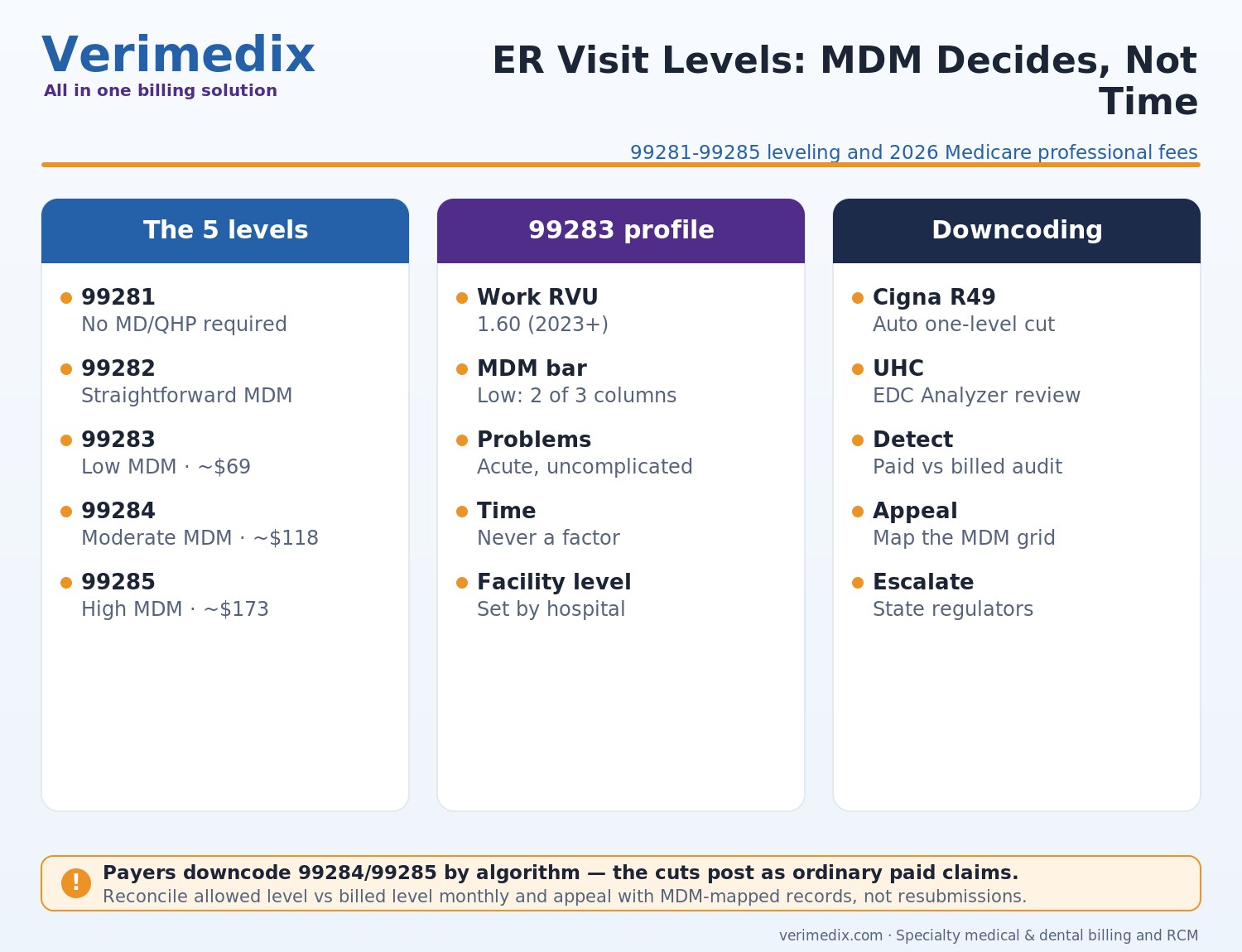
- Since the 2023 AMA revision, ED E/M codes 99281-99285 are selected on medical decision making only — history and exam are documented as medically appropriate, and time plays no role.
- 99283 requires low MDM: typically one acute uncomplicated illness or injury, limited data review, and low risk of morbidity from treatment.
- Every ED encounter produces two claims — the clinician's professional fee (about $69 nationally for 99283 under the 2026 Medicare fee schedule) and a hospital facility fee leveled by the hospital's own internal criteria under OPPS.
- Payers now downcode ED and E/M levels by algorithm — Cigna's 2025 R49 policy and UnitedHealthcare's Optum EDC Analyzer are the highest-profile programs — and many cuts post as ordinary paid claims.
- Downcodes are winnable: appeals that map the chart to the AMA MDM grid element by element regularly overturn one-level reductions.
- Reconcile paid level versus billed level monthly; silent downcoding rarely shows up in a denial report.
Emergency department coding is the one corner of E/M where the 2023 overhaul changed everything and nothing at once. The five familiar codes survived, but the leveling logic underneath them was rebuilt: no more counting history elements or exam bullets, no time thresholds — just the medical decision making grid. That simplification cut both ways. Charts are easier to level honestly, and they are also easier for a payer's algorithm to second-guess. This guide walks through 99283 and its neighbors, the professional-versus-facility split that confuses even experienced billers, and the downcoding programs quietly shaving levels off ED claims.
The five ED levels after the 2023 rules
Emergency department codes describe new and established patients alike — there is no distinction in the ED — and none of them can be selected on time, because ED care is not continuous face-to-face time the way an office visit is. The American College of Emergency Physicians (ACEP) and the AMA both confirm MDM is the sole driver. Approximate 2026 Medicare national professional payments below are unadjusted for locality (based on the roughly $33.40 conversion factor); verify your locality in the MPFS lookup.
| Code | MDM level | Work RVU (2023+) | Approx. 2026 Medicare pro fee | Typical presentations |
|---|---|---|---|---|
| 99281 | None — may not require physician/QHP presence | 0.25 | ~$11 | Suture removal, dressing change, work-note visit |
| 99282 | Straightforward | 0.93 | ~$40 | Insect bite, simple rash, medication refill |
| 99283 | Low | 1.60 | ~$69 | Uncomplicated UTI, ankle sprain with X-ray, minor laceration evaluated with low-risk care |
| 99284 | Moderate | 2.74 | ~$118 | Abdominal pain with labs and imaging, asthma exacerbation treated and discharged, prescription management |
| 99285 | High | 4.00 | ~$173 | Chest pain rule-out, sepsis workup, any decision regarding hospitalization or emergency surgery |
Dollar figures are illustrative national approximations, not locality rates. Critical care (99291-99292) sits outside this ladder entirely and replaces the ED code when its requirements are met.
What low MDM actually requires for 99283
MDM is scored on three columns — problems addressed, data reviewed and analyzed, and risk of morbidity — and the encounter must meet or exceed the level in two of the three. For 99283 (low MDM):
| MDM column | Low (99283) | Moderate (99284) — for contrast |
|---|---|---|
| Problems addressed | Two or more self-limited/minor problems; one stable chronic illness; or one acute, uncomplicated illness or injury | Chronic illness with exacerbation; acute illness with systemic symptoms; acute complicated injury; undiagnosed new problem with uncertain prognosis |
| Data reviewed | Limited — e.g., two unique test orders/reviews, or one test plus an independent historian | Moderate — three data elements, independent interpretation of a test, or discussion with an external provider |
| Risk | Low risk of morbidity from additional testing or treatment (OTC medications, simple splinting, wound care) | Moderate risk — prescription drug management, decision about hospitalization, social determinants limiting care |
Notice how narrow the 99283 lane really is. The moment the clinician manages a prescription, entertains admission, or works up systemic symptoms, the chart usually supports 99284 — which is exactly why ED level distributions skew toward levels 4 and 5, and why payers built algorithms to push back. The same grid logic governs office visits; our 99211-99215 guide covers that side of the fence.
Facility fee vs professional fee: two claims, two logics
Every ED visit generates parallel claims, and they do not have to land on the same level:
- Professional fee — billed on the CMS-1500 for the clinician's work, leveled strictly by the AMA MDM grid described above, paid under the physician fee schedule.
- Facility fee — billed by the hospital on the UB-04 using the same CPT codes, but leveled by the hospital's own internal criteria. CMS has never published national facility-leveling rules for ED visits; it requires each hospital's system to reasonably relate resource use to the level and to be applied consistently. Many hospitals adopt the ACEP ED Facility Level Coding Guidelines, which map interventions — IV medications, monitoring, number of treatments — to a level. Under OPPS, the five levels map to ambulatory payment classifications (APCs 5021-5025 for Type A EDs), and the facility payment typically dwarfs the professional fee.
Practical consequence: a visit can legitimately bill 99283 professional and a Level 4 facility charge, or vice versa. Auditing one claim against the other's criteria is a classic false alarm — and conflating the two is how urgent care and freestanding ED operators misprice their services. (Freestanding and urgent care settings have their own rules; see our urgent care billing guide.)
Payer downcoding programs — and how to fight them
The biggest revenue threat to ED groups in 2026 is not denial; it is silent re-leveling. Several payers now run claim-logic programs that reduce high-level E/M codes based on diagnosis codes and claim data, without reviewing the chart:
| Program | How it works | Status and notes |
|---|---|---|
| Cigna policy R49 | Effective October 2025, automatically downcodes certain level 4-5 E/M claims by one level when the algorithm judges the diagnosis inconsistent with the level | Drew formal pushback from AAFP, AMA and others; in March 2026 the Maryland Insurance Administration ordered Cigna to cease the policy in that state and fined it $80,000, per press reports — but versions persist elsewhere |
| UnitedHealthcare / Optum EDC Analyzer | Scores ED facility claims on presenting problem, diagnostic workup and patient complexity; reduces or rejects Level 4-5 facility claims it scores lower | Long-running program aimed primarily at facility levels; hospitals can submit records for reconsideration |
| Other national and Blues plans | Diagnosis-driven ED level review, prepayment review of 99285, or "leveling" edits vary by plan and state | Policies change frequently; several states restrict algorithmic downcoding without record review |
Because downcoded claims usually post as paid, they evade denial dashboards. Defend systematically with this five-step loop:
- Detect: reconcile the paid CPT/level on each 835 against the billed level monthly; flag every mismatch and quantify the variance.
- Verify: confirm the chart supports the billed level on the MDM grid — two of three columns, explicitly.
- Appeal: dispute with a letter that maps the documentation to each MDM column and cites the AMA guidelines; do not simply resubmit. Many one-level reductions are overturned when records are actually reviewed.
- Escalate: invoke state prompt-pay and prudent-layperson protections for ED claims, and report persistent algorithmic downcoding to your state insurance department — the Maryland action shows regulators are receptive.
- Prevent: feed appeal outcomes back into documentation templates so systemic gaps (unstated differentials, unlabeled independent interpretations) get closed. Our claim appeal guide covers letter structure and deadlines.
What one level is worth: a worked example
Illustrative math for a hospital-based ED group billing 1,000 professional-fee visits per month. Suppose a commercial payer's allowable is $95 for 99283 and $150 for 99284, and its algorithm downcodes 8% of the group's 99284 claims (say 40 claims per month) to 99283:
- Per claim lost: $55.
- Monthly: 40 × $55 = $2,200 — invisible in a denial report, since every claim shows as paid.
- Annually: about $26,400 from one payer, before counting 99285 reductions or the far larger facility-side impact.
Groups that reconcile paid-versus-billed levels and appeal with MDM-mapped records recover a meaningful share of this; groups that only watch denial rates never see it leave.
Quick Answers
What is CPT code 99283? CPT 99283 is the Level 3 emergency department visit: a medically appropriate history and/or examination with low medical decision making, such as an acute uncomplicated illness or injury with limited workup and low-risk treatment.
How are ER E/M levels determined now? Since January 2023, codes 99281-99285 are leveled solely by medical decision making — the problems addressed, data reviewed, and risk columns of the AMA MDM grid. History and exam no longer score, and time is never a selection factor for ED codes.
How much does Medicare pay for 99283? Roughly $69 nationally for the professional fee under the 2026 Medicare physician fee schedule (1.60 work RVUs), before locality adjustment. The hospital's facility payment is separate under OPPS.
What is the difference between the ER facility fee and the professional fee? The professional fee pays the clinician and follows AMA MDM rules; the facility fee pays the hospital, uses the same CPT codes but is leveled by the hospital's own resource-based criteria, and is paid through APCs. The two levels can legitimately differ for the same visit.
Why did the insurance company change my 99284 to 99283? Most likely an automated downcoding program — such as Cigna's R49 policy or diagnosis-driven ED review logic — reduced the level without reviewing the chart. These reductions can be appealed with documentation mapped to the MDM grid, and appeals frequently succeed.
Frequently asked questions
No. Time is not a descriptive component for emergency department E/M codes because ED care is typically not continuous. Since 2023, level selection rests entirely on medical decision making, and prolonged-service codes cannot be added to ED visits either.
No. The ED codes make no new-versus-established distinction — any patient presenting to the emergency department is leveled on the same 99281-99285 ladder based on the MDM documented for that encounter.
Yes, legitimately. The professional claim follows the AMA MDM grid, while the facility claim is leveled by the hospital's own internal, resource-based criteria — CMS requires consistency and a reasonable relationship to hospital resource use, not a match with the physician's level.
When the chart supports high MDM in at least two of the three columns — for example, a problem posing a threat to life or bodily function, extensive data review or independent test interpretation, and high-risk decisions such as hospitalization, parenteral controlled substances, or emergency surgery.
Compare the CPT code and allowed amount on each remittance against what you billed — downcoded claims typically post as paid, not denied. A rising share of 99283 payments against 99284-99285 submissions, or remark codes referencing E/M leveling policy, are the tell. Reconcile monthly and appeal with MDM-mapped documentation.